דילוג לתוכן הראשי
תיקי DNA

Khovd Echoes: Terraces of Time

Fragments from the lower and middle terraces of the Uliastai River linking Bronze Age pastoral lifeways to Early Medieval heirs

1278 BCE - 774 CE
Khovd province, Mongolia (Uliastai River terraces)

הסיפור

Archaeogenetic and archaeological material from Khovd (1278 BCE–774 CE) reveal a small, time-transcending sample from Mongolia's Uliastai terraces. Evidence hints at steppe mobility, mixed maternal lineages, and limited western paternal input—preliminary patterns that illuminate connections across Eurasia.

Time Period

1278 BCE – 774 CE

Region

Khovd province, Mongolia (Uliastai River terraces)

Common Y-DNA

R (1), J (1) — low sample

Common mtDNA

U (1), B (1), H (1) — maternal diversity

ציר הזמן

1278 BCE

Earliest dated individual from Khovd terraces

Radiocarbon date anchors the earliest sampled individual to 1278 BCE, placing it in the Middle–Late Bronze Age context of western Mongolia.

1000 BCE

Bronze Age pastoral landscape

Regional patterns indicate mobile herding and riverine seasonal use across the steppe during the first millennium BCE.

774 CE

Latest dated individual in the series

The most recent radiocarbon date in this sample set is 774 CE, within the Early Medieval horizon of the Khovd region.

Origins & Emergence

Archaeological data from the lower and middle terraces along the Uliastai River in Khovd province record human presence spanning the Middle–Late Bronze Age into the Early Medieval era. Radiocarbon-constrained remains from this collection range between 1278 BCE and 774 CE, anchoring a long-lived occupation of river terraces that functioned as seasonal hubs in a broad steppe network.

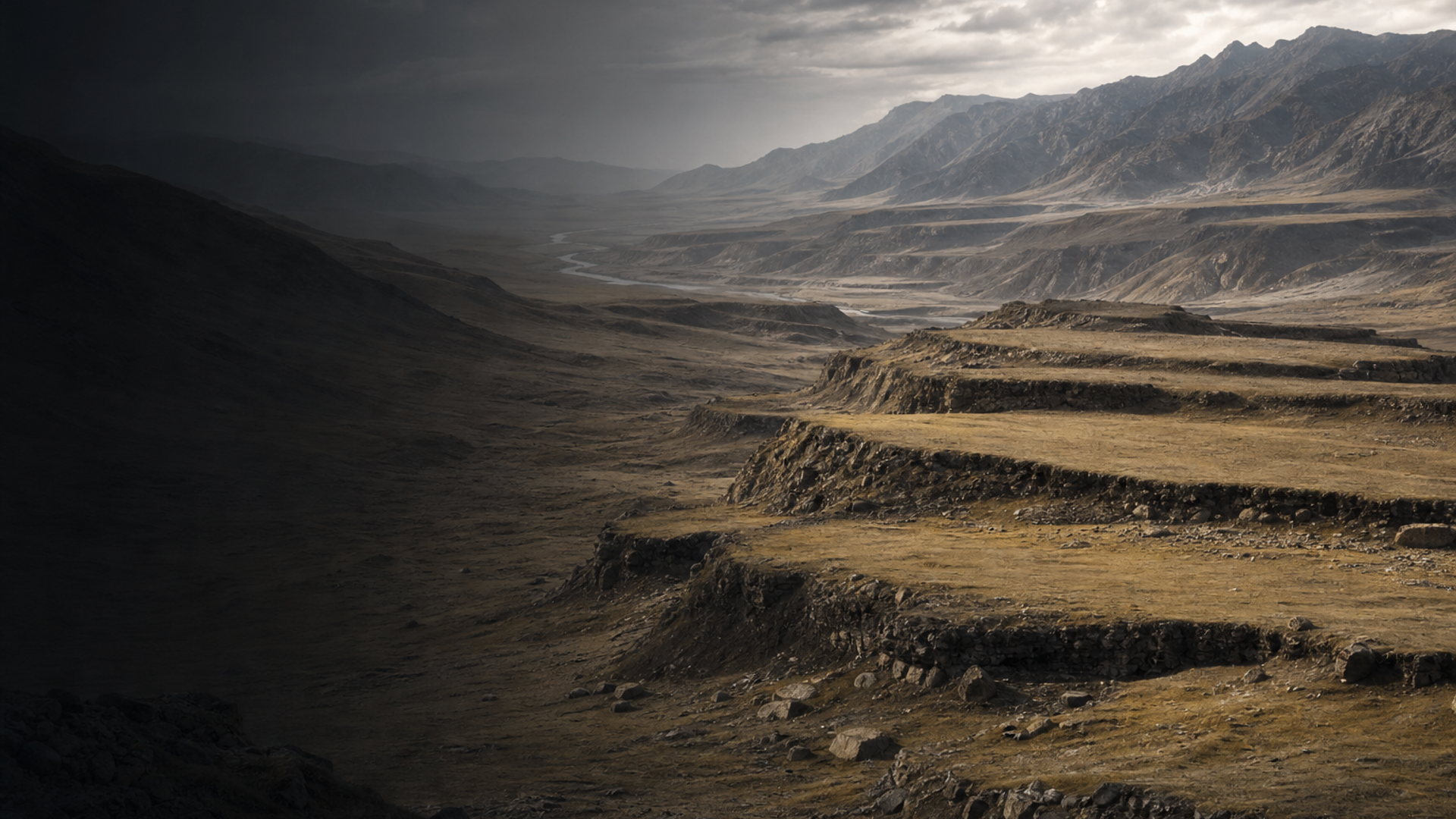
The cinematic sweep of the terraces — wind-polished loess benches above the river — conceals layered deposits: hearth charcoal, fragmented pottery, and burial contexts that archaeologists interpret as pastoral camp sites and episodic funerary loci. Regional comparisons place Khovd within the western Mongolian frontier of Bronze Age mobility, where pastoralists engaged in long-distance exchange of metalwork and animal stock. Over subsequent centuries, the landscape retained its role as a corridor, absorbing cultural transformations that culminated in early medieval social reconfigurations.

Limited evidence suggests that cultural continuity was punctuated by periods of inward influence from wider Eurasian contacts. Archaeological material indicates adaptation to seasonal river valleys, a mixed economy oriented around herding, and funerary variability that reflects changing social expressions across more than a millennium.

  • Radiocarbon-dated human remains from 1278 BCE–774 CE
  • Occupation concentrated on lower/middle Uliastai River terraces
  • Material culture suggests pastoral mobility and regional exchange

Daily Life & Society

The human story on the Uliastai terraces is one of movement, seasonal rhythms, and intimate relationship with the steppe. Archaeological contexts point to pastoral households that shifted camp with the seasons, exploiting riverine grasses and upland pastures. Faunal remains in comparable Khovd assemblages commonly indicate sheep, goat, horse, and cattle herding; while actual species lists from these three samples are limited, the terrace setting strongly implies herding at the core of subsistence.

Burial contexts found in terrace deposits range from single interments to scattered grave goods, reflecting social differentiation through time. Metal objects and worked bone recovered in nearby Khovd sites imply access to metallurgical networks that linked the Mongolian plateau to broader Eurasian circuits. Seasonal aggregation at rivers like the Uliastai would have facilitated exchange of animals, marriage ties, and climatic buffering during harsh winters.

Archaeological indicators also suggest roles for both mobility and ritual in daily life: transient camps leave thin but telling traces—fire-cracked stones, postholes, and occasional grave cuttings—each a quiet testimony to lives lived in motion across an expansive landscape.

  • Pastoral economy oriented on sheep, goat, horse, cattle (regional inference)
  • Seasonal camps and funerary variability reflect mobile social structures

Genetic Profile

Genomic sampling from the Khovd lower and middle terraces is extremely limited (n = 3). Nevertheless, the genetic snapshots yield provocative signals when paired with archaeological context. Y-chromosome lineages observed include R (1) and J (1). Haplogroup R is widespread across Eurasia and commonly found on the steppe; haplogroup J has stronger associations with West and Southwest Asia. On the maternal side, mitochondrial haplogroups detected are U (1), B (1), and H (1). Haplogroup U and H are frequent across western and northern Eurasia, while B is more often linked to East and Northeast Asian populations.

Taken together, the mix of maternal and paternal lineages hints at bi-directional connectivity across Eurasia: maternal diversity that includes eastern-associated mtDNA (B) alongside western-associated types (U, H), and a paternal signal that includes a typically west-associated R and a J lineage. However, sample count is below the threshold for robust population-level inference. Archaeological dates spanning 1278 BCE to 774 CE mean these genetic signatures may reflect multiple demographic episodes rather than a single homogeneous group.

In short: archaeogenetics from Khovd suggest admixture and long-distance contact as plausible processes, but conclusions remain preliminary pending larger sample sizes and comparative datasets.

  • Y-DNA: R (1) and J (1) — suggests western and southwest Eurasian paternal influences
  • mtDNA: U (1), B (1), H (1) — mixed maternal ancestry reflecting east–west connections

Legacy & Modern Connections

The genetic and archaeological echoes of the Khovd terraces persist in the region's complex human tapestry. Modern populations in western Mongolia carry genetic lineages shaped by millennia of steppe mobility, and the mixture indicated here—if replicated in larger samples—would align with a long history of east–west interaction on the plateau. Material traditions unearthed at Uliastai River terraces feed narratives of pastoral resilience and regional exchange that underpin later nomadic empires.

Importantly, given the tiny sample size, any linkage to contemporary groups must be cautious. The most productive path forward is comparative analysis: expanding ancient DNA sampling across Khovd and neighboring valleys, and integrating isotopic and archaeological data to trace movements, marriage patterns, and herd management strategies. Even in fragmentary form, these remains invite us to imagine a landscape where rivers like the Uliastai shaped human stories across a millennium.

  • Signals of long-term east–west connectivity may inform regional ancestry patterns
  • Caution: modern connections require more samples and integrated analyses

עוזר הבינה המלאכותית

עוזר הבינה המלאכותית מאת DNA Genics

פתיחת התכונה הזו
שאלו שאלות על תרבות Khovd Echoes: Terraces of Time. העוזר יכול להסביר ממצאים גנטיים, הקשר היסטורי, ראיות ארכאולוגיות וקשרים לעת המודרנית.
דוגמה לניתוח בבינה מלאכותית

מבט על תרבות Khovd Echoes: Terraces of Time

דגימות DNA קדום עוזרות לחוקרים לחקור דפוסי נדידה וקשרים גנטיים בין אוכלוסיות קדומות.

זו תצוגה מקדימה של הניתוח. העוזר המלא מאפשר לעיין בנושאים הבאים:

  • הרכב גנטי ודמיון גנטי
  • דפוסי נדידה ומקורות
  • חיי יומיום ומנהגים תרבותיים
  • קשרים גנטיים בני זמננו