Saltar para o conteúdo principal
Cultura de destaque

Northern Cape: A Modern Genetic Snapshot

Echoes of deep past and recent histories converge in samples from 2000 CE South Africa

2000 CE
Northern Cape, South Africa

A História

A concise, museum-quality profile linking archaeological landscapes of the Northern Cape with a 2000 CE genetic snapshot (16 samples). Highlights regional archaeological context, cautions on limited modern sampling, and situates expected genetic signals within South Africa's complex admixture history.

Time Period

2000 CE (modern snapshot)

Region

Northern Cape, South Africa

Common Y-DNA

Not reported in this dataset

Common mtDNA

Not reported in this dataset

Cronologia

1994 CE

Democratic transition in South Africa

End of apartheid reshaped mobility, identity, and research priorities across the country, affecting population dynamics in the Northern Cape.

2000 CE

Modern genetic snapshot collected

Sixteen individuals sampled from Andriesvale, Upington, and Olifantshoek form a small contemporary dataset for ancestry analysis.

Origins & Emergence

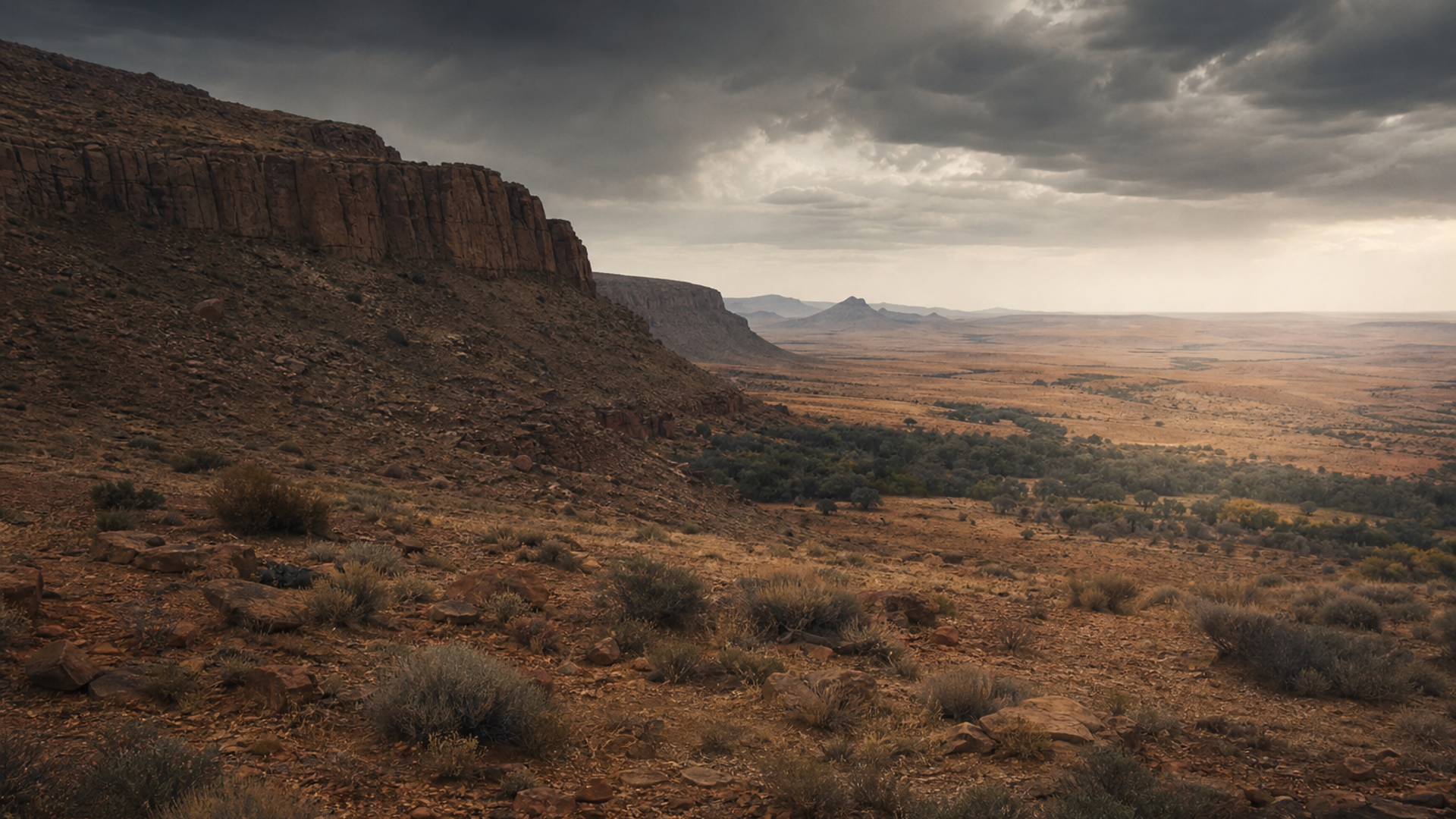
This dataset represents a contemporary snapshot — sixteen individuals sampled around the year 2000 CE from towns in the Northern Cape (Andriesvale, Upington, Olifantshoek). Archaeologically, the Northern Cape is a palimpsest: millennia of hunter‑gatherer rock‑art, pastoralist sites, and later colonial settlements overlay one another along the Orange River corridor. While modern samples do not directly record those early occupations, their genomes carry the accumulated signals of migrations, contacts, and demographic shifts that shaped the modern population.

Archaeological data indicates deep continuity of Khoe‑San lifeways in this landscape, evidenced by characteristic stone tools and rock paintings at sites across the region. From the late Holocene onward, the arrival and spread of pastoralism and later Bantu‑speaking farmers introduced new material cultures and demographic inputs. Colonial-era settlement and twentieth‑century mobility added further layers of admixture. The samples in this collection come from communities living in historically dynamic places: Upington near the Orange River, Andriesvale on semi‑arid plains, and Olifantshoek to the northwest. Together they offer a localized view of a region that has been a crossroads for millennia.

Limited evidence from a small modern sample cannot reconstruct those entire trajectories alone, but when combined with archaeological contexts, museum collections, and broader regional genetic surveys, these genomes help trace how ancient and recent movements sculpted present-day diversity.

  • 16 modern individuals sampled in 2000 CE from Northern Cape towns
  • Landscape contains rock art and pastoralist/colonial archaeological layers
  • Genomes reflect millennia of contact: Khoe‑San, Bantu, and colonial influences

Daily Life & Society

The material world of the sampled communities is shaped by the arid beauty of the Northern Cape: seasonal riverine agriculture along the Orange River, dispersed homesteads, and small towns that function as regional hubs. Archaeological traces in the region—stone scatters, rock engravings, and colonial farm remains—capture a long history of adaptation to scarce water, mobile herding, and trade routes that connected inland deserts to coastal markets.

In the modern era around 2000 CE, livelihoods blend ancestral practices and contemporary economies. People draw on pastoral knowledge, small‑scale agriculture where water permits, wage labor in towns, and cultural practices that preserve languages, stories, and ceremonial life. Material culture includes local crafts, household assemblages with both traditional and imported goods, and the visible imprint of twentieth‑century infrastructure. The sensory image is cinematic: wind‑scoured plains, orange river sunsets, and settlements that stand at the meeting point of past and present.

Archaeological observation indicates continuity of space use—old pathways reused as modern roads, rock art places remaining cultural landmarks—yet social identity is fluid, shaped by migration, intermarriage, and colonial histories. These layers are essential background when interpreting the genetic signals carried by modern residents.

  • Economy shaped by riverine agriculture, pastoralism, and town labor
  • Material culture and landscape reuse link archaeological past to modern life

Genetic Profile

The dataset here is explicitly modern and limited: 16 individuals sampled circa 2000 CE from Andriesvale, Upington, and Olifantshoek. The input does not list specific Y‑DNA or mtDNA haplogroups for these samples. Because of that absence, interpretations must remain cautious and framed by regional genetic knowledge rather than dataset‑specific claims.

Regionally, genetic studies across southern Africa reveal a complex tapestry. Indigenous Khoe‑San groups carry some of the deepest maternal lineages in humans (for example, diverse L0 subclades) and unique early diverging paternal lineages in certain Y‑haplogroups. Bantu‑language speakers who expanded into southern Africa during the past 2,000 years often show markers associated with E1b1a Y‑lineages and various L haplogroups on the maternal side. Colonial and migrant European and Asian inputs contribute additional Eurasian markers (e.g., R‑lineages and various mtDNA types) to admixed urban and coastal populations.

For these 16 Northern Cape samples, archaeological context suggests potential admixture among Khoe‑San descendants, Bantu‑speaking groups, and later colonial communities, but without reported haplogroup calls the genetic narrative remains provisional. Larger comparative panels, ancient DNA from nearby archaeological burials, and high‑coverage sequencing of these individuals would be required to resolve ancestry proportions, sex‑biased admixture, and temporal layering of signals. Given the moderate sample size, conclusions should be framed as preliminary and integrated with archaeological and historical records for the strongest inferences.

  • Dataset: 16 modern individuals from Northern Cape; no haplogroups reported
  • Regional expectations: Khoe‑San mtDNA depth, Bantu‑associated Y markers, Eurasian admixture—interpret cautiously

Legacy & Modern Connections

These 2000 CE genomes are part of an ongoing conversation between past and present. Genomes from the Northern Cape carry echoes of deep prehistory—hunter‑gatherer persistence and pastoral innovations—while also reflecting the upheavals of the last few centuries: colonial settlement, internal migration, and the formation of new identities. For descendants and museum visitors, genetics offers a tangible link to ancestral landscapes, but it must be presented alongside archaeological artifacts, oral histories, and historical documents.

Ethically and scientifically, modern genetic snapshots are most powerful when contextualized. Collaborative work with communities, transparent reporting of limitations, and integration with archaeological evidence allow these data to inform personal ancestry, regional histories, and national narratives without overreach. Ultimately, the legacy of these samples is their potential to deepen public understanding of how human stories are written on both earth and genome.

  • Genomes connect contemporary communities to layered archaeological and historical landscapes
  • Responsible interpretation requires community engagement and integration with material evidence

Assistente de IA

Assistente de IA por DNAGENICS

Desbloquear esta função
Pregunta sobre la cultura Northern Cape: A Modern Genetic Snapshot. El asistente con IA puede explicar hallazgos genéticos, contexto histórico, pruebas arqueológicas y conexiones modernas, con sus límites de interpretación.
Exemplo de análise com IA

La cultura Northern Cape: A Modern Genetic Snapshot representa un capítulo de la historia humana...

A análise genética permite estudar semelhanças com populações anteriores e possíveis adaptações. As amostras de DNA antigo fornecem informações para investigar padrões migratórios e relações entre populações, com limites que dependem do estudo e do contexto arqueológico.

Esta é uma antevisão da análise com IA. Aceder ao assistente completo para explorar informações sobre:

  • Composição e similaridade genética
  • Padrões migratórios e origens
  • Vida cotidiana e práticas culturais
  • Contexto genético moderno