Ansarve Megalithic People

下载的 PDF 是图像副本。如需可选中文本及更好的辅助技术支持,请使用打印功能。

Ansarve Megalithic People

揭开一个失落的文明

正在加载考古记录……

正在收集古代记录

跳转到主内容
Ansarve Megalithic People
文明焦点

Ansarve Megalithic People

Stone chambers on Gotland and the fragile genetic traces of a maritime Neolithic world

3525 CE - 2631 BCE
Ansarve, Gotland, Sweden
滚动开始
Chapter I

剧情

了解 Ansarve Megalithic People 文化

Archaeological and ancient-DNA evidence from Ansarve (3525–2631 BCE) reveals a small, locally rooted megalithic community on Gotland. Limited samples suggest paternal continuity (haplogroup I) alongside diverse maternal lineages linked to Neolithic networks. Conclusions remain preliminary.

Time Period

3525–2631 BCE

Region

Ansarve, Gotland, Sweden

Common Y-DNA

I (4/6 samples)

Common mtDNA

J (2), HV (1), H7d (1), T (1), K (1)

Chapter II

时间线

这种文化历史上的关键时刻

3525 BCE

Earliest dated burial at Ansarve

Radiocarbon dates mark the earliest sampled burial at Ansarve around 3525 BCE, initiating centuries of megalith use.

Chapter III

Origins & Emergence

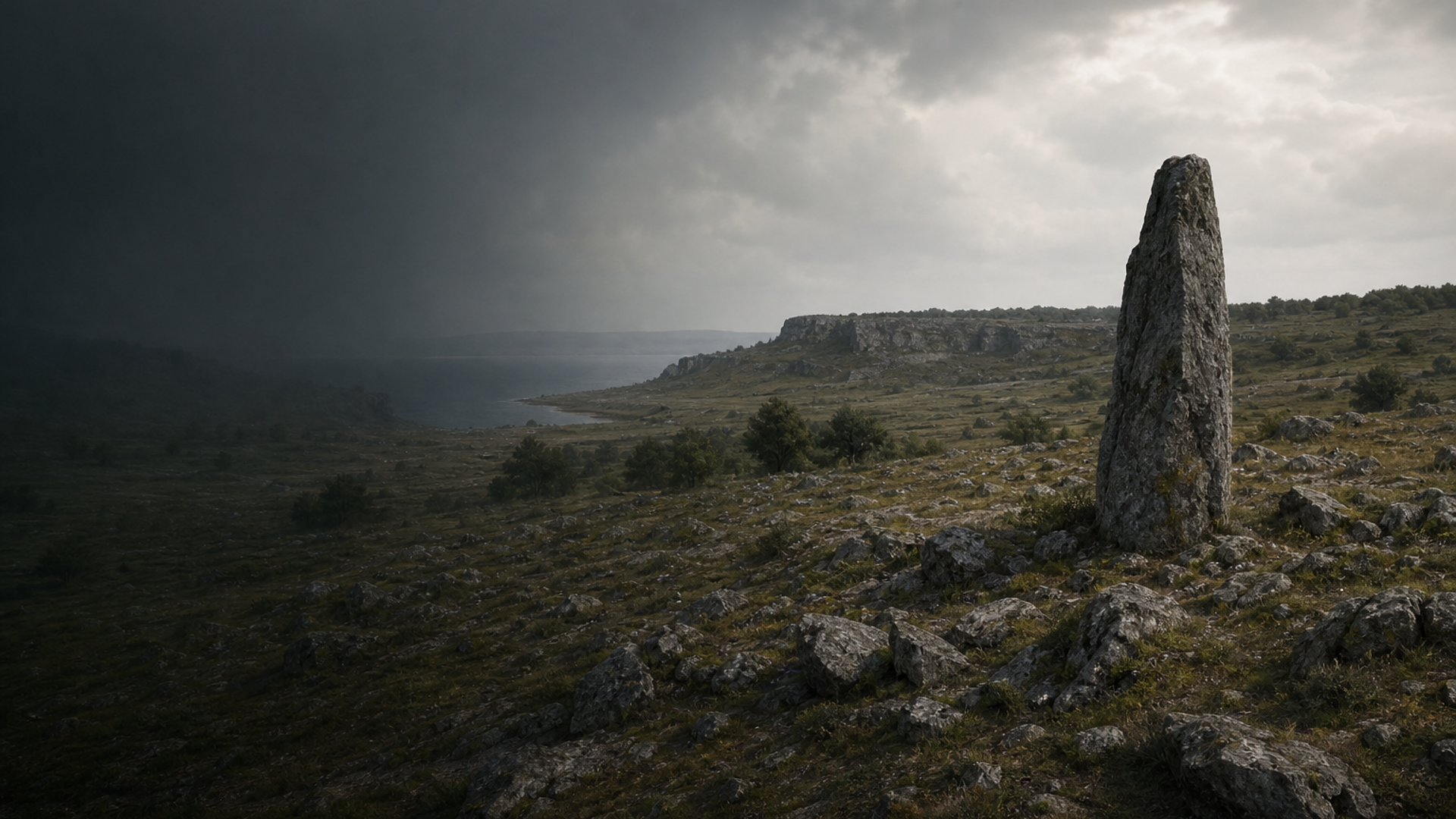
The Ansarve megalithic site, set in the windswept coastlines of Gotland, belongs to a broader north Baltic tradition of stone-built tombs and communal burial architecture. Radiocarbon-calibrated material associated with human remains falls between 3525 and 2631 BCE, placing Ansarve in the late Neolithic, a period of intensified maritime contact and monument building across northern Europe. Archaeological data indicates careful construction of stone chambers and repeated use of burial space, suggesting a community that invested both labor and memory in fixed monuments.

Cinematic images of boats and long-stone shadows meet the archaeological reality: small, mobile farmsteads exploiting sea and land, punctuated by communal rites at megaliths. Material traces at Ansarve — the stones themselves, traces of weathered bone, and scattered artefacts — hint at regional ties to Gotlandic and Baltic networks, but preservation is uneven. Limited evidence suggests cultural continuity with earlier coastal foragers as well as adoption of Neolithic practices. Given the small sample set (six genomes), any reconstruction of population origins must remain cautious: Ansarve appears to be a local expression within a patchwork of Neolithic and Mesolithic traditions rather than the product of a single migrating people.

  • Located at Ansarve on Gotland; dated 3525–2631 BCE
  • Part of Baltic megalithic building traditions and coastal networks
  • Evidence points to long-term local use of stone chamber tombs
Chapter IV

Daily Life & Society

Life around the Ansarve tomb was shaped by the interplay of sea and field. Archaeological inference from Gotlandic Neolithic contexts suggests mixed economies: small-scale cereal cultivation and animal husbandry combined with fishing, seal hunting, and foraging. The megalith served as a social anchor — a place where burial practices, memory, and social identity were enacted and visible on the landscape.
Social structure at Ansarve was likely kin-centered, with communal burial reflecting lineage or household ties rather than individualized elite display. Craft activities — pottery, flint-knapping, bone working — would have been woven into household life and seasonal mobility. Ritual deposition in the chamber and repeated use over centuries indicate differential treatment of the dead and possibly inherited rights to tomb use. However, direct evidence for diet, house plans, or craft assemblages specific to Ansarve is limited; many reconstructions rely on comparative data from contemporaneous Gotlandic and Baltic sites.

  • Economy likely mixed: small-scale farming plus marine resources
  • Megaliths functioned as communal centers for burial and identity
Chapter V

Genetic Profile

Six ancient genomes from Ansarve provide a slender but revealing window into population history. Four of the six male individuals carry Y-chromosome haplogroup I, a lineage commonly observed in Mesolithic and later Scandinavian contexts; this pattern is consistent with substantial local male continuity on Gotland during the late Neolithic. Maternal lineages are more diverse: two individuals with mtDNA J, and one each of HV, H7d, T, and K. These mitochondrial haplogroups include lineages that appear in Neolithic farmer-associated contexts (for example haplogroups J and K) as well as broader European distributions.

Taken together, the genetic picture suggests a community shaped by local paternal continuity and more mixed maternal ancestry, consistent with regional admixture between incoming Neolithic farmer-related groups and resident hunter‑gatherers. Important caveats apply: the sample count is small (n=6), so patterns could change with additional data. Archaeogenetic comparisons to other Baltic and Scandinavian datasets hint at connections across maritime networks, but specific admixture proportions and mobility patterns remain unresolved. Consequently, interpretations remain provisional and should be seen as hypotheses to test with further sampling.

  • Y-DNA dominated by haplogroup I (4/6) — suggests local paternal continuity
  • mtDNA shows diverse maternal input (J, HV, H7d, T, K); implies admixture
Chapter VI

Legacy & Modern Connections

The stone chambers of Ansarve continue to shape how modern inhabitants of Gotland read their past: monuments anchor stories of ancestry and place. Genetically, haplogroup I endures in modern Scandinavia at appreciable frequencies, hinting at threads of continuity over millennia, while mitochondrial diversity reflects long-term interactions between incoming and local groups. Ancient DNA from Ansarve contributes a piece to a larger puzzle: the mosaic of northern European ancestry created by waves of migration, local survival, and maritime exchange.

Because the dataset is small, claims about direct descent to specific modern populations should be cautious. Instead, Ansarve’s greatest contribution is its power to illuminate processes — continuity, contact, and memory — that shaped the Neolithic and left enduring archaeological landscapes across the Baltic.

  • Haplogroup I continuity resonates with later Scandinavian paternal lineages
  • Megalithic monuments remain focal points of cultural memory on Gotland
AI 电源

AI 助手

就 Ansarve Megalithic People 文化提问

AI 助手 由DNAGENICS公司制作

解锁此特性
Ask questions about the Ansarve Megalithic People culture. Our AI assistant can explain genetic findings, historical context, archaeological evidence, and modern connections.
AI 样本分析

Ansarve Megalithic People 文化是人类历史中值得了解的一章……

遗传分析揭示了与早期种群的联系,同时显示了独特的适应和文化创新的证据。 古代DNA样本提供了对迁徙模式、社会结构以及古代种群之间的生物关系的深刻见解。

这是人工智能分析的预览。 解锁全AI 助手, 以探索关于:

  • 遗传组成和祖先
  • 移徙模式和起源
  • 日常生活和文化习俗
  • 现代遗传遗产

探索更古老的文化

揭开古代世界文明的故事

使用优惠码 可减免 35% • 11月12日 到期




