Armenia Early Bronze Horizon

下载的 PDF 是图像副本。如需可选中文本及更好的辅助技术支持,请使用打印功能。

Armenia Early Bronze Horizon

揭开一个失落的文明

正在加载考古记录……

正在收集古代记录

跳转到主内容
Armenia Early Bronze Horizon
文明焦点

Armenia Early Bronze Horizon

A fragmentary portrait of Early Bronze communities in the Armenian Highlands

3350 CE - 2354 BCE
Armenian Highlands (Armenia)
滚动开始
Chapter I

剧情

了解 Armenia Early Bronze Horizon 文化

Armenia_EBA (3350–2354 BCE): archaeological sites at Kalavan, Talin and Karnut reveal Early Bronze Age lifeways. Five genomic samples show a mix of Y-DNA R and diverse mtDNA lineages; conclusions are preliminary given the small sample size.

Time Period

3350–2354 BCE

Region

Armenian Highlands (Armenia)

Common Y-DNA

R (observed in 1 sample)

Common mtDNA

U (2), X2f (1), H (1), U7b (1)

Chapter II

时间线

这种文化历史上的关键时刻

2500 BCE

Early Bronze communities active in Armenian Highlands

Around 2500 BCE, settlements and cemeteries at Kalavan, Talin and Karnut reveal metallurgy, agriculture and varied burial rites characteristic of Early Bronze Age Armenia.

Chapter III

Origins & Emergence

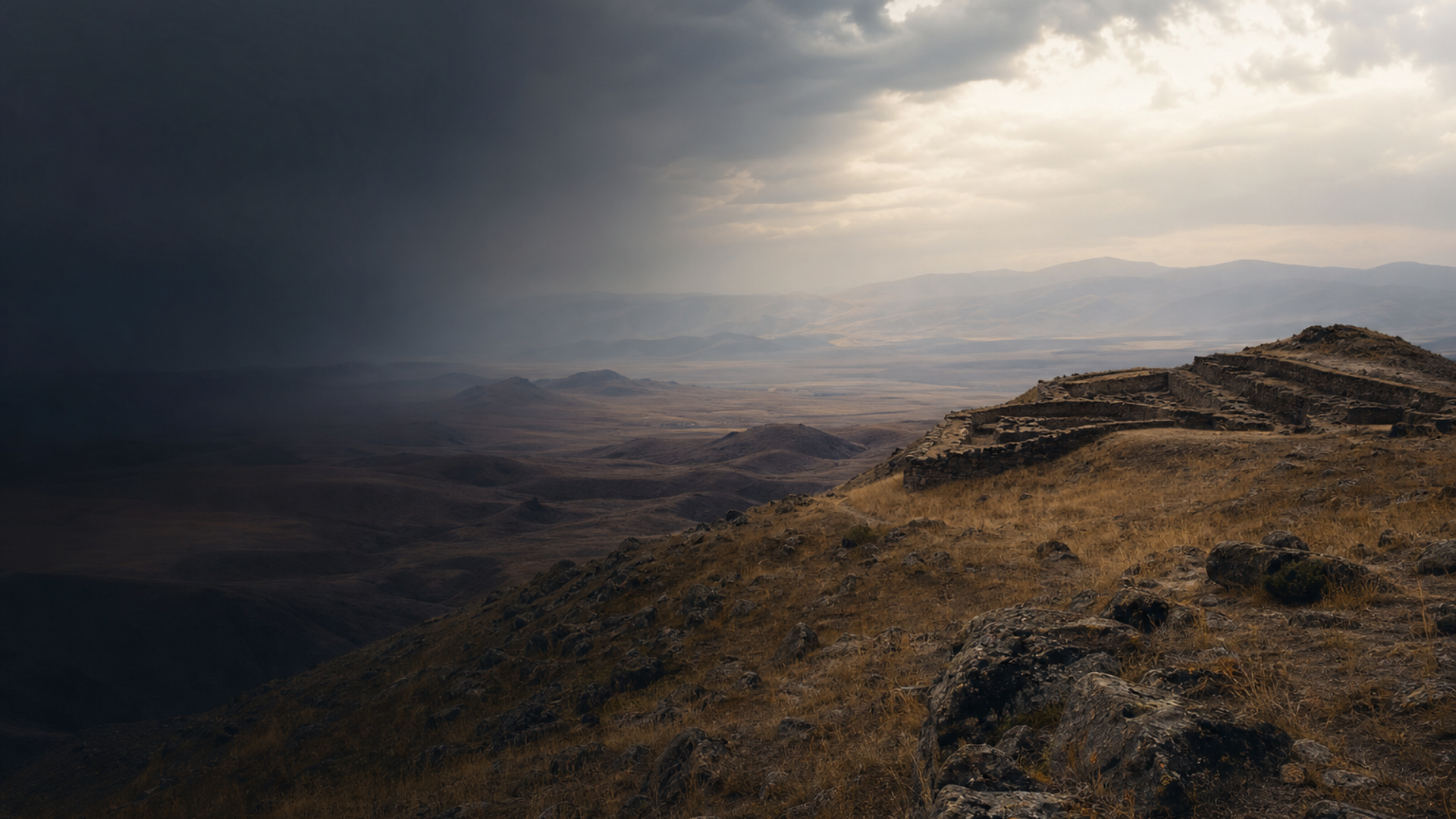
The Early Bronze Age horizon in Armenia unfolds across high valleys and volcanic plateaus between ca. 3350 and 2354 BCE. Archaeological deposits at Karnut, Kalavan and Talin capture a period of intensified metallurgy, expanding settlements and more elaborate burial rites. Excavations at the Karnut Archaeological Complex reveal stratified habitation layers where copper and early bronze objects appear alongside ceramic types that mark a local continuity from late Chalcolithic traditions.

Archaeological data indicates increasing contact with neighboring zones of the southern Caucasus and Anatolia: trade in metal and finished goods likely flowed along river corridors and mountain passes. Material culture shows both local innovations—house plans, funerary practices—and imported motifs, suggesting networks rather than simple replacement.

Limited evidence suggests that the social landscape was heterogeneous: some sites show more permanent architecture and storage, while smaller hamlets appear seasonally used by pastoral households. The cinematic image is of a region in motion—herds crossing basalt ridges, furnaces glowing at dusk, and communities negotiating new technologies and social forms.

Because the surviving record is patchy and the number of ancient genomes from this specific Armenia_EBA grouping is small, models of origin must remain provisional.

  • Dates: ca. 3350–2354 BCE across multiple Armenian sites
  • Sites: Karnut, Kalavan, Talin (including Talin cemetery)
  • Evidence: metallurgy, evolving settlement patterns, mixed local and external influences
Chapter IV

Daily Life & Society

Daily life in Early Bronze Age Armenia combined agriculture, pastoralism and crafts. Archaeobotanical remains and storage contexts at regional sites suggest cultivation of cereals and pulses, while faunal assemblages point to sheep, goat and cattle herding as central economic activities. Seasonal mobility of flocks would have tied highland pastures to lower valleys, creating a rhythm of settlement, transhumance and exchange.

Craft specialization appears in metallurgy and ceramics. Foundry waste and finished metal objects from Karnut and nearby sites attest to on-site metalworking—small ornaments, tools and perhaps weaponry—while pottery styles reflect both local forms and decorative influences traceable across the southern Caucasus.

Funerary evidence from the Talin cemetery shows variability in burial treatment: some interments are simple, others accompanied by grave goods such as beads or metal items, indicating differences in status or role. Architectural remains—compact houses of stone and mudbrick—speak to family-based households with craft and domestic spaces in close proximity.

Archaeological interpretations are cautious: the material record suggests social complexity but cannot by itself resolve questions of hierarchy or political organization without broader regional data.

  • Mixed economy: agriculture, herding, and metallurgy
  • Burials at Talin show variable grave goods suggesting social differentiation
Chapter V

Genetic Profile

Genetic sampling for the Armenia_EBA group currently comprises five individuals from Kalavan, Talin (including Talin cemetery) and the Karnut complex. Among these, one male carries a Y-chromosome haplogroup assigned to macro-haplogroup R. Maternal lineages are diverse: two individuals carry mtDNA haplogroups of the U clade, and the others fall into X2f, H and U7b. This distribution points to a mix of maternal ancestries and at least one paternal lineage commonly seen across wide parts of Bronze Age Eurasia.
Because the sample count is small (<10), any population-level inference must be treated as preliminary. The presence of Y-haplogroup R aligns with broader patterns where R-associated lineages appear in steppe-influenced contexts, but a single occurrence cannot demonstrate a dominant demographic wave. Likewise, mtDNA types such as U and H are long-standing lineages in Europe and West Asia; their presence here may reflect deep regional continuity as well as mobility.

Archaeogenetic data from the wider southern Caucasus indicate complex admixture during the Early Bronze Age; the Armenia_EBA samples are consistent with that complexity but insufficient to resolve specific migration events. Further sampling and genome-wide analyses are required to clarify proportions of local versus incoming ancestry and to test hypotheses about kinship and social structure within cemeteries.

  • Sample size: 5 individuals — conclusions preliminary
  • Y-DNA: R (1); mtDNA: U (2), X2f (1), H (1), U7b (1)
Chapter VI

Legacy & Modern Connections

The archaeological and genetic fragments from Armenia_EBA hint at threads of continuity that might feed into later cultural horizons in the Armenian Highlands, but the story is complex. Material culture demonstrates enduring local traditions alongside new influences, while maternal lineages common in ancient Europe and West Asia persist into later periods. Genetic signals in modern populations of the Caucasus show mixtures of deep local ancestry and pulses of external gene flow across millennia; the Early Bronze Age is one chapter in that long palimpsest.

Caution is essential: five genomes cannot capture the full diversity of the Early Bronze Age population, nor can they prove direct ancestry to present-day communities. What they do provide is a tangible link—small, evocative—between people who lived among the highland valleys and the genomic landscape we observe today. Continued excavation, radiocarbon dating and expanded aDNA sampling will be needed to turn these provisional glimpses into a fuller narrative of continuity and change.

  • Suggests possible continuity of maternal lineages into later periods
  • Highlights need for more samples to assess links to modern populations
AI 电源

AI 助手

就 Armenia Early Bronze Horizon 文化提问

AI 助手 由DNAGENICS公司制作

解锁此特性
Ask questions about the Armenia Early Bronze Horizon culture. Our AI assistant can explain genetic findings, historical context, archaeological evidence, and modern connections.
AI 样本分析

Armenia Early Bronze Horizon 文化是人类历史中值得了解的一章……

遗传分析揭示了与早期种群的联系,同时显示了独特的适应和文化创新的证据。 古代DNA样本提供了对迁徙模式、社会结构以及古代种群之间的生物关系的深刻见解。

这是人工智能分析的预览。 解锁全AI 助手, 以探索关于:

  • 遗传组成和祖先
  • 移徙模式和起源
  • 日常生活和文化习俗
  • 现代遗传遗产

探索更古老的文化

揭开古代世界文明的故事

使用优惠码 可减免 35% • 11月12日 到期




