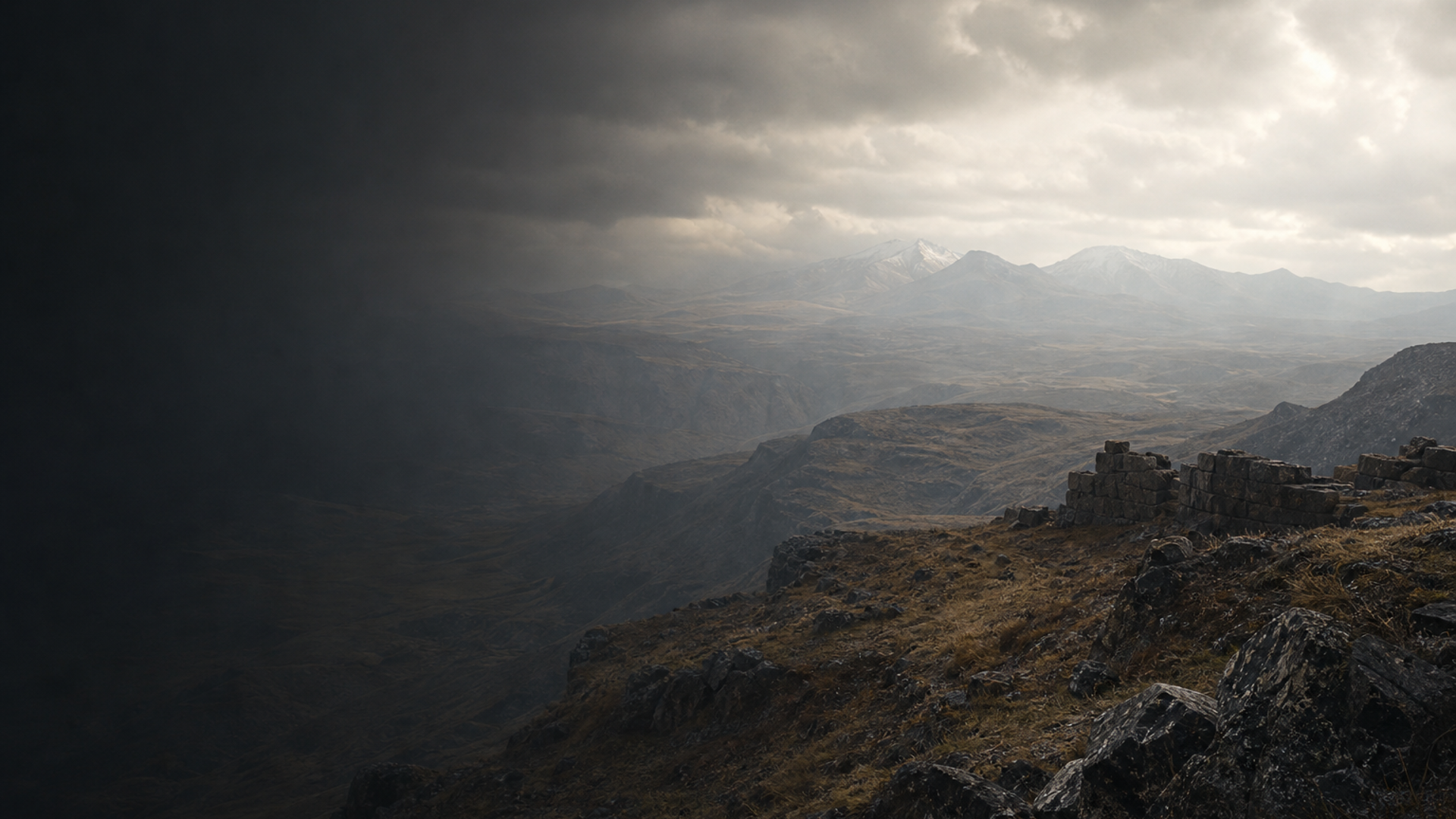
Beniamin Urartu: A Highland Echo

下载的 PDF 是图像副本。如需可选中文本及更好的辅助技术支持,请使用打印功能。

Beniamin Urartu: A Highland Echo

揭开一个失落的文明

正在加载考古记录……

正在收集古代记录

跳转到主内容
Beniamin Urartu: A Highland Echo
文明焦点

Beniamin Urartu: A Highland Echo

A single Iron Age voice from Shirak Province connects stones, inscriptions and DNA

801 CE - 774 BCE
Shirak Province, Armenia
滚动开始
Chapter I

剧情

了解 Beniamin Urartu: A Highland Echo 文化

Archaeological evidence from Shirak Province (Beniamin) dated 801–774 BCE offers a preliminary glimpse into Urartian-era life in the Armenian Highlands. Limited genetic data (N=1) hints at regional continuity; conclusions remain tentative pending more samples.

Time Period

801–774 BCE (sample)

Region

Shirak Province, Armenia

Common Y-DNA

Not reported (sample N=1)

Common mtDNA

Not reported (sample N=1)

Chapter II

时间线

这种文化历史上的关键时刻

2500 BCE

Early Bronze Age roots in the Highlands

Communities in the Armenian Highlands establish long-term occupation, agriculture and craft traditions that lay the groundwork for later Urartian society.

Chapter III

Origins & Emergence

In the sweep of the highlands, the Urartian political horizon rose in the late second and early first millennium BCE as a network of fortified centers and irrigated plains. The sample from Shirak Province (Beniamin), dated 801–774 BCE, sits squarely within the Urartian epoch when kings from the southern shore of Lake Van extended influence across the Armenian Highlands. Archaeological data indicates a pattern of fortified hilltops, reservoir construction, and characteristic pottery styles across sites such as Erebuni (Yerevan), Teishebaini (Karmir Blur), and Altintepe — material manifestations of a state-level society often called the Urartian Kingdom or Empire.

The Beniamin material context—archaeological layers with Urartian ceramic forms and architectural fragments—ties this single individual to that political landscape. Limited evidence suggests local communities both adopted and adapted Urartian administrative and craft practices, producing a mosaic of local traditions and imperial markers. While epigraphic and architectural records emphasize state projects and elite activity, smaller settlements provide the best clues about how ordinary lives and local identities were woven into that larger tapestry.

Because the dataset here is a single skeletal/genetic sample, claims about population origins must remain cautious. Archaeological patterns suggest long-term occupation and interaction across the highlands before and during Urartian dominance, but robust population-level conclusions require larger genetic and archaeological series.

  • Sample dated to 801–774 BCE, within the Urartian period
  • Material culture links to Urartian administrative and craft networks
  • Local communities show continuity and regional interaction
Chapter IV

Daily Life & Society

Archaeological traces from Urartian-era settlements evoke a world of carved stone, bronze tools, and irrigated fields. House plans recovered at regional sites reveal mudbrick and stone architecture with courtyards, storage rooms, and hearths for everyday domestic life. Terraced fields and evidence of canal work point to organized agricultural systems that supported barley, wheat, legumes, and animal herding — the economic backbone of highland settlements.

Craft specialization is visible in metallurgy workshops and pottery kilns: bronze weapons and tools, along with distinctive painted and burnished pottery, speak of skilled artisans. Administrative seals and inscriptional fragments at major centers demonstrate bureaucratic control over resources, labor and trade. Religious life combined local cult practices with state-sponsored worship; temples and cult installations at fortified centers hosted ceremonies that reinforced political order.

Everyday mobility included seasonal transhumance, market exchange between valleys, and long-distance connections to Anatolia, the Zagros and beyond. Funerary practices at smaller cemeteries reveal variability in burial rites — suggesting social differentiation and a mix of local traditions alongside Urartian influences. These material signals help frame the biological story contained in the single genetic sample from Beniamin.

  • Agriculture and irrigation were central to local economies
  • Craftsmen produced bronze tools, distinctive pottery, and administrative goods
Chapter V

Genetic Profile

The genetic evidence for Armenia_Beniamin_Urartu_IA is extremely limited: a single sampled individual dated 801–774 BCE from Shirak Province. Archaeogenetic studies across the Caucasus and adjacent regions commonly identify ancestry components tied to Caucasus hunter-gatherer (CHG), Anatolian Neolithic, and varying degrees of Steppe-related ancestry; such broad patterns suggest a long history of regional continuity and episodic admixture. However, with only one genome from Beniamin, any inference about population structure, migrations, or demographic shifts must be framed as provisional.

For this sample, Y‑DNA and mtDNA haplogroups are not reported, so paternal and maternal lineages cannot be used to draw conclusions. Where larger datasets exist in the region, researchers have used genome-wide data to detect continuity between Bronze Age and Iron Age populations alongside signals of interaction with neighboring zones. If additional Urartian-period samples from Shirak and nearby sites become available, analysts could test whether the Beniamin individual represents local continuity, incoming groups, or a mixed ancestry profile characteristic of imperial frontiers.

In short: archaeological context anchors this person within Urartian-era life, but genetic interpretation awaits more samples. Limited evidence suggests continuity with broader Caucasus genetic backgrounds, yet that remains an open question until sample sizes grow beyond the single-individual level.

  • Sample size is N=1 — conclusions are preliminary
  • Genome-wide ancestry likely reflects regional CHG, Anatolian, and Steppe-related components (general pattern)
Chapter VI

Legacy & Modern Connections

The material and genetic echoes of Urartian-era communities persist in the cultural landscape of the Armenian Highlands. Stone fortresses, irrigation works, and place-names carve a continuity of human labor across millennia. Genetically, modern populations of the South Caucasus show signals of deep local ancestry intertwined with later layers of migration; the Beniamin sample hints at these deep roots but cannot alone map them onto living communities.

Archaeology and aDNA together create a layered narrative: stones and inscriptions tell of statecraft, canals and workshops of daily management, while genetic fragments offer direct but sparse glimpses of the people who lived that life. Each new skeleton and genome will refine how we connect Urartian-era individuals to later medieval and modern populations of Armenia and the surrounding regions. Until then, the Beniamin individual remains a poignant, solitary voice from an empire of stone and water.

  • Material infrastructure (forts, canals) influenced later landscape and settlement
  • Genetic continuity is plausible but unproven with only one sample
AI 电源

AI 助手

就 Beniamin Urartu: A Highland Echo 文化提问

AI 助手 由DNAGENICS公司制作

解锁此特性
Ask questions about the Beniamin Urartu: A Highland Echo culture. Our AI assistant can explain genetic findings, historical context, archaeological evidence, and modern connections.
AI 样本分析

Beniamin Urartu: A Highland Echo 文化是人类历史中值得了解的一章……

遗传分析揭示了与早期种群的联系,同时显示了独特的适应和文化创新的证据。 古代DNA样本提供了对迁徙模式、社会结构以及古代种群之间的生物关系的深刻见解。

这是人工智能分析的预览。 解锁全AI 助手, 以探索关于:

  • 遗传组成和祖先
  • 移徙模式和起源
  • 日常生活和文化习俗
  • 现代遗传遗产

探索更古老的文化

揭开古代世界文明的故事

使用优惠码 可减免 35% • 11月12日 到期