Butakty-1: Karakhanid South-East Kazakhstan

下载的 PDF 是图像副本。如需可选中文本及更好的辅助技术支持,请使用打印功能。

Butakty-1: Karakhanid South-East Kazakhstan

揭开一个失落的文明

正在加载考古记录……

正在收集古代记录

跳转到主内容
Butakty-1: Karakhanid South-East Kazakhstan
文明焦点

Butakty-1: Karakhanid South-East Kazakhstan

Three medieval individuals revealing hints of Silk Road admixture in the Almaty foothills (800–1100 CE)

800 CE - 1100 CE
South‑East Kazakhstan (Almaty Region)
滚动开始
Chapter I

剧情

了解 Butakty-1: Karakhanid South-East Kazakhstan 文化

Archaeogenetic data from three individuals at Butakty-1 (Medeu District, Almaty Region) dated c. 800–1100 CE provide a preliminary glimpse of Karakhanid-era population interactions, with male-line J haplogroups and mixed maternal lineages suggesting Silk Road-era admixture.

Time Period

c. 800–1100 CE

Region

South‑East Kazakhstan (Almaty Region)

Common Y-DNA

J (2 of 3 samples)

Common mtDNA

G, J1c, A+ (each observed)

Chapter II

时间线

这种文化历史上的关键时刻

800 CE

Early Karakhanid-era activity

Circa 800 CE the region experiences increased settlement complexity and integration into emerging Karakhanid political networks (approximate and regionally variable).

1000 CE

High medieval exchange

Around 1000 CE Karakhanid domains and Silk Road trade facilitate intensified cultural and genetic exchange across Central Asia.

1100 CE

Later Karakhanid transitions

By c. 1100 CE political shifts and regional realignments reshape local settlement networks in south‑east Kazakhstan.

Chapter III

Origins & Emergence

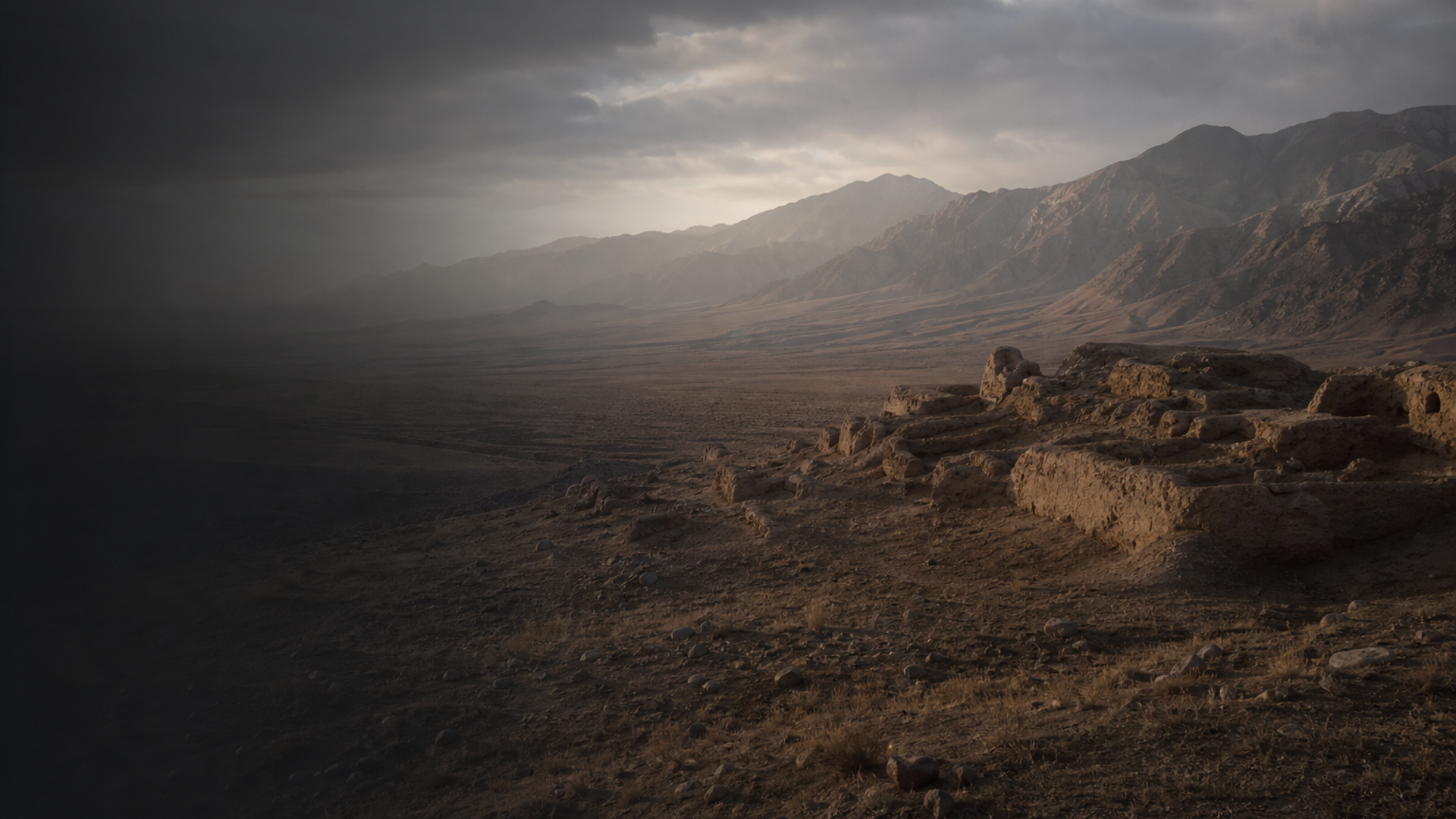
The remains from Butakty-1 sit on a cinematic threshold where highland steppe and irrigated valleys meet. Archaeological data indicate occupation during the Karakhanid era (c. 9th–12th centuries CE), a time when Turkic polities consolidated power across Central Asia and the Silk Road arteries funneled goods, peoples and ideas across Eurasia. Butakty-1 (Medeu District, Almaty Region) yields a narrow but evocative snapshot: three directly dated individuals spanning roughly 800–1100 CE. Material culture from nearby Karakhanid sites includes fortified settlements, caravanserai-related infrastructure and urban centers that acted as nodes of exchange; similar landscape use likely informed life at Butakty and its environs.

Genetically and archaeologically, the region reflects layered origins. Steppe pastoralist traditions persisted alongside increasing urbanism and Islamic cultural influence associated with the Karakhanid Khanate. Limited evidence suggests the population was not a single homogeneous group but a mosaic shaped by local continuity and incoming groups along trade and political networks. Given the tiny sample size, any reconstruction of origins must remain provisional: these individuals hint at diverse sources rather than definitive demographic trajectories. Future excavation and a larger ancient DNA series in the Almaty foothills will be required to clarify the processes that produced the people of the Karakhanid south‑east.

  • Butakty-1 individuals dated to c. 800–1100 CE; Karakhanid-era context
  • Region at crossroads of steppe pastoralism and Silk Road urbanism
  • Evidence suggests layered local continuity plus incoming influences
Chapter IV

Daily Life & Society

Archaeological parallels from Karakhanid-era settlements paint a picture of life that could have framed the experiences of Butakty-1 people: seasonal mobility tied to pastoralism, alongside agricultural households in irrigated valleys, and participation in long-distance trade networks. Caravan routes nearby brought textiles, metalwork, and ideas; coins and imported ceramics at regional sites indicate economic integration into Silk Road circuits. Burials in the Karakhanid period vary from simple inhumations to more elaborate graves in urban cemeteries, reflecting social differentiation and the increasing prominence of Islam — though local practices often blended older steppe rites with new customs.

Social roles may have been fluid. Men engaged in herding, warfare, and caravan escort; women managed household production, textile work and kin networks that underpinned exchange. Artisans and merchants concentrated in market towns linked to caravan traffic. Climatic variability and political shifts could push communities between settled and more mobile lifeways, producing cultural hybridity visible in material remains. Archaeological data indicates a dynamic landscape of commerce and pastoral resilience rather than static village life.

Caution: these reconstructions are inferential for Butakty-1 specifically, given the small number of locally sampled individuals.

  • Mix of pastoral mobility and settled agriculture near caravan routes
  • Material culture shows economic ties to wider Silk Road networks
Chapter V

Genetic Profile

The genomic snapshot from Butakty-1 comprises three Karakhanid-era individuals. Two males carry Y-chromosome haplogroup J, while mtDNA lineages are diverse: G, J1c and A+. Though limited, these results are biologically informative and archaeologically resonant.

Haplogroup J has a broad distribution across West Asia and the Caucasus and is commonly associated with Near Eastern male lineages. Its presence in two individuals may signal male-mediated gene flow from western or southwestern Eurasian sources into the Almaty foothills during the medieval period, potentially linked to migration, military movements, or merchant communities operating along the Silk Road. Maternal lineages show a more complex picture: mtDNA G and A+ are often found in Northeast Asian and Siberian-associated populations, while J1c is widespread in West Eurasia. This mixture suggests admixture between eastern and western maternal ancestries — consistent with the region’s role as a contact zone.

Important caveats: with only three samples, any population-level inference is preliminary. Small sample counts (<10) can over-emphasize rare lineages and miss broader patterns. The pattern of two J Y-haplogroups could reflect a localized patriline or limited sampling; conversely, the mtDNA diversity hints at female-mediated movement or long-term admixture. Additional ancient genomes from contemporaneous Karakhanid contexts are needed to test whether these patterns reflect local demographic processes or individual life histories tied to trade and migration.

  • Two of three males carry Y-haplogroup J, suggesting western/near‑eastern male inputs
  • mtDNA diversity (G, J1c, A+) points to mixed eastern and western maternal ancestries
Chapter VI

Legacy & Modern Connections

The Karakhanid-era people of south‑east Kazakhstan contributed to cultural and genetic mosaics that feed into the modern population landscape. Today’s Kazakh genetic diversity reflects many layers — steppe pastoralists, Turkic expansions, medieval Islamic polities and Silk Road exchanges. The Butakty-1 individuals, while few, echo this complexity: male-line J and mixed maternal haplogroups illustrate how medieval contacts could leave a discernible imprint.

Archaeologically, the Karakhanid legacy endures in urban planning, trade corridors and the spread of Islamic cultural markers across Central Asia. Genetically, continuity and turnover are both likely: some lineages persisted locally, while others arrived via long-distance connections. Given the preliminary nature of the Butakty-1 samples, robust statements about modern ancestry require many more comparative ancient and present-day genomes. Nevertheless, these genomes provide a cinematic, humanizing glimpse of individuals who lived at a cultural crossroads and whose biologies carry traces of Eurasia’s interconnectedness.

  • Reflects the complex ancestry seen in modern Kazakh populations
  • Illustrates Silk Road-era admixture and the entanglement of cultural and genetic exchange
AI 电源

AI 助手

就 Butakty-1: Karakhanid South-East Kazakhstan 文化提问

AI 助手 由DNAGENICS公司制作

解锁此特性
Ask questions about the Butakty-1: Karakhanid South-East Kazakhstan culture. Our AI assistant can explain genetic findings, historical context, archaeological evidence, and modern connections.
AI 样本分析

Butakty-1: Karakhanid South-East Kazakhstan 文化是人类历史中值得了解的一章……

遗传分析揭示了与早期种群的联系,同时显示了独特的适应和文化创新的证据。 古代DNA样本提供了对迁徙模式、社会结构以及古代种群之间的生物关系的深刻见解。

这是人工智能分析的预览。 解锁全AI 助手, 以探索关于:

  • 遗传组成和祖先
  • 移徙模式和起源
  • 日常生活和文化习俗
  • 现代遗传遗产

探索更古老的文化

揭开古代世界文明的故事

使用优惠码 可减免 35% • 11月12日 到期