Echoes from Ulgii Barrows

下载的 PDF 是图像副本。如需可选中文本及更好的辅助技术支持,请使用打印功能。

Echoes from Ulgii Barrows

揭开一个失落的文明

正在加载考古记录……

正在收集古代记录

跳转到主内容
Echoes from Ulgii Barrows
文明焦点

Echoes from Ulgii Barrows

Five Early Bronze Age burials in western Mongolia link earth, bone and ancient DNA

3012 CE - 2474 BCE
Bayan-Ölgii, Ulaankhus (western Mongolia)
滚动开始
Chapter I

剧情

了解 Echoes from Ulgii Barrows 文化

Archaeogenetic study of five Early Bronze Age burials (3012–2474 BCE) from Ulaankhus, Bayan-Ölgii, Mongolia, reveals predominantly East Eurasian maternal lineages (A, D) and a single C Y-chromosome—offering a tentative glimpse into Altai–Mongolian population dynamics.

Time Period

3012–2474 BCE (Early Bronze Age)

Region

Bayan-Ölgii, Ulaankhus (western Mongolia)

Common Y-DNA

C (observed in 1 of 5 samples)

Common mtDNA

A (4 of 5), D (1 of 5)

Chapter II

时间线

这种文化历史上的关键时刻

2750 BCE

Secondary burials in Ulaankhus

Reburial of human remains at Kurgak Govi, Kulala Ula and Kumdii Govi reflects curated mortuary practices in the Early Bronze Age highlands.

Chapter III

Origins & Emergence

Beneath the wind-scoured grasses of Bayan-Ölgii, barrows preserve quiet chapters of human movement. The five individuals attributed to Mongolia_EBA_Ulgii_1 date from 3012 to 2474 BCE and were recovered in Ulaankhus sum at Kurgak Govi barrow 2 (secondary burial), Kulala Ula barrow 1 (secondary burial), and Kumdii Govi barrow (burial 2). Archaeological data indicates these were secondary interments—bones reburied or curated after initial decomposition—suggesting ritual care of the dead.

Material culture at nearby Early Bronze Age sites in the Altai and Mongolian uplands shows mobile pastoral economies and long-distance connections, but the Ulgii barrows themselves preserve limited grave goods, complicating social reconstruction. Radiocarbon dates anchor the assemblage firmly in the early third to mid-third millennium BCE, a period of growing pastoralism across the steppe fringe. Limited evidence suggests these burials represent local communities adapting to highland ecologies rather than a sudden migration event.

Because only five genomes are available, any narrative of population origin must remain provisional. Archaeological contexts and stratigraphy provide a canvas; ancient DNA adds delicate brushstrokes, hinting at continuity with regional East Eurasian maternal lineages while leaving open questions about incoming paternal ancestry and cultural transmission.

  • Five individuals from Ulaankhus, Bayan-Ölgii (3012–2474 BCE)
  • Secondary burials indicate curated mortuary practices
  • Evidence suggests local highland pastoral adaptations
Chapter IV

Daily Life & Society

Archaeological traces from Ulgii Early Bronze Age contexts evoke a life balanced between stone, felt and herd. Settlement evidence in the greater Bayan-Ölgii region of this era points to seasonal mobility, corralling of livestock, and the pragmatic use of high-mountain pastures. The barrow contexts at Kurgak Govi, Kulala Ula and Kumdii Govi are funerary rather than domestic, but their burial architecture and few associated artifacts hint at social identities tied to kin groups and pastoral stewardship.

Secondary burial practices imply a ritualized relationship with ancestors: bodies were initially left or processed, then reinterred, sometimes in collective mounds. Such actions can reflect beliefs about life cycles, property transmission, or social memory. Lithic tools, pottery fragments and occasional metal items in nearby sites suggest craft specialization and networks of exchange—commodities and ideas moving along foothill corridors toward the Altai and beyond.

Archaeobotanical and faunal remains are sparse in these specific barrows, so reconstruction of diet and seasonal rhythms relies on regional analogies. Consequently, while the cinematic image of nomadic herders tending sheep and horses is plausible, archaeological data indicates cautious interpretation: local lifeways likely combined mobility with anchored ritual landscapes centered on burial mounds.

  • Seasonal pastoralism inferred from regional archaeological patterns
  • Secondary burials point to ritualized ancestor practices
Chapter V

Genetic Profile

Genetic data from Mongolia_EBA_Ulgii_1 offers a concentrated, if preliminary, portrait. Of the five individuals sequenced, four carry mitochondrial haplogroup A and one carries haplogroup D—both maternal lineages commonly associated with Northeast Asian and Siberian populations. On the paternal side, a single observed Y-chromosome belongs to haplogroup C, a lineage with deep roots across East and Central Eurasia.
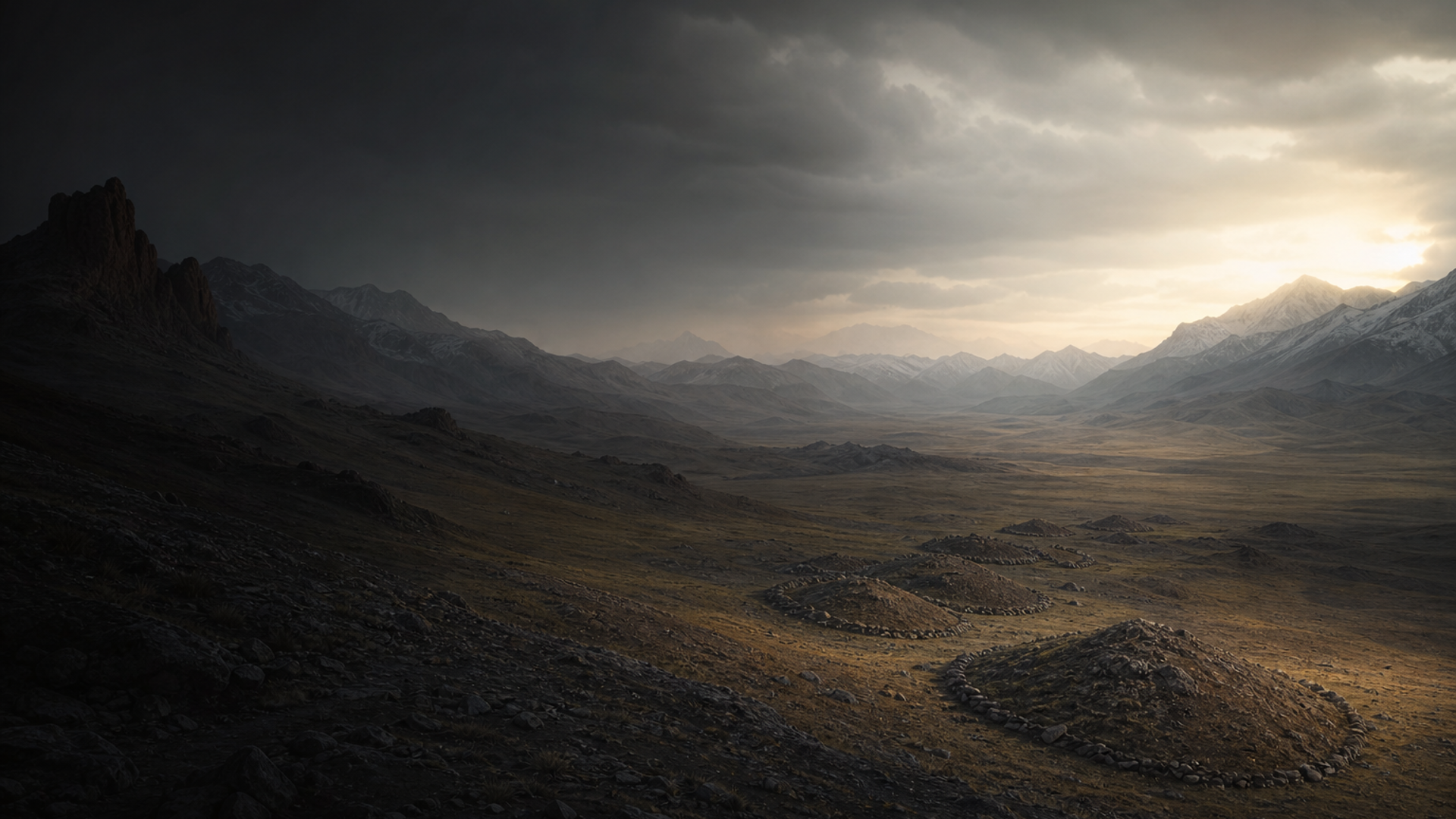

These results suggest predominant East Eurasian maternal ancestry in this small Ulaankhus sample, consistent with broader patterns seen across northern Mongolia and adjacent Siberia in the Early Bronze Age. The presence of Y-haplogroup C in one male aligns with regional paternal diversity but, with only one Y observation, offers limited insight into male-mediated gene flow.

Comparative analyses (when available) can test whether these individuals cluster with contemporaneous Altai and northern Mongolian groups or show admixture with western steppe populations. At present, with only five genomes, conclusions about population structure, sex-biased migration, or continuity into later periods must be tentative. Future sampling from neighbouring cemeteries and settlement contexts will be essential to move from evocative glimpses to robust population histories.

  • mtDNA dominated by A (4/5) with one D (1/5)—typical of Northeast Asian maternal ancestry
  • Y-DNA C observed in 1/5 samples; low Y-sample count limits paternal inferences
Chapter VI

Legacy & Modern Connections

The maternal lineages found in these Ulaankhus burials—haplogroups A and D—persist in varying frequencies among contemporary populations across Mongolia, Siberia and northeastern Asia. Archaeogenetic continuity of mtDNA types suggests elements of maternal ancestry may have deep regional roots. However, cultural and genetic landscapes have been reshaped repeatedly across millennia by mobility, trade and migration.

These burials form a fragile bridge between past and present: they allow modern communities and researchers to glimpse ancestral threads but do not provide a complete lineage map. Given the small sample size, any claims of direct descent or cultural continuity should remain cautious. The true legacy of Mongolia_EBA_Ulgii_1 lies in its potential to, when combined with broader datasets, reveal how highland pastoral lifeways and human networks in the Early Bronze Age contributed to the genetic tapestry of Eurasia.

  • Maternal haplogroups echo patterns still seen in modern Mongolia and Siberia
  • Small sample size means connections to modern populations are tentative
AI 电源

AI 助手

就 Echoes from Ulgii Barrows 文化提问

AI 助手 由DNAGENICS公司制作

解锁此特性
Ask questions about the Echoes from Ulgii Barrows culture. Our AI assistant can explain genetic findings, historical context, archaeological evidence, and modern connections.
AI 样本分析

Echoes from Ulgii Barrows 文化是人类历史中值得了解的一章……

遗传分析揭示了与早期种群的联系,同时显示了独特的适应和文化创新的证据。 古代DNA样本提供了对迁徙模式、社会结构以及古代种群之间的生物关系的深刻见解。

这是人工智能分析的预览。 解锁全AI 助手, 以探索关于:

  • 遗传组成和祖先
  • 移徙模式和起源
  • 日常生活和文化习俗
  • 现代遗传遗产

探索更古老的文化

揭开古代世界文明的故事

使用优惠码 可减免 35% • 11月12日 到期




