Echoes of Early Bronze Bulgaria

下载的 PDF 是图像副本。如需可选中文本及更好的辅助技术支持,请使用打印功能。

跳转到主内容
文明焦点

Echoes of Early Bronze Bulgaria

Archaeology and DNA illuminate life in Bulgaria, 3400–2000 BCE

3400 CE - 2000 BCE
Bulgaria (Central & Northeast)

剧情

A portrait of Early Bronze Age communities across central and northeastern Bulgaria (3400–2000 BCE) combining archaeological context from tells and necropoleis with genomic evidence from 19 ancient individuals to explore continuity, mobility, and social change.

Time Period

3400–2000 BCE

Region

Bulgaria (Central & Northeast)

Common Y-DNA

I (3), G (1), H (1)

Common mtDNA

U (5), K (2), T (2), T2f (1), H (1)

时间线

2500 BCE

Consolidation of Early Bronze Culture in Central Bulgaria

Regional settlements and necropoleis show intensified metal use, expanded exchange networks and evolving burial practices around 2500 BCE.

Origins & Emergence

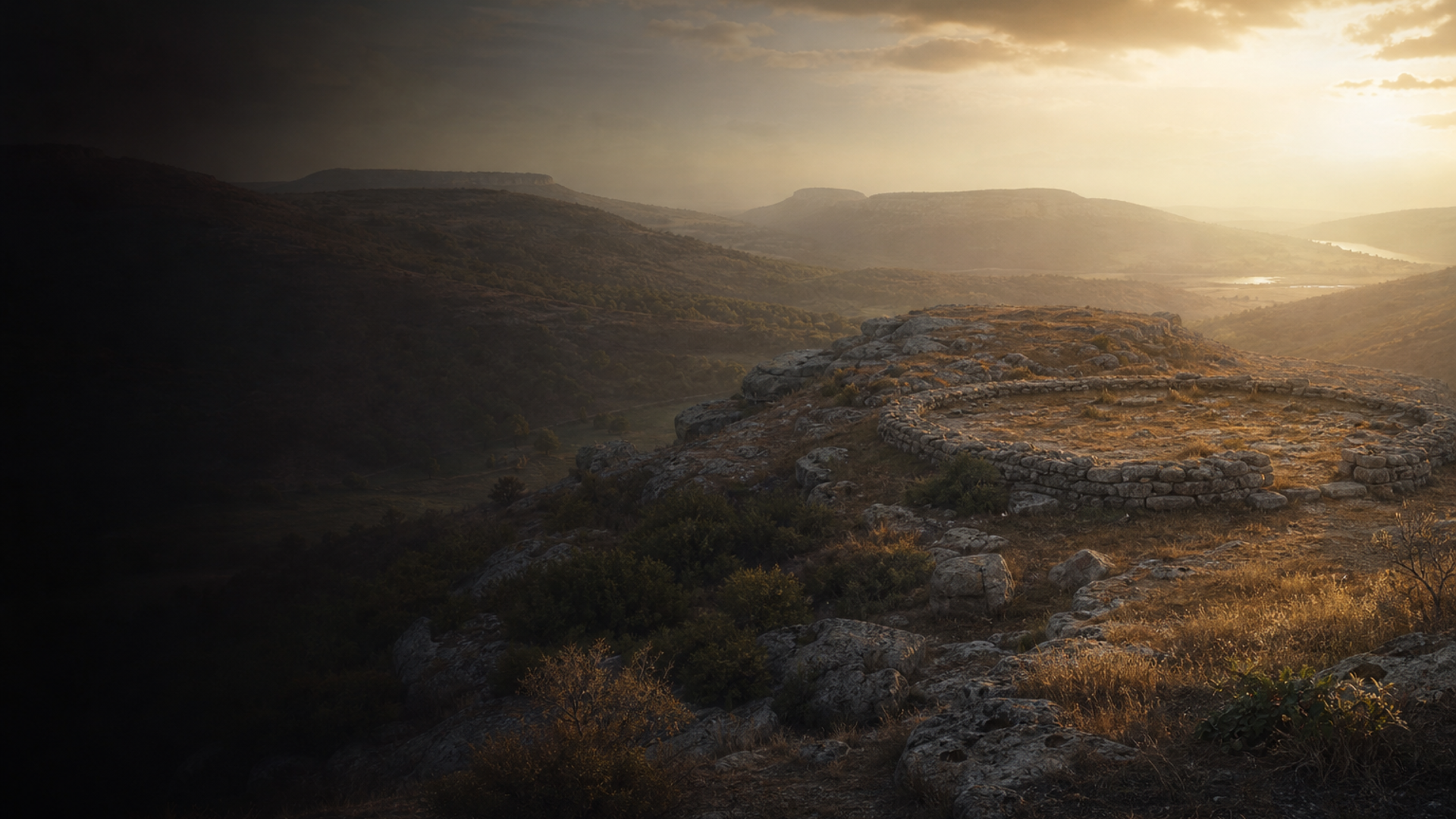
The Early Bronze Age in what is now Bulgaria unfolds across a landscape of tells, fortified mounds and clustered necropoleis from ca. 3400 to 2000 BCE. Sites represented in this dataset—Tell Ezero (South Central), Tell Kran (near Kazanlak), the Kairyaka necropolis at Merichleri (Dimitrovgrad), Dzhulyunitsa (Veliko Tarnovo), Smyadovo and Nova Zagora—preserve a sequence of local settlement intensification, metalworking and shifting burial practices.

Archaeological data indicates continuity with late Chalcolithic lifeways: long-lived tells show domestic rebuilding, and grave goods increasingly include copper and bronze objects alongside pottery styles that evolve regionally. At Kairyaka and other necropoleis, burials range from simple inhumations to richer interments, pointing to emerging social differentiation. Find assemblages suggest networks of exchange connecting the central Bulgarian plain to the lower Danube, the Aegean coast and the Pontic-Caspian steppe.

Genetically, the region sits at an intersection. Broader studies of Southeast Europe document the persistence of Neolithic farmer ancestry together with incoming steppe-related components during the 3rd millennium BCE; the 19 samples here capture that complex transition unevenly. Limited evidence suggests a mix of local continuity and episodes of contact or mobility rather than a single sweeping population replacement. Because settlements and burials span more than a millennium, patterns can vary by site and period, and interpretations must remain cautious.

  • Sites sampled include Tell Ezero, Tell Kran, Kairyaka necropolis, Dzhulyunitsa, Smyadovo, Nova Zagora
  • Archaeology shows continuity from Chalcolithic tells to Early Bronze metallurgy and changing burial rites
  • Regional connections to the Aegean, Danube corridor, and steppe are archaeologically visible but genetically heterogeneous

Daily Life & Society

Daily life in Early Bronze Age Bulgaria likely blended settled agriculture with seasonal mobility. Surveys and excavations at central sites such as Tell Ezero and the tells near Kazanlak reveal compact houses, storage pits and courtyard complexes indicating crop cultivation—wheat, barley and pulses—and animal husbandry (sheep, goats, cattle). The cinematic image of smoke rising from simple mudbrick homes is grounded in evidence: cooking hearths, grinding stones and charred seeds testify to subsistence routines.

Metalwork becomes a visible hallmark of the era. Small copper and early bronze tools, pins and ornaments recovered in necropoleis and settlements speak to growing craft specialization. Archaeological contexts at Merichleri’s Kairyaka necropolis show metal items placed in graves, signaling their role in social identity or status. Ceramic styles diversify: local decorative traditions mix with new motifs, suggesting stylistic exchange across communities.
Mortuary practices illuminate social organization. Variability in grave goods—from modest pottery to metal objects—suggests emerging inequalities or differentiated roles within communities, though quantifying rank is difficult from funerary material alone. Settlement hierarchies may have been fluid, with seasonal pastoral routes connecting lowland agricultural villages to upland pastures. Limited direct textual evidence obliges us to read social texture from material remains and from the genetic signals preserved in bones—both of which hint at connected, changing lifeways across the Bulgarian plains.

  • Mixed farming economy with evidence for craft specialization in metalworking
  • Burial variability (from modest to metal-rich graves) suggests social differentiation

Genetic Profile

This population sample comprises 19 individuals dated between ca. 3400 and 2000 BCE from multiple Bulgarian localities. The Y-chromosome distribution in these remains is dominated by haplogroup I (n = 3), with single instances of G (n = 1) and H (n = 1) recorded among the male samples. Mitochondrial lineages are largely composed of haplogroup U (n = 5), with K (n = 2), T (n = 2), a single T2f, and one H. These maternal lineages echo a pattern seen across southeastern Europe: persistence of lineages associated with Europe’s Mesolithic and Neolithic past alongside lineages common in Neolithic farmer communities.

Interpreting ancestry components requires care. Archaeological and regional genomic studies indicate that the Balkans experienced admixture between local Neolithic farmer descendants and incoming steppe-related groups during the third millennium BCE. In this particular dataset the observed Y haplogroups do not show a dominant presence of classic steppe-associated paternal markers (e.g., widespread R1a/R1b), which suggests that at these sites and times local male lineages remained important—but absence should not be taken as proof of no steppe influence, especially given limited geographic and temporal sampling.

Maternally, the prominence of U alongside K and T points to a mixed maternal heritage—some continuity with pre-Neolithic or early-Neolithic lineages and ongoing integration of diverse groups. Because sample sizes for specific sub-periods and locations are modest, conclusions about demographic shifts should be viewed as provisional. Future, denser sampling and genome-wide analyses will refine the balance between local continuity and mobility.

  • 19 individuals show Y haplogroups I (3), G (1), H (1) and mtDNA dominated by U, K, T lineages
  • Genetic picture suggests mixed ancestry—local Neolithic roots with evidence for external contacts, but site-level variation is high

Legacy & Modern Connections

The threads of Early Bronze Age Bulgaria continue to echo into the present. Many mitochondrial haplogroups found in these ancient individuals—U, K, T and H—persist in modern European populations, including in contemporary Bulgaria, indicating a degree of maternal continuity across millennia. Archaeologically visible traditions—metallurgy, ceramic styles and long-distance exchange—helped shape later Balkan cultural developments and the emergence of Bronze Age networks that connected Europe, Anatolia and the steppe.

However, legacy is not simple continuity: demographic processes over the subsequent Bronze and Iron Ages, medieval migrations and modern population movements layered additional genetic and cultural inputs over the Early Bronze Age foundation. The 19-sample snapshot presented here offers a vivid, localized window into one chapter of that deep history, but broader sampling and genome-scale analyses are needed to trace direct lines of descent. In short, the people buried at Kairyaka, Tell Ezero and other sites contributed threads to the tapestry of Southeast European ancestry, woven together with many later influences.

  • Maternal lineages seen here persist in modern populations, implying partial continuity
  • Cultural innovations (metallurgy, exchange) contributed to long-term Balkan connections

AI 助手

AI 助手 由DNAGENICS公司制作

解锁此特性
Ask questions about the Echoes of Early Bronze Bulgaria culture. Our AI assistant can explain genetic findings, historical context, archaeological evidence, and modern connections.
AI 样本分析

Echoes of Early Bronze Bulgaria 文化是人类历史中值得了解的一章……

遗传分析揭示了与早期种群的联系,同时显示了独特的适应和文化创新的证据。 古代DNA样本提供了对迁徙模式、社会结构以及古代种群之间的生物关系的深刻见解。

这是人工智能分析的预览。 解锁全AI 助手, 以探索关于:

  • 遗传组成和祖先
  • 移徙模式和起源
  • 日常生活和文化习俗
  • 现代遗传遗产
使用优惠码 可减免 30% • 11月14日 到期




