Fleury-sur-Orne Neolithic Cluster

下载的 PDF 是图像副本。如需可选中文本及更好的辅助技术支持,请使用打印功能。

Fleury-sur-Orne Neolithic Cluster

揭开一个失落的文明

正在加载考古记录……

正在收集古代记录

跳转到主内容
Fleury-sur-Orne Neolithic Cluster
文明焦点

Fleury-sur-Orne Neolithic Cluster

A small Neolithic community in Calvados whose stones whisper of farmers and foragers

4446 CE - 3530 BCE
Calvados, Normandy, France
滚动开始
Chapter I

剧情

了解 Fleury-sur-Orne Neolithic Cluster 文化

Archaeogenetic and archaeological traces from Fleury-sur-Orne (Calvados, France) span 4446–3530 BCE. Five ancient genomes reveal a mixed Neolithic profile—signals of local hunter‑gatherer persistence alongside incoming farmers. Limited samples mean conclusions remain preliminary but evocative.

Time Period

4446–3530 BCE

Region

Calvados, Normandy, France

Common Y-DNA

I (2), H (1), H2* (1), G (1)

Common mtDNA

U (2), K (2), H (1)

Chapter II

时间线

这种文化历史上的关键时刻

3500 BCE

Fleury‑sur‑Orne burials dated

Radiocarbon dates place human remains at Fleury‑sur‑Orne firmly in the mid‑to‑late Neolithic, marking local participation in wider farming expansions across western Europe.

Chapter III

Origins & Emergence

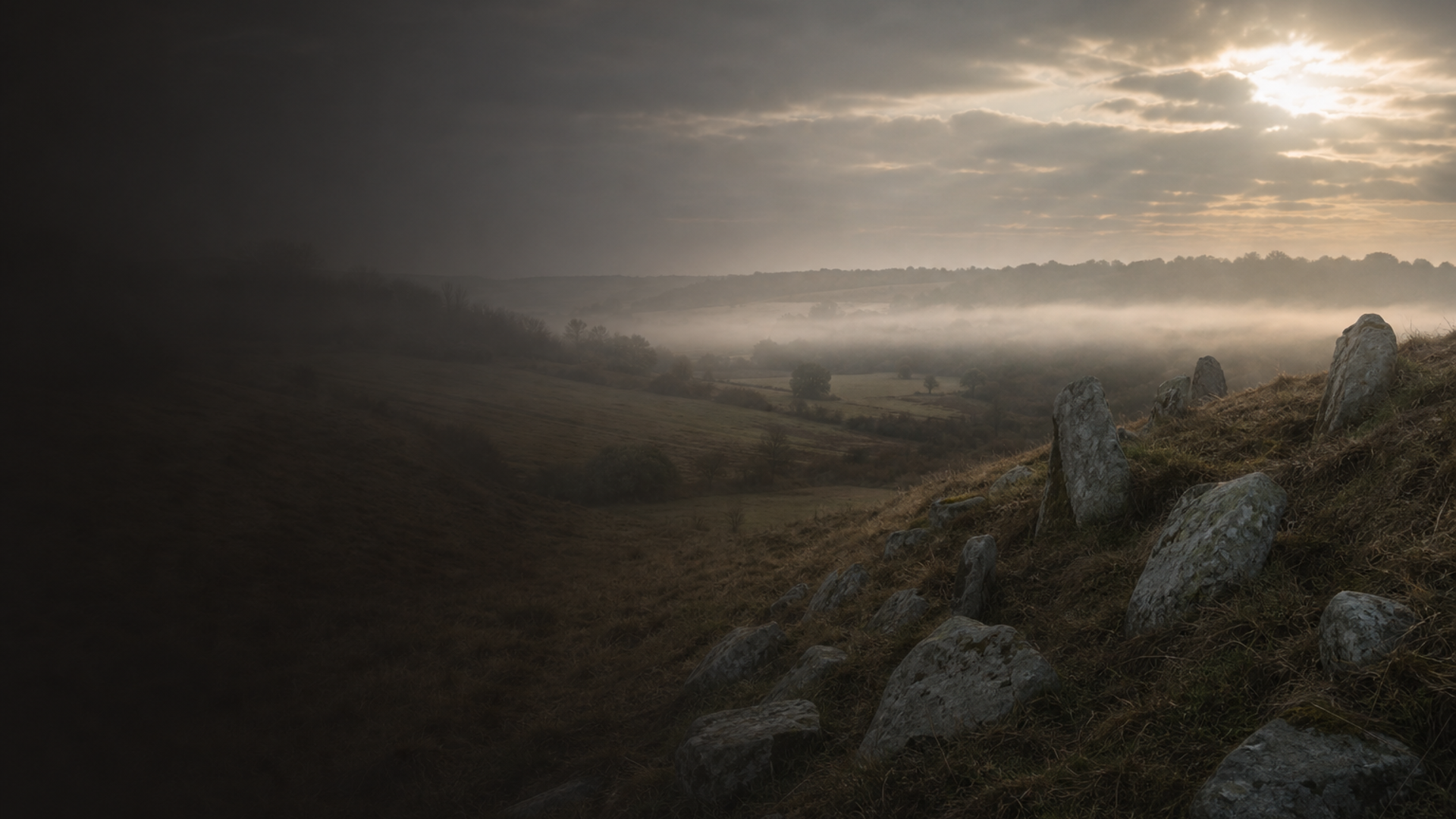
The human traces from Fleury‑sur‑Orne sit at the edge of the Atlantic façade of Neolithic Europe, dated between 4446 and 3530 BCE. Archaeological contexts in Calvados indicate small farming communities that adopted domesticated cereals, sheep and cattle while still interacting with residual forager networks in Normandy. The site’s material culture—simple pottery forms, flint toolkits and burial deposits—fits within broader Neolithic traditions of northwestern France, but local variation is clear.

Genetically, the Fleury cluster captures a moment of blending: paternal lineages include haplogroup I (found twice) which has deep Mesolithic roots in Europe, alongside haplogroups more commonly associated with farming expansions. Archaeological data indicates continuity of landscape use rather than sudden replacement. Limited evidence suggests these people lived in dispersed farmsteads rather than large nucleated villages, and their remains preserve a mixture of cultural and biological influences.

Because this dataset comprises only five genomes from a single locality, archaeological and genetic interpretations must remain cautious. The cinematic image of coastal fields and mixed diets is supported by both bones and molecules, but the picture is fragmentary: further excavation and sampling across Normandy are required to move from evocative hypothesis to confident model.

  • Newly dated Neolithic burials at Fleury‑sur‑Orne (4446–3530 BCE)
  • Material culture aligns with Neolithic Normandy but shows local traits
  • Small sample size — interpretations are preliminary
Chapter IV

Daily Life & Society

Archaeological data from Calvados paints a tactile portrait: fields cleared, hearths warmed, and flint edges retouched at the river’s edge. Faunal remains at contemporaneous Neolithic sites in Normandy show domesticated cattle, sheep and pigs alongside hunted deer and aurochs, suggesting mixed subsistence economies. Pottery fragments at Fleury‑sur‑Orne indicate cooking and storage practices; vessel shapes and tempering echo regional Neolithic traditions but are modest and functional rather than ornate.

Settlement patterns in the region favor dispersed homesteads and small hamlets. Houses were likely timber or wattle constructions, periodically rebuilt and reorganized across generations. Burial practice evidence—few collective monuments but isolated interments—suggests households exercised local ritual authority rather than centralized monumental displays. Social life would have been organized around kin networks, seasonal cycles, and exchange of raw materials such as flint and salt.

Isotopic studies in nearby Neolithic contexts often show a diet dominated by terrestrial proteins and cultivated cereals; while direct isotope data from these five individuals are limited or absent, the regional baseline supports similar lifeways. The archaeological record thus complements the genetic signal: communities of farmers living within a landscape still shaped by forager mobility and older traditions.

  • Mixed farming and hunting economy inferred from regional remains
  • Dispersed homesteads and household-based burials indicate local social organization
Chapter V

Genetic Profile

The Fleury-sur-Orne genetic snapshot (n = 5) reveals a mosaic typical of early-to-middle Neolithic northwestern Europe but must be read with caution because of the small sample count. Male lineages include haplogroup I in two individuals, a paternal lineage with deep Mesolithic roots in Europe and often interpreted as a sign of local hunter‑gatherer continuity. The presence of haplogroup G (one individual) aligns with the broader signal of Anatolian‑derived farmers who spread into Europe carrying G2a and related subclades; while the dataset lists G without subclade resolution, its occurrence is consistent with incoming Neolithic paternal ancestry.

The occurrence of H and H2* (two instances combined) is intriguing but uncertain: H is rare in later European Y‑chromosome surveys, and H2* has been observed sporadically in ancient contexts. Low counts prevent robust inferences about their regional prevalence.

Mitochondrial haplogroups add nuance: U (2) points toward maternal lineages often associated with Mesolithic populations, while K (2) and H (1) are frequent among early farmers and later Neolithic groups. This mix—U alongside K and H—mirrors an autosomal pattern commonly observed in western European Neolithic samples: substantial Anatolian‑farmer ancestry admixed with persistent local hunter‑gatherer ancestry.

Overall, the genetic profile supports an interpretation of demographic blending at Fleury‑sur‑Orne: farmer migration introduced new lineages and lifeways, while local paternal and maternal lineages persisted. Given the sample size (five), these trends are preliminary and should guide further targeted sampling rather than definitive narratives.

  • Paternal mix: I (2) suggests hunter‑gatherer persistence; G (1) aligns with farmer influx
  • Maternal mix: U (2) with K (2) and H (1) suggests admixture of local and farmer lineages
Chapter VI

Legacy & Modern Connections

The Fleury‑sur‑Orne genomes capture a formative moment in Normandy’s deep past: a region shaped by the meeting of local foragers and incoming farmers. Elements of this genetic legacy persist in modern western Europeans as layered ancestries—Neolithic farmer lineages overlaid on older Mesolithic components. Archaeological continuity in land use and small-scale social organization hints that modern rural landscapes in Normandy are palimpsests of millennia of human activity.

Caveats are essential: with only five samples, we cannot map direct lines to contemporary populations or claim continuity for specific surnames or communities. What these data do offer is a vivid, scientifically grounded glimpse of how migration, adaptation, and local resilience combined to form the genetic and cultural tapestry of early Neolithic Normandy. Continued sampling across Calvados and neighboring departments will clarify how representative Fleury‑sur‑Orne was and how its people fit into the wider story of European prehistory.

  • Represents early blending of farmer and forager ancestries in Normandy
  • Small sample size — useful glimpse, not a comprehensive regional portrait
AI 电源

AI 助手

就 Fleury-sur-Orne Neolithic Cluster 文化提问

AI 助手 由DNAGENICS公司制作

解锁此特性
Ask questions about the Fleury-sur-Orne Neolithic Cluster culture. Our AI assistant can explain genetic findings, historical context, archaeological evidence, and modern connections.
AI 样本分析

Fleury-sur-Orne Neolithic Cluster 文化是人类历史中值得了解的一章……

遗传分析揭示了与早期种群的联系,同时显示了独特的适应和文化创新的证据。 古代DNA样本提供了对迁徙模式、社会结构以及古代种群之间的生物关系的深刻见解。

这是人工智能分析的预览。 解锁全AI 助手, 以探索关于:

  • 遗传组成和祖先
  • 移徙模式和起源
  • 日常生活和文化习俗
  • 现代遗传遗产

探索更古老的文化

揭开古代世界文明的故事

使用优惠码 可减免 35% • 11月12日 到期





