Grosseto Etruscans: Voices from Tuscan Tombs

下载的 PDF 是图像副本。如需可选中文本及更好的辅助技术支持,请使用打印功能。

Grosseto Etruscans: Voices from Tuscan Tombs

揭开一个失落的文明

正在加载考古记录……

正在收集古代记录

跳转到主内容
Grosseto Etruscans: Voices from Tuscan Tombs
文明焦点

Grosseto Etruscans: Voices from Tuscan Tombs

Iron Age communities of Grosseto revealed through archaeology and ancient DNA

806 CE - 56 BCE
Tuscany, Italy (Grosseto)
滚动开始
Chapter I

剧情

了解 Grosseto Etruscans: Voices from Tuscan Tombs 文化

Archaeological remains and 25 ancient DNA samples (806–56 BCE) from Casenovole, Magliano, Marsiliana d'Albegna and Vetulonia illuminate Etruscan life in southern Tuscany. Maternal lineages (H, J, T2b) mirror broader Italian Iron Age patterns; Y-DNA is not reported for these samples.

Time Period

806–56 BCE (samples)

Region

Tuscany, Italy (Grosseto)

Common Y-DNA

Not reported / limited data

Common mtDNA

H (total 8 incl. H45,H1), J (5), T2b (2)

Chapter II

时间线

这种文化历史上的关键时刻

800 BCE

Urbanization and Tomb Monumentalization

Vetulonia and nearby centers develop large necropoleis and urban features, marking Etruscan urban emergence in Grosseto (late 9th–8th c. BCE).

540 BCE

Regional Prosperity and Trade

Monumental tombs and imported goods attest to peak wealth and maritime trade connections in southern Tuscany.

396 BCE

Roman Contacts Intensify

Political and military interactions with Rome increase, reshaping Etruscan polities and networks in Grosseto.

56 BCE

Latest Sample Date

The most recent radiocarbon-dated individual in this Grosseto dataset falls in the late Republican period (56 BCE).

Chapter III

Origins & Emergence

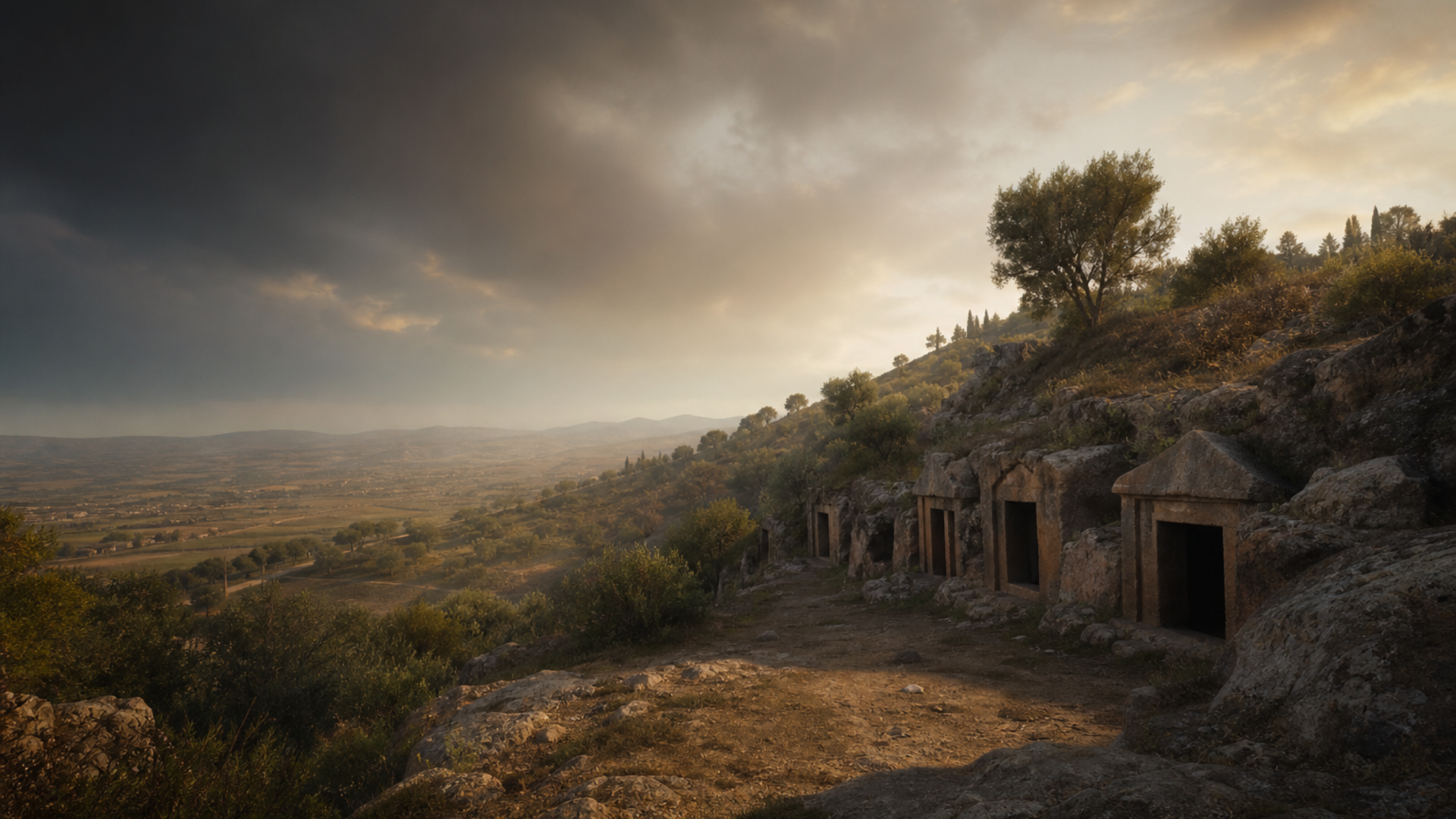
In the low hills and coastal plains of Grosseto—at Vetulonia, Marsiliana d'Albegna, Magliano and the Casenovole necropoleis—archaeology records a dramatic Iron Age urbanizing pulse. From the late 9th–8th centuries BCE Villanovan traditions give way to the monumental cemeteries and richly furnished tombs associated with the Etruscan city-states. Material culture—bronze work, imported ceramics, monumental stone tumuli—speaks of local craftsmen linked to Mediterranean trade networks and of social hierarchies crystallizing in stone and grave goods.

Genetic data from 25 dated individuals (806–56 BCE) sampled in Grosseto offer a complementary lens. Maternal lineages are dominated by haplogroups common across Europe (notably H and J), which archaeological context suggests may reflect long-standing local populations augmented by maritime contact and mobility. Archaeological data indicates regular exchange with the Aegean and central Mediterranean; the mitochondrial signatures preserved in these burials are consistent with a region shaped by continuity and connection rather than wholesale population replacement.

Limited evidence suggests the Etruscan phenomenon in Grosseto was both deeply local—rooted in pre-Iron Age communities—and dynamically entangled with wider Mediterranean currents. Where DNA and objects intersect, they reveal a story of rootedness braided with movement, but the precise demographic mechanisms remain modestly constrained by sample size and the types of genetic markers available.

  • Emergence in Grosseto follows Villanovan traditions (9th–8th c. BCE).
  • Major sites: Vetulonia, Marsiliana d'Albegna, Magliano, Casenovole.
  • Material culture shows local continuity with Mediterranean contacts.
Chapter IV

Daily Life & Society

The landscape of Grosseto in the Iron Age was a tapestry of hilltop settlements, clustered farmsteads and funerary landscapes. Tomb chambers at Vetulonia and Marsiliana often contained carved stone, bronze fibulae, painted pottery and luxury imports—objects that dramatize status, craft specialization and long-distance exchange. Urban centers organized agricultural hinterlands and mediated trade in salt, metals and ceramics along coastal and riverine routes.

Everyday life would have revolved around mixed farming, metalworking and textile production, while ritual life centered on funerary display: tomb architecture and grave assemblages were public performance as much as private remembrance. Archaeological data indicates complex social differentiation—elite tombs appear alongside modest burials—yet material wealth does not map simply to genetic difference. Where ancient DNA can be integrated with burial context, it sometimes highlights kin-based tomb groups, but in Grosseto the available genetic sample set is moderate and does not yet resolve household structures.

Isotopic and osteological studies done elsewhere in Etruria point to individual mobility—for merchants, artisans and brides—so we can imagine Grosseto as a place of rooted households and arriving travelers, where identity was negotiated through objects, language, and kin networks.

  • Tombs and grave goods indicate craft specialization and social ranks.
  • Funerary display coexisted with everyday agrarian and artisan economies.
Chapter V

Genetic Profile

The genetic dataset from Grosseto comprises 25 individuals dated between 806 and 56 BCE. Maternal haplogroups are led by H (aggregate of H, H45, H1 ≈ 8 samples), followed by J (5) and T2b (2). These mitochondrial lineages are common in Bronze and Iron Age Europe and the central Mediterranean; their presence in Grosseto suggests continuity of maternal ancestry with broader Italian populations and does not by itself specify a single geographic origin.

Notably, Y-DNA haplogroups are not reported for these samples in the provided dataset, so paternal-lineage patterns and male-mediated mobility remain unresolved here. Autosomal context—critical for understanding admixture and ancestry proportions—is not fully represented in the summary data. Other ancient-DNA research on Etruscan and Italic contexts has generally found substantial genetic continuity with preceding Bronze Age inhabitants of Italy, with varying degrees of Mediterranean and steppe-derived ancestry in different regions. Whether the Grosseto individuals reflect that exact pattern requires genome-wide and Y-chromosome data for confirmation.

Because the sample set is moderate and spatially focused, conclusions must remain cautious. Maternal haplogroup frequencies align Grosseto with common Iron Age Mediterranean signatures, implying local continuity punctuated by connections to wider trade and mobility networks. Future analyses combining autosomal DNA, Y-chromosome results and isotopic evidence will sharpen reconstructions of kinship, migration and cultural exchange.

  • 25 samples (806–56 BCE) show dominant mtDNA H and J lineages.
  • Y-DNA not reported here; autosomal analyses needed for admixture insights.

Chapter VI

Legacy & Modern Connections

The material and genetic echoes of the Grosseto Etruscans continue to shape Tuscany's cultural landscape. Cities such as Vetulonia, once luminous in the Iron Age, leave place-names, monumental remains and ceramic traditions that fed into Roman Italy. On a biological level, maternal lineages like H and J persist in modern Italian populations, suggesting partial continuity of maternal ancestry through millennia, though demographic events since antiquity have layered additional complexity.

For contemporary descendants and researchers using ancestry platforms, these Grosseto samples offer a tangible bridge to Etruscan lifeways—burials, artisanry and the rhythm of coastal trade. Yet it is important to frame such connections carefully: shared maternal haplogroups indicate affinity but not identity, and modern regional genomes are palimpsests of many migrations. Continued collaboration between archaeologists, geneticists and local historians will refine how these ancient voices are heard in the present.

  • Material culture and place continuity link Grosseto to the broader Etruscan world.
  • Maternal lineages show persistence into the present but do not equal direct ancestry claims.
AI 电源

AI 助手

就 Grosseto Etruscans: Voices from Tuscan Tombs 文化提问

AI 助手 由DNAGENICS公司制作

解锁此特性
Ask questions about the Grosseto Etruscans: Voices from Tuscan Tombs culture. Our AI assistant can explain genetic findings, historical context, archaeological evidence, and modern connections.
AI 样本分析

Grosseto Etruscans: Voices from Tuscan Tombs 文化是人类历史中值得了解的一章……

遗传分析揭示了与早期种群的联系,同时显示了独特的适应和文化创新的证据。 古代DNA样本提供了对迁徙模式、社会结构以及古代种群之间的生物关系的深刻见解。

这是人工智能分析的预览。 解锁全AI 助手, 以探索关于:

  • 遗传组成和祖先
  • 移徙模式和起源
  • 日常生活和文化习俗
  • 现代遗传遗产

探索更古老的文化

揭开古代世界文明的故事

使用优惠码 可减免 35% • 11月12日 到期




