Guanche of the Canary Islands

下载的 PDF 是图像副本。如需可选中文本及更好的辅助技术支持,请使用打印功能。

Guanche of the Canary Islands

揭开一个失落的文明

正在加载考古记录……

正在收集古代记录

跳转到主内容
Guanche of the Canary Islands
文明焦点

Guanche of the Canary Islands

Island-born peoples whose stone sanctuaries and ancient DNA trace North African and Atlantic ties

1031 BCE - 1500 CE
Canary Islands (Tenerife, Gran Canaria)
滚动开始
Chapter I

剧情

了解 Guanche of the Canary Islands 文化

The Guanche were the indigenous inhabitants of the Canary Islands (c. 1031 BCE–1500 CE). Archaeology from Gran Canaria and Tenerife and DNA from 46 individuals reveal primarily North African affinities with some maternal sub‑Saharan and European signals, illuminating island lifeways and migrations.

Time Period

1031 BCE – 1500 CE

Region

Canary Islands (Tenerife, Gran Canaria)

Common Y-DNA

E (observed in 5 samples)

Common mtDNA

L (2), H2a (2), T (2), U (2)

Chapter II

时间线

这种文化历史上的关键时刻

1031 BCE

Earliest dated island occupations (archaeological)

Archaeological contexts and calibrated dates mark human presence on Canary Islands by c. 1031 BCE, initiating island adaptations and local cultural trajectories.

Chapter III

Origins & Emergence

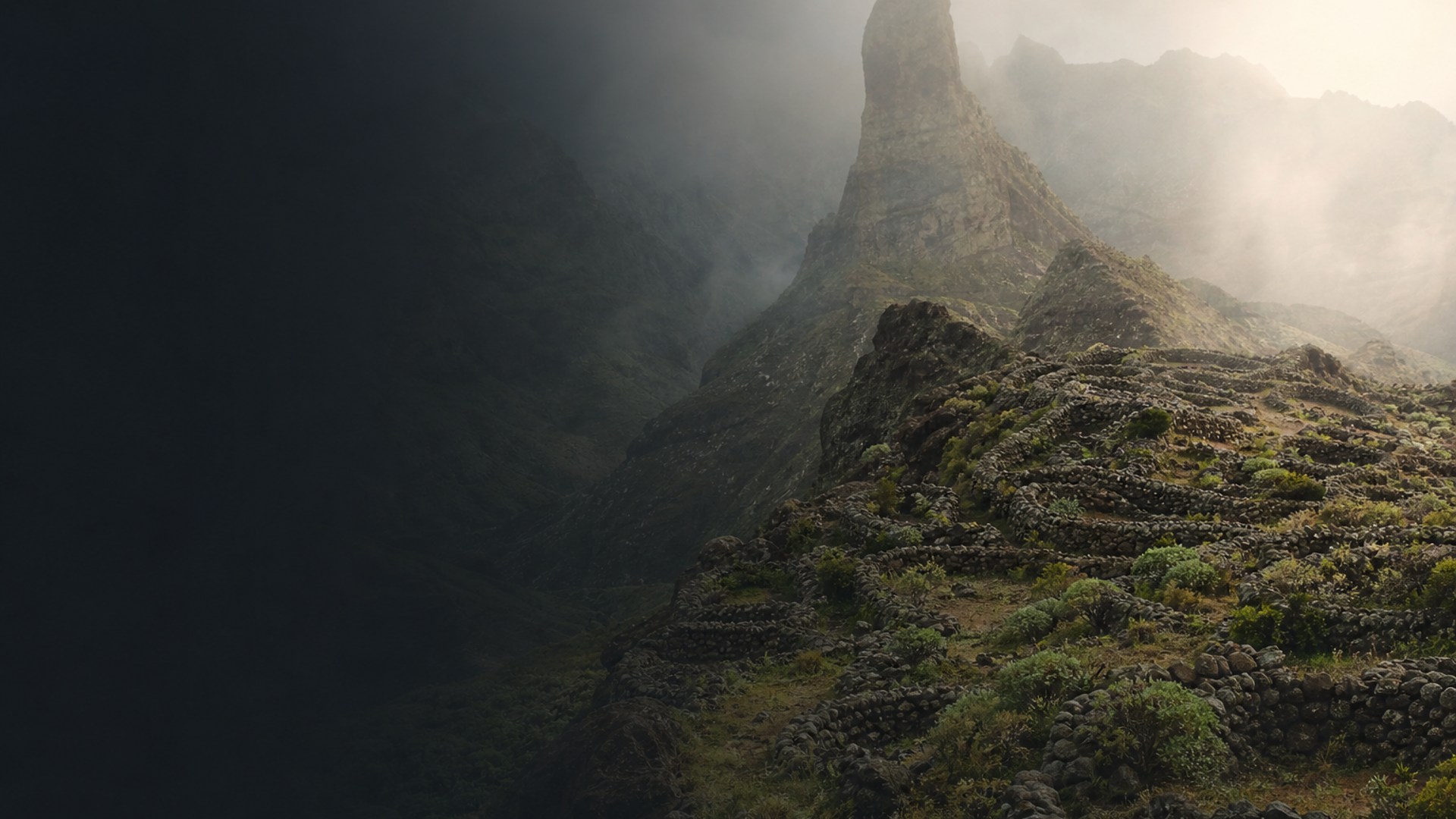
The story of the Guanche begins like a slow tide: people crossing the Atlantic fringe from North Africa and settling volcanic islands whose cliffs and caves became repositories of memory. Archaeological evidence on Tenerife and Gran Canaria — including cave occupations, rock-cut funerary chambers and dry-stone architecture at sites associated with Risco Caído (Gran Canaria) and cave systems such as Cueva del Viento (Tenerife) — indicates island colonization during the first millennium BCE, consistent with calibrated radiocarbon dates in the input range (earliest ~1031 BCE).

Material culture is characterized by simple pastoral and agricultural adaptations to island environments: pottery fragments, stone tools, terraced fields, and elaborate burial constructions carved into rock. These features point to small, mobile kin groups adapting North African traditions to Atlantic islands. Limited evidence suggests staggered settlement pulses rather than a single colonizing wave; island-to-island interaction and local innovation generated distinct island cultures within the broader Guanche identity.

Archaeological data indicates continuity in ritual landscapes — burial caves, mountain sanctuaries, and talayotic-like structures — but also change over time as new resources and external contacts influenced practices. Where preservation is uneven, interpretations remain provisional and benefit from integration with ancient DNA to clarify population origins and movement.

  • Early settlements visible in cave sites on Tenerife and Gran Canaria
  • Material culture blends North African pastoral traits with island innovations
  • Settlement likely involved multiple arrivals and local diversification
Chapter IV

Daily Life & Society

Life for the Guanche was shaped by the sea and the mountain. Archaeological contexts reveal a mixed economy: animal herding (goats and sheep), small-scale cultivation on terraced slopes, fishing, and the gathering of wild resources. Domestic sites often cluster near sheltered caves or rock shelters where wind and volcanic landscapes provided natural protection.

Social organization appears to have been kin-based and place-centered. Funerary architecture — from individual pit burials to communal cave interments — suggests varied mortuary practices and social differentiation. Rock art, personal ornaments, and grave goods indicate symbolic worlds where ancestry and landscape were deeply entangled. Craft specializations such as weaving and bone tool production are visible in the material record, while the use of caves as both homes and sanctuaries lends a cinematic quality to island ritual life.

Contact with Mediterranean and North African networks was likely intermittent; trade and episodic voyaging may explain the presence of non-local raw materials. By the late medieval period, increasing European contact culminated in profound social upheaval after the 15th-century Castilian conquest, which dramatically altered Guanche lifeways and demographic continuity.

  • Economy centered on herding, small-scale farming, fishing, and gathering
  • Mortuary diversity: individual and communal cave burials reflect social complexity
Chapter V

Genetic Profile

Genetic data from 46 ancient individuals associated with the Guanche span c. 1031 BCE to the threshold of European contact. These samples provide a moderate dataset that allows reasonable inferences about population history while still requiring caution in finer-scale interpretations.

Y-chromosome lineages in this dataset show a presence of haplogroup E (5 instances), a marker commonly associated with North African and Saharan populations. Mitochondrial DNA is diverse: counts include L (2), H2a (2), T (2), and U (2). The presence of haplogroup L on the maternal side indicates episodes of sub‑Saharan maternal ancestry, while H2a, T and U are lineages found across North Africa and Europe, reflecting complex maternal origins.

When combined with archaeological context, the genetic profile supports a model of predominant North African (likely Berber-related) ancestry with additional inputs: maternal lineages point to connections with both North African and sub‑Saharan gene pools, and some European-affiliated mtDNA might reflect later contacts or pre-contact maritime links. Admixture patterns are consistent with island colonization from the Maghreb followed by genetic drift and island-specific developments. Because the dataset, although larger than many island studies, remains regionally limited, some population structure and timing of admixture events remain uncertain and benefit from further sampling across islands and time.

  • 46 samples provide moderate power to infer North African affinity and island-specific drift
  • Y-DNA dominated by E (5); mtDNA includes L indicating sub‑Saharan maternal input
Chapter VI

Legacy & Modern Connections

The Guanche are not only archaeological figures but ancestors traced in the genomes and place names of modern Canary Islanders. Genetic continuity is partial: post‑15th‑century European colonization introduced substantial Iberian ancestry, but ancient DNA shows persistent island lineages surviving in modern populations. Cultural memory is tangible in toponyms, folklore, and archaeological landscapes such as the mountain sanctuaries and cave cemeteries that remain visible today.

Museums, protected sites like Risco Caído, and ongoing aDNA projects continue to illuminate how islands mediate human stories of migration, adaptation, and resilience. Scientific synthesis of archaeology and genetics offers a cinematic but evidence-based portrait: island societies rooted in North African origins, shaped by the Atlantic environment, and transformed by historic encounters.

  • Partial genetic continuity with modern Canary Islanders alongside Iberian admixture
  • Archaeological sites remain living landmarks of Guanche cultural memory
AI 电源

AI 助手

就 Guanche of the Canary Islands 文化提问

AI 助手 由DNAGENICS公司制作

解锁此特性
Ask questions about the Guanche of the Canary Islands culture. Our AI assistant can explain genetic findings, historical context, archaeological evidence, and modern connections.
AI 样本分析

Guanche of the Canary Islands 文化是人类历史中值得了解的一章……

遗传分析揭示了与早期种群的联系,同时显示了独特的适应和文化创新的证据。 古代DNA样本提供了对迁徙模式、社会结构以及古代种群之间的生物关系的深刻见解。

这是人工智能分析的预览。 解锁全AI 助手, 以探索关于:

  • 遗传组成和祖先
  • 移徙模式和起源
  • 日常生活和文化习俗
  • 现代遗传遗产

探索更古老的文化

揭开古代世界文明的故事

使用优惠码 可减免 35% • 11月12日 到期




