Kaspan Saka: Mounds of the Almaty Steppe

下载的 PDF 是图像副本。如需可选中文本及更好的辅助技术支持,请使用打印功能。

Kaspan Saka: Mounds of the Almaty Steppe

揭开一个失落的文明

正在加载考古记录……

正在收集古代记录

跳转到主内容
Kaspan Saka: Mounds of the Almaty Steppe
文明焦点

Kaspan Saka: Mounds of the Almaty Steppe

Four Iron Age Saka burials from Kaspan Valley linking archaeology and early steppe DNA

1499 BCE - 72 CE
Kaspan Valley, Almaty Region, Kazakhstan
滚动开始
Chapter I

剧情

了解 Kaspan Saka: Mounds of the Almaty Steppe 文化

Archaeological and genetic data from four Saka-era burials in Kaspan Valley (Almaty Region, Kazakhstan) suggest a mixed steppe heritage. Limited samples hint at western and eastern Eurasian ancestry within a pastoral, horse-centered culture. Conclusions remain preliminary.

Time Period

1499 BCE – 72 CE

Region

Kaspan Valley, Almaty Region, Kazakhstan

Common Y-DNA

R (2), Q (1)

Common mtDNA

G (1), I1b (1)

Chapter II

时间线

这种文化历史上的关键时刻

800 BCE

Emergence of Saka pastoral communities

Archaeological horizons show the consolidation of mobile, horse-centered Saka groups across the Eurasian steppe, forming the context for Kaspan Valley burials.

Chapter III

Origins & Emergence

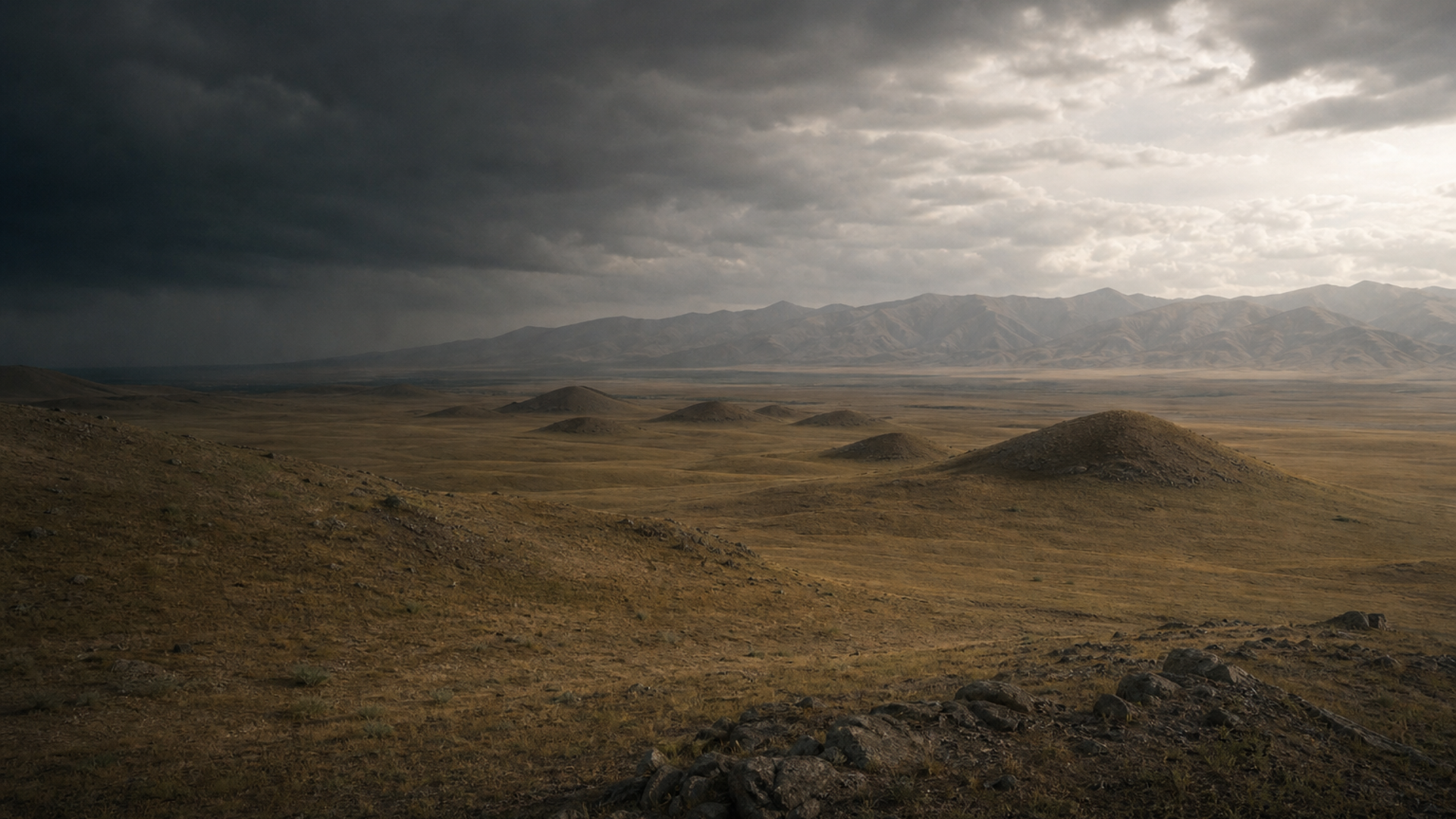
The Kaspan burials sit within the sweeping narrative of Iron Age nomads who animated the Central Asian steppe with mounted pastoralism and richly decorated metalwork. Archaeological data indicates a Saka cultural horizon across what is now eastern Kazakhstan from the first millennium BCE. The three excavated mounds at Kaspan-2 (mound 3) and Kaspan-6 (mounds 1 and 4) are local expressions of the broader kurgan tradition — earthen or stone mounds marking elite graves and community memory.

Material traces across the steppe — horse equipment, patterned gold, and textile imprints — often accompany Saka burials elsewhere and suggest a mobile economy based on horses and herds, tied by seasonal rounds to river valleys. In Kaspan Valley, the funerary architecture points toward these pastoral lifeways, though site-scale publication remains limited.

From a genetic perspective, the dated span associated with the Kaspan samples (1499 BCE–72 CE) overlaps long-term processes: the persistence of Bronze Age steppe ancestry and later interactions with eastern Eurasian groups. Limited evidence suggests these Kaspan individuals reflect that blend, but with only four samples the picture is fragmentary. Archaeological interpretation must therefore remain cautious: the mounds are evocative, but they are one small window into a dynamic Iron Age frontier.

  • Sites: Kaspan-2 (mound 3), Kaspan-6 (mounds 1 & 4) in Kaspan Valley
  • Cultural horizon: Iron Age Saka pastoralists across Kazakhstan
  • Evidence limited — only four genomic samples; interpretations are preliminary
Chapter IV

Daily Life & Society

Archaeological data indicates a society organized around mobile herding, horse mastery, and seasonal exploitation of steppe resources. The Kaspan mounds represent ritualized treatment of the dead, often associated elsewhere with attached grave goods that display social rank and long-distance connections — for example, weapons, bridles, and adornments.

Ethnographic analogy and regional archaeology suggest households were semi-nomadic, moving animals between lowland pastures and upland summer grazing. Trade and raiding tied steppe communities into vast exchange networks: metalwork styles and raw materials at many Saka sites show links from the Altai to the Black Sea. The Kaspan Valley, a corridor in the foothills of southeastern Kazakhstan, would have been a seasonal node where mobility met riverine resources.

Osteological remains from such contexts can show wear patterns consistent with horseback riding and repetitive tasks, but the Kaspan skeletal series is small. Archaeological data thus highlights a life of mobility, social differentiation visible in burials, and cultural connectivity — while reminding us that local variation could be great.

  • Economy centered on pastoralism and horse culture
  • Burials likely reflect social differentiation and long-distance contacts
Chapter V

Genetic Profile

Genetic data from four individuals recovered in the Kaspan Valley provide a tantalizing, but tentative, glimpse of Saka-era ancestry. Reported Y-chromosome lineages include R in two individuals and Q in one; mitochondrial haplogroups include G and I1b in at least two individuals. One Kaspan individual lacked a reported Y result in the available summary (likely female or unresolved), and mtDNA was not reported for all samples.

Interpretation: Haplogroup R is commonly associated with West Eurasian and steppe male lineages; Q has strong links to northeastern Eurasian and Siberian populations. On the maternal side, mtDNA G is typically found in eastern Eurasia, while I1b has a distribution more common in western and northern Eurasia. Taken together, these markers are consistent with archaeological expectations for the Saka: a mixture of western steppe ancestry and eastern Eurasian inputs reflecting centuries of contact along east–west corridors.

Uncertainty and sample size: With only four genomes, conclusions are preliminary. The small sample set risks overrepresenting rare lineages or local kin groups rather than population-wide patterns. Further sampling across time, sex, and burial contexts at Kaspan and neighboring valleys is required to robustly model admixture, continuity, and demographic shifts.

  • Y lineages: R (2), Q (1) — suggesting western and northeastern affinities
  • mtDNA: G and I1b — indicating mixed eastern and western maternal inputs
Chapter VI

Legacy & Modern Connections

The Kaspan Saka remain part of a deep network of steppe peoples whose cultural forms — mounted pastoralism, rich burial rites, and decorative metalwork — influenced vast regions from the Altai to the Pontic steppe. Genetically, the mixed markers seen in the Kaspan individuals echo a broader pattern across Central Asia: enduring steppe ancestry layered with east–west admixture over millennia.

For modern populations of Kazakhstan, these burials illustrate one ancestral thread among many. Contemporary Kazakh genetic diversity reflects later migrations and empire-building as well as local continuity; the Kaspan data hint at continuity but are insufficient to draw direct lines to modern groups. As more genomes from the Almaty region and beyond are analyzed, we can better trace which elements of the Saka genetic legacy persist and how cultural traditions were transmitted in a mobile, interconnected landscape.

  • Connects to broader steppe cultural and genetic continuity
  • Current genetic links to modern populations are plausible but not yet proven
AI 电源

AI 助手

就 Kaspan Saka: Mounds of the Almaty Steppe 文化提问

AI 助手 由DNAGENICS公司制作

解锁此特性
Ask questions about the Kaspan Saka: Mounds of the Almaty Steppe culture. Our AI assistant can explain genetic findings, historical context, archaeological evidence, and modern connections.
AI 样本分析

Kaspan Saka: Mounds of the Almaty Steppe 文化是人类历史中值得了解的一章……

遗传分析揭示了与早期种群的联系,同时显示了独特的适应和文化创新的证据。 古代DNA样本提供了对迁徙模式、社会结构以及古代种群之间的生物关系的深刻见解。

这是人工智能分析的预览。 解锁全AI 助手, 以探索关于:

  • 遗传组成和祖先
  • 移徙模式和起源
  • 日常生活和文化习俗
  • 现代遗传遗产

探索更古老的文化

揭开古代世界文明的故事

使用优惠码 可减免 35% • 11月12日 到期