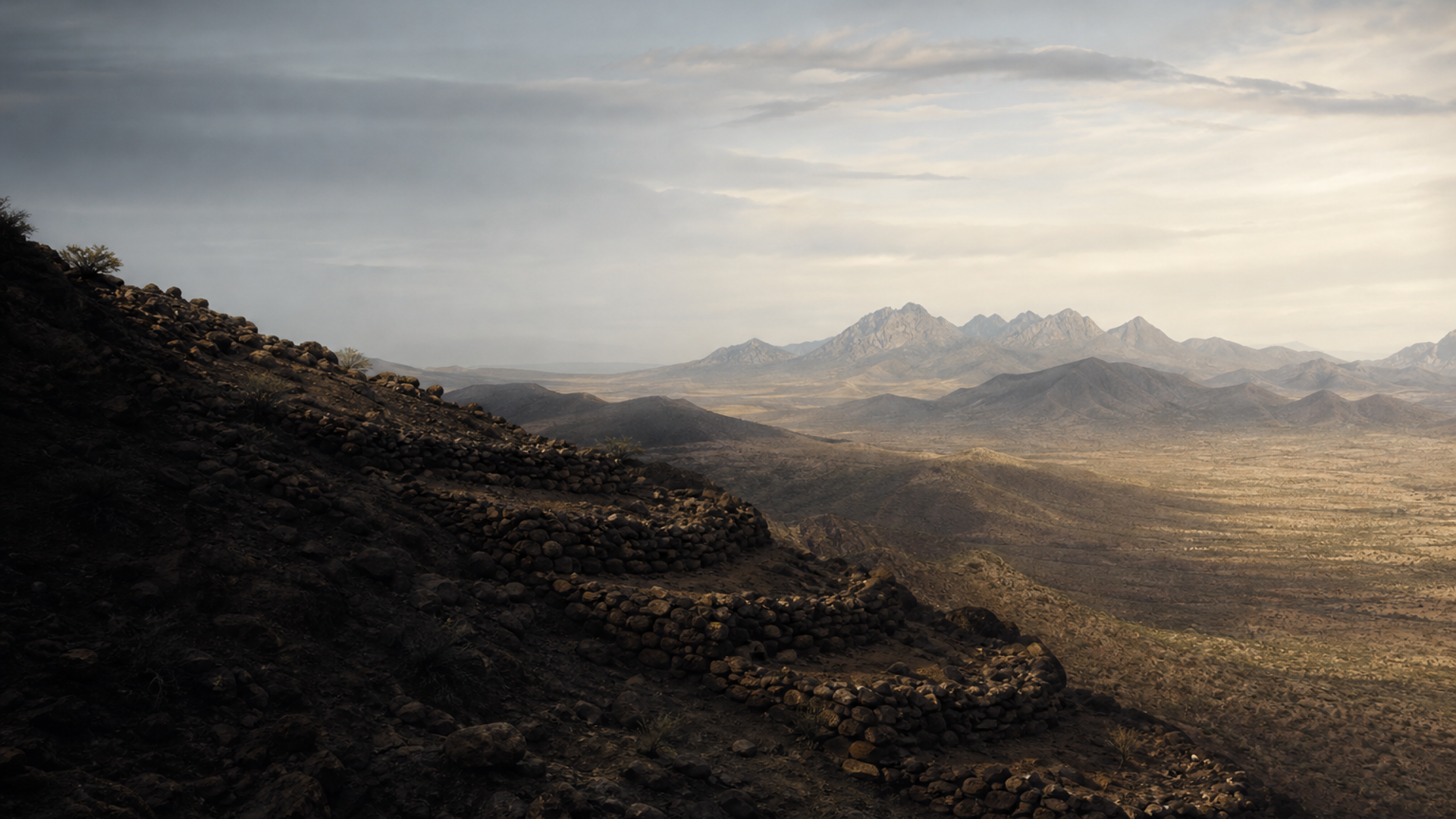
La Playa: Trincheras of Cerro Trincheras

下载的 PDF 是图像副本。如需可选中文本及更好的辅助技术支持,请使用打印功能。

La Playa: Trincheras of Cerro Trincheras

揭开一个失落的文明

正在加载考古记录……

正在收集古代记录

跳转到主内容
La Playa: Trincheras of Cerro Trincheras
文明焦点

La Playa: Trincheras of Cerro Trincheras

Hilltop terraces and ancient DNA reveal Sonoran lifeways, 1200–1450 CE

1200 CE - 1450600 CE
Cerro Trincheras, La Playa — Sonora, Northwest Mexico
滚动开始
Chapter I

剧情

了解 La Playa: Trincheras of Cerro Trincheras 文化

Archaeological and aDNA evidence from seven individuals at La Playa (Cerro Trincheras), Sonora (1200–1450 CE) sheds light on Trincheras hilltop settlement, burial practices, and regional connections. Y-DNA Q predominates; mtDNA shows A2c, B2, C, D and one H. Small sample size makes genetic conclusions preliminary.

Time Period

1200–1450 CE (approx. 600 BP)

Region

Cerro Trincheras, La Playa — Sonora, Northwest Mexico

Common Y-DNA

Q (observed in 5 of 7 samples)

Common mtDNA

C (2), H (1), A2c (1), B2 (1), D (1)

Chapter II

时间线

这种文化历史上的关键时刻

1200 CE

Intensified occupation at La Playa

Terracing and construction at Cerro Trincheras indicate growing settlement activity and landscape modification around 1200 CE.

Chapter III

Origins & Emergence

The terraces and defensive stonework of Cerro Trincheras rise like a carved horizon over the Sonoran desert. Archaeological data indicates that the La Playa complex was intensively occupied between about 1200 and 1450 CE (roughly 600 years before present), a period when hilltop settlements across the Trincheras cultural sphere show investment in terraces, retaining walls, and clustered habitations.

Excavations at named loci — Terraza B2, B4, B7 and B8 — reveal construction episodes and discrete activity areas. Radiocarbon and stratigraphic associations place the primary occupation in the Late Prehispanic era of northwest Mexico. Material remains suggest coordinated construction and landscape modification that required organized labor and knowledge of local soils and water catchment.

Limited evidence suggests participation in regional exchange networks: non-local raw materials and stylistic influences appear in ceramics and ornaments, hinting at connections to coastal and interior groups. However, the full trajectory of emergence and interaction remains incompletely understood; the archaeological record at La Playa is fragmentary and subject to ongoing interpretation.

These terraces are part of the broader Trincheras cultural tradition — an ensemble of hilltop settlements across Sonora and nearby regions — and reflect adaptive strategies in an arid environment where control of cultivated terraces and vantage points carried social and economic significance.

  • Primary occupation dated to 1200–1450 CE at Cerro Trincheras
  • Terracing and stone architecture indicate organized labor and landscape engineering
  • Evidence for regional exchange, but the scope of interactions is uncertain
Chapter IV

Daily Life & Society

Life on the terraces would have unfolded in tight-knit households and communal spaces, with the rhythm of planting, craft, and pilgrimage shaping days beneath an expansive desert sky. Archaeological indicators — domestic features, hearths, and artifact scatters from Terraza B2, B4, B7 and B8 — point to mixed subsistence that likely combined cultivated crops with foraging and hunting adapted to Sonoran microenvironments.

Pottery sherds, ground stone tools and chipped stone debris recovered from surface and stratified deposits speak to food processing, storage and routine manufacture. Ornamental items and modified marine shells found at La Playa imply long-distance exchange or itinerant networks that linked inland terraces to coastal resources. The hilltop position afforded both defensive visibility and social prominence: terraces could mark control of agricultural niches and act as centers for seasonal aggregation.

Interpreting social organization from material remains requires caution. Burial treatment and mortuary placement at La Playa are only partly documented; skeletal samples are limited. Ethnographic analogy and regional comparative studies provide helpful frames, but the daily experience of Trincheras inhabitants must be reconstructed carefully from fragmentary evidence and a modest archaeological record.

  • Terraces supported mixed subsistence: cultivation plus foraging and hunting
  • Artifacts indicate craft production and long-distance exchange, though patterns are still being defined
Chapter V

Genetic Profile

Ancient DNA from seven individuals excavated at La Playa (Cerro Trincheras, Terraza B2, B4, B7, B8) provides a rare molecular window into Trincheras populations between 1200 and 1450 CE. Of these seven, five carry Y-chromosome haplogroup Q, a lineage widely observed among Indigenous American paternal lineages. Mitochondrial diversity in the set includes haplogroups C (2 individuals), A2c (1), B2 (1), D (1) and a single H lineage.

The predominance of Y-DNA Q aligns with broad regional patterns in the Americas and supports continuity of paternal lineages in northwest Mexico. Maternal haplogroups A2, B2, C and D are part of the canonical set of Native American founder lineages; their presence here is consistent with Indigenous maternal ancestry.

The single mtDNA H is unexpected in this context. Its presence is intriguing but must be treated with caution: contamination, post-contact admixture, or hitherto underrecognized maternal diversity are all possible explanations. Crucially, the sample count is small (n=7): with fewer than ten individuals, any population-level inference is preliminary. Archaeogenetic interpretations should be integrated with archaeological context and expanded through larger, ethically conducted sampling to robustly resolve patterns of ancestry, mobility, and admixture.

  • Y-DNA Q observed in 5 of 7 males, consistent with Indigenous American paternal lineages
  • mtDNA shows primarily American founder lineages (A2c, B2, C, D); one H requires cautious interpretation
Chapter VI

Legacy & Modern Connections

The terraces of La Playa resonate in the landscape and in the living memory of Indigenous peoples of Sonora and adjacent regions. Archaeological and genetic data together can illuminate aspects of ancestry and continuity, but must be communicated with humility and in collaboration with descendant communities.

Genetic signals from these seven individuals suggest links to broader Indigenous American lineages rather than simple narratives of replacement or unbroken descent. Ethical stewardship — including consultation, transparent reporting, and respect for local perspectives on remains and heritage — is essential. Further research, with larger sample sizes and community partnership, can strengthen connections between material culture, lifeways, and the genetic threads that tie ancient Trincheras people to present-day populations.

  • Genetic data hint at continuity with Indigenous American lineages but require community-engaged research
  • Responsible interpretation and further sampling are needed to clarify connections to modern descendant groups
AI 电源

AI 助手

就 La Playa: Trincheras of Cerro Trincheras 文化提问

AI 助手 由DNAGENICS公司制作

解锁此特性
Ask questions about the La Playa: Trincheras of Cerro Trincheras culture. Our AI assistant can explain genetic findings, historical context, archaeological evidence, and modern connections.

AI 样本分析

La Playa: Trincheras of Cerro Trincheras 文化是人类历史中值得了解的一章……

遗传分析揭示了与早期种群的联系,同时显示了独特的适应和文化创新的证据。 古代DNA样本提供了对迁徙模式、社会结构以及古代种群之间的生物关系的深刻见解。

这是人工智能分析的预览。 解锁全AI 助手, 以探索关于:

  • 遗传组成和祖先
  • 移徙模式和起源
  • 日常生活和文化习俗
  • 现代遗传遗产

探索更古老的文化

揭开古代世界文明的故事

使用优惠码 可减免 35% • 11月12日 到期