Lchashen: Echoes of the Armenian LBA

下载的 PDF 是图像副本。如需可选中文本及更好的辅助技术支持,请使用打印功能。

Lchashen: Echoes of the Armenian LBA

揭开一个失落的文明

正在加载考古记录……

正在收集古代记录

跳转到主内容
Lchashen: Echoes of the Armenian LBA
文明焦点

Lchashen: Echoes of the Armenian LBA

Burials from 1420–1150 BCE revealing maternal lineages and regional ties

1420 CE - 1150 BCE
Armenia (Lchashen cemetery)
滚动开始
Chapter I

剧情

了解 Lchashen: Echoes of the Armenian LBA 文化

Archaeological and genetic evidence from 13 individuals in the Lchashen cemetery (Armenia) illuminates Late Bronze Age lifeways and maternal ancestry (mtDNA H, N, T2h, W). Findings are suggestive but preliminary for reconstructing population history in the Armenian Highlands.

Time Period

1420–1150 BCE

Region

Armenia (Lchashen cemetery)

Common Y-DNA

Not reported / limited data

Common mtDNA

H (4), N (2), T2h (2), H20 (1), W (1)

Chapter II

时间线

这种文化历史上的关键时刻

1420 BCE

Local Late Bronze Age burials begin

Initial dated burials at Lchashen commence, marking the local Late Bronze Age interval represented in the sampled individuals.

1150 BCE

Terminal Late Bronze Age horizons

By this time Lchashen cemetery use, as represented in the dataset, approaches its later phases within regional LBA transformations.

Chapter III

Origins & Emergence

The Lchashen cemetery sits on the western Armenian Highlands and preserves a sequence of burials dated to the Late Bronze Age, here represented between 1420 and 1150 BCE. Archaeological data indicates that this phase belongs to the broader Armenian LBA horizon: a time of intensified metallurgy, interregional exchange, and locally distinctive funerary practices. Excavations at Lchashen and neighboring sites reveal stratified tombs and assemblages that speak to both continuity with earlier Bronze Age traditions in the Highlands and evolving connections with Anatolian and Caucasus networks.

Material culture from the region—ceramic types, metalwork, and settlement traces—suggests communities engaged in mixed farming, livestock management, and specialized craft production. Trade in raw materials and finished objects likely linked Lchashen to river valleys and highland passes, channels that carried ideas as well as goods. Limited evidence suggests a mosaic of local identities rather than a single, uniform polity: different burial rites and grave assemblages point to social differentiation within the landscape.

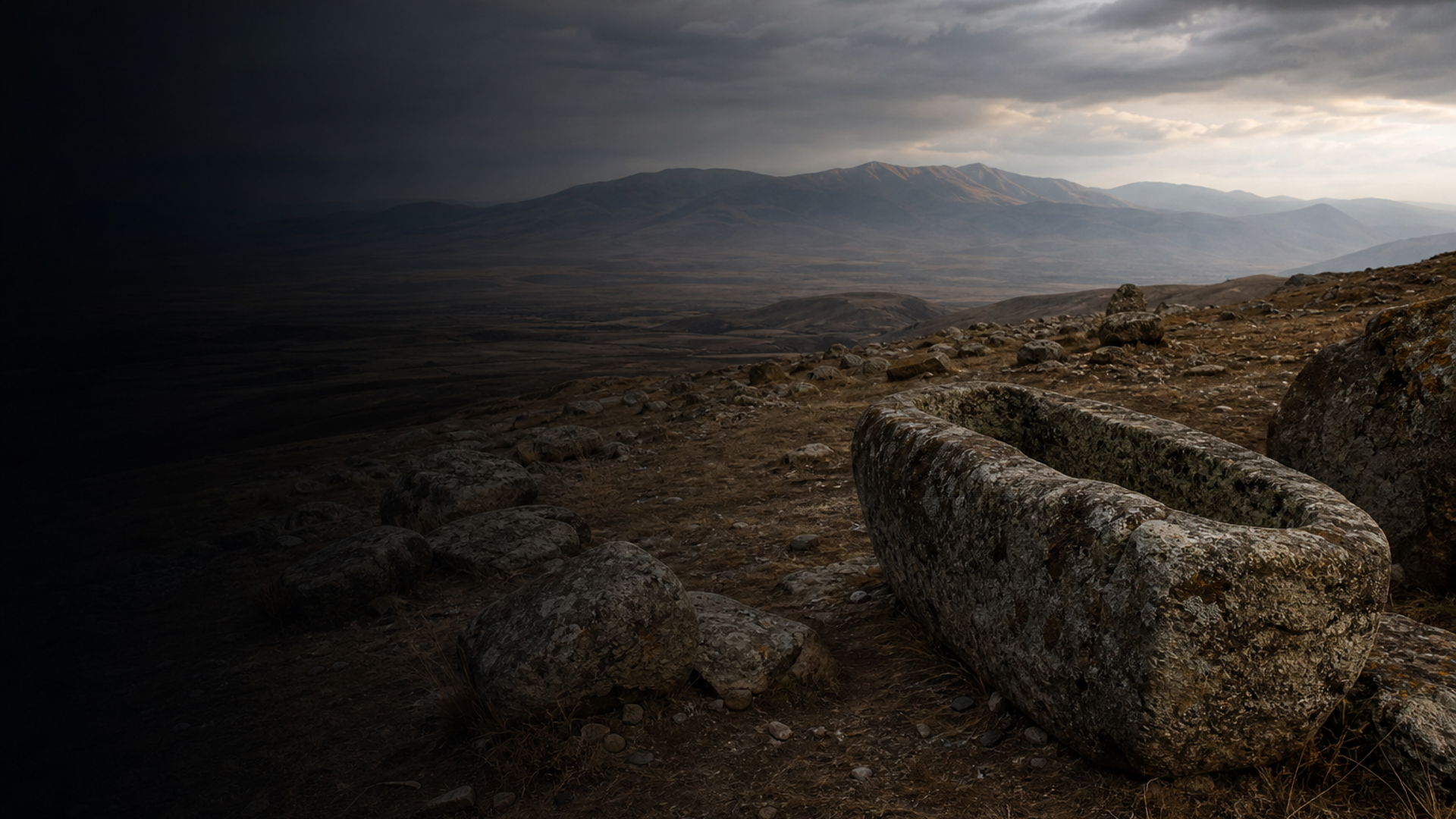
From a landscape perspective, Lchashen occupies a cinematic position between lake and steppe, a node where mountain corridors funnel human movement. Archaeology alone frames the cultural stage; ancient DNA adds voices to the scene, helping to test whether material continuities reflect biological continuity, migration, or a mixture of both.

  • Lchashen cemetery dates: 1420–1150 BCE
  • Armenian Late Bronze Age context with regional exchange
  • Material culture suggests local continuity with broader contacts
Chapter IV

Daily Life & Society

Archaeological evidence paints a picture of communities balancing agriculture, animal herding, and craft specialization. At Lchashen and comparable Armenian LBA localities, household ceramics, metal artifacts, and workshop debris indicate routine domestic activities alongside more specialized production of bronze tools, ornaments, and possibly textiles. Graves in the cemetery often contain personal objects that reflect status, craft affiliation, or life trajectory; while specific inventories vary, the pattern is one of social differentiation rather than strict uniformity.

Settlement patterns in the Armenian Highlands combine sheltered valley sites with highland pastures—economies oriented to seasonal mobility as well as permanent fields. Such mixed economies fostered resilient communities capable of long-distance exchange: raw metals and finished objects moved along mountain routes, and ideas moved with them. Craft specialists, likely itinerant traders, and agricultural households formed an interdependent social fabric.

Age and sex distributions inferred from burial contexts suggest family groups and multi-generational use of cemetery spaces; funerary placement and associated goods imply kin-based neighborhoods and social networks. Ritual behavior—careful interment, the presence of symbolic items—reflects collective memory and identity formation within the landscape.

Taken together, the archaeological record positions Lchashen inhabitants as active participants in Late Bronze Age economies, negotiating local traditions and wider connections across the Caucasus and Anatolia.

  • Mixed farming and animal herding with craft specialization
  • Cemetery use suggests kin groups and social differentiation
Chapter V

Genetic Profile

Thirteen individuals sampled from the Lchashen cemetery yield a maternal snapshot: mtDNA lineages are dominated by haplogroup H (4 individuals), with additional representation of N (2), T2h (2), H20 (1), and W (1). These maternal markers are broadly West Eurasian in distribution and occur today and in ancient populations across the Near East, Anatolia, and Europe. Archaeogenetic data indicates maternal diversity at Lchashen consistent with a population that had long-standing local roots while also partaking in wider regional gene flow.

Crucially, common Y-DNA haplogroups were not reported for this dataset or preservation was insufficient to characterize paternal lineages reliably. The absence of robust Y-chromosome data limits conclusions about male-mediated migration and social patrilocality. Autosomal (genome-wide) analyses would be necessary to quantify ancestry proportions—such as local highland, Anatolian, or Steppe-related input—yet those broader genomic signals are not provided here.

Because the sample count is 13, interpretations must remain cautious: the maternal composition suggests continuity with West Eurasian maternal pools but cannot alone resolve the timing or direction of population movements. Future recovery of additional samples, particularly nuclear DNA and Y-chromosome data, will clarify whether the Lchashen community represents genetic continuity from earlier Bronze Age populations, admixture with incoming groups, or dynamic local interaction over centuries.

  • mtDNA: H (4), N (2), T2h (2), H20 (1), W (1)
  • Y-DNA not reported — conclusions about male lineages are limited
Chapter VI

Legacy & Modern Connections

The maternal haplogroups observed at Lchashen resonate with haplotypes found across the Near East and Europe, suggesting threads of genetic continuity that may extend into later populations of the Armenian Highlands. Archaeogenetic connections like these help frame how modern genetic diversity in Armenia could be the product of long-term local persistence interwoven with episodic contact and migration.

However, caution is essential: 13 samples provide a valuable but limited lens. While mtDNA points to West Eurasian maternal ancestry, it captures only a fraction of population history. Modern Armenian genetic landscapes reflect millennia of interactions that require broader genome-wide sampling to reconstruct robustly. Still, Lchashen offers a cinematic moment—burials and mitochondria together—where archaeology and genetics combine to illuminate the human face of the Late Bronze Age in the Armenian Highlands.

  • Maternal lineages align with broader West Eurasian gene pools
  • Findings are suggestive; broader genome-wide data needed for firm links
AI 电源

AI 助手

就 Lchashen: Echoes of the Armenian LBA 文化提问

AI 助手 由DNAGENICS公司制作

解锁此特性
Ask questions about the Lchashen: Echoes of the Armenian LBA culture. Our AI assistant can explain genetic findings, historical context, archaeological evidence, and modern connections.
AI 样本分析

Lchashen: Echoes of the Armenian LBA 文化是人类历史中值得了解的一章……

遗传分析揭示了与早期种群的联系,同时显示了独特的适应和文化创新的证据。 古代DNA样本提供了对迁徙模式、社会结构以及古代种群之间的生物关系的深刻见解。

这是人工智能分析的预览。 解锁全AI 助手, 以探索关于:

  • 遗传组成和祖先
  • 移徙模式和起源
  • 日常生活和文化习俗
  • 现代遗传遗产

探索更古老的文化

揭开古代世界文明的故事

使用优惠码 可减免 35% • 11月12日 到期