Manda: Swahili Island of Trade

下载的 PDF 是图像副本。如需可选中文本及更好的辅助技术支持,请使用打印功能。

Manda: Swahili Island of Trade

揭开一个失落的文明

正在加载考古记录……

正在收集古代记录

跳转到主内容
Manda: Swahili Island of Trade
文明焦点

Manda: Swahili Island of Trade

Genetic and archaeological echoes of medieval Indian Ocean exchange on Manda Island, Kenya

800 CE - 1700 CE
Manda (Lamu Archipelago), Kenya
滚动开始
Chapter I

剧情

了解 Manda: Swahili Island of Trade 文化

Eight ancient genomes from Manda (800–1700 CE) reveal predominantly African maternal lineages (mtDNA L) and some Southwest Asian-associated Y haplogroups (J, G), reflecting maritime trade, cultural fusion, and limited male-mediated gene flow along the Swahili coast.

Time Period

800–1700 CE

Region

Manda (Lamu Archipelago), Kenya

Common Y-DNA

J (3), G (1) — small sample

Common mtDNA

L (7) — predominantly African maternal lineages

Chapter II

时间线

这种文化历史上的关键时刻

800 CE

Emergence of Manda as a trading node

Archaeological evidence indicates Manda was active in Indian Ocean trade networks from about 800 CE, with imported ceramics and early settlement features.

1000 CE

Medieval expansion

Material culture on Manda diversifies during the medieval period, reflecting intensified trade with Arabia, Persia, India, and East Africa (50 words max).

1600 CE

Shifts under global pressures

By the 16th–17th centuries, changing Indian Ocean dynamics (Portuguese and Omani influence) alter trade patterns and material culture observed archaeologically at Manda.

Chapter III

Origins & Emergence

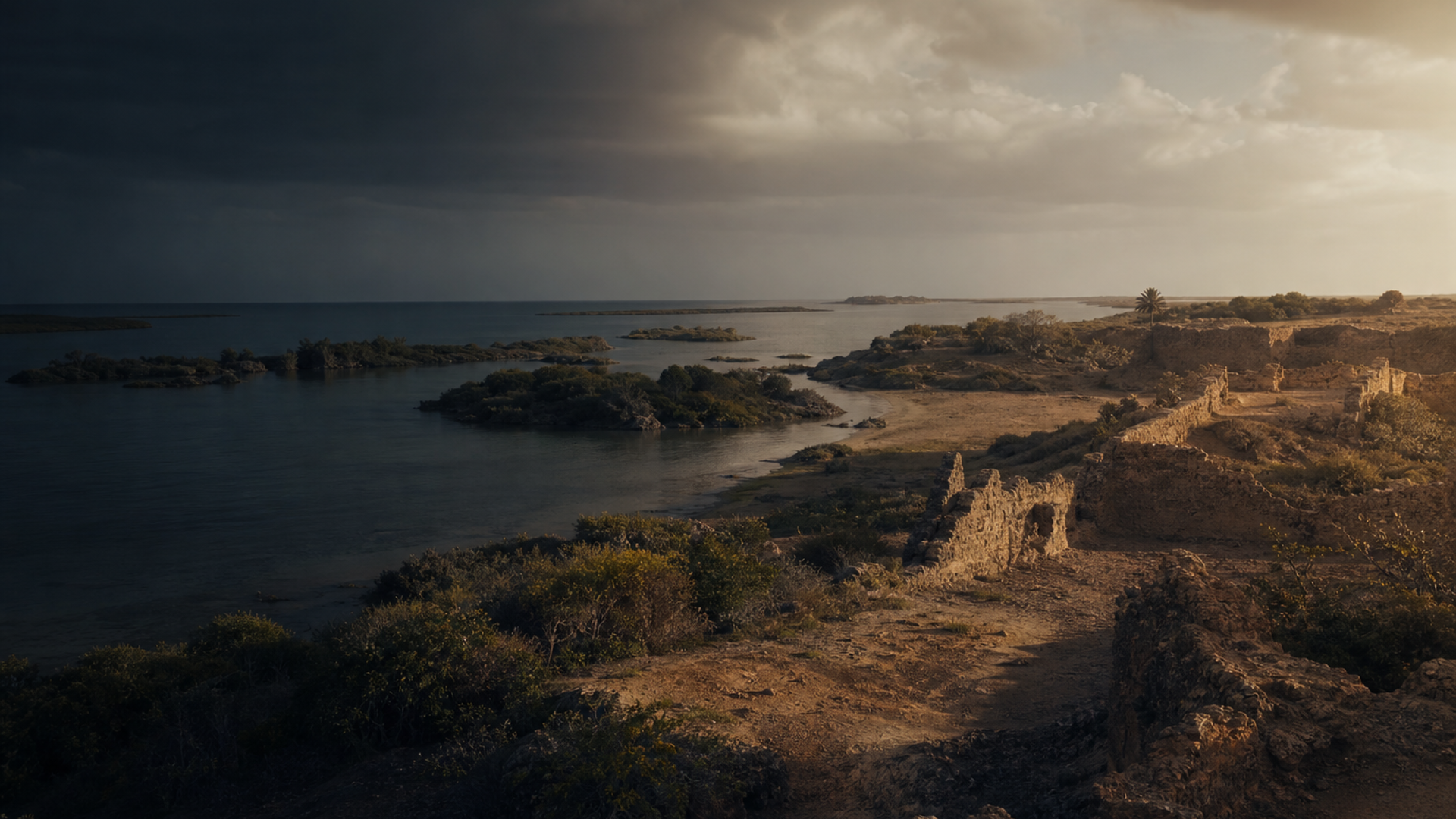
On the wind-swept atoll of Manda, archaeological layers preserve a long, luminous chapter of the Swahili coast. From roughly 800 CE, Manda Island in the Lamu Archipelago became a node in the Indian Ocean’s web of exchange. Excavations at shoreline settlements and inland mounds have revealed coral-built houses, mosques, burial grounds, and a scatter of imported ceramics — Chinese porcelain, Persian sgraffito, and Indian red-slip wares — testifying to early and persistent maritime connections.

Archaeological data indicates the settlement grew through the medieval period (ca. 1000–1500 CE), when trade in ivory, gold, and slaves linked East Africa to Arabia, Persia, India, and beyond. By the 16th–17th centuries, changes in material culture reflect shifts in global trade patterns after Portuguese and later Omani involvement. Limited evidence suggests continuity of local craft and burial practice alongside imported goods, pointing to a social landscape shaped by both local African traditions and sustained foreign contact.

The genetic samples from Manda (n = 8) span this long arc. While archaeological artifacts provide the texture of exchange—beads, ceramics, architecture—the ancient DNA offers a complementary, biological window into who lived, moved, and mixed on this island. Because sample numbers are small, interpretations must remain provisional and integrated with archaeological context.

  • Manda active in Indian Ocean trade from ca. 800 CE
  • Material culture shows African traditions plus imported goods
  • Archaeology and aDNA should be combined cautiously
Chapter IV

Daily Life & Society

Life on Manda would have been shaped by salt breezes, monsoon rhythms, and the steady arrival of ships. Houses of coral rag and lime were clustered around small mosques and communal spaces. Archaeological features — domestic hearths, storage pits, and faunal remains — indicate a mixed economy of fishing, small-scale agriculture, and commerce. Beadwork, imported ceramics, glass, and metal objects would have marked social status and long-distance ties.

Burial practices on Manda reveal a community attentive to both local customs and Islamic rites. Graves with oriented burials, some accompanied by imported grave goods, suggest a society negotiating new religious identities alongside inherited practices. Craft specialization — beadmaking, ironworking, and textile production — likely supported an economy integrated with regional markets.

Ethnically and culturally, the Swahili identity emerged as a creole of African coastal communities and incoming ideas, languages, and people. Archaeological data indicates a porous society in which material and ideological exchange was constant. The genetic evidence (eight individuals) suggests predominantly African maternal ancestry paired with some paternal lineages associated with Southwest Asia, a pattern consistent with historical narratives of male-dominated long-distance trade networks meeting local coastal populations.

  • Coral-built houses, mosques, craft areas documented archaeologically
  • Economy: fishing, agriculture, craft, and long-distance trade
Chapter V

Genetic Profile

The ancient genomic snapshot from Manda (8 samples dated between 800 and 1700 CE) paints a nuanced picture of ancestry on the Swahili coast. Seven of the eight individuals carry mtDNA haplogroups of the L clade, lineages that are common across sub-Saharan Africa and indicative of deep local maternal ancestry. This strong maternal continuity suggests that, across centuries of trade and contact, local African women remained a demographic cornerstone of the island population.

Y-chromosome data show J in three individuals and G in one individual. Haplogroup J is frequently associated with populations of the Near East and Arabia, while G has roots in Caucasus and western Asia. The presence of these Y haplogroups, combined with predominantly African mtDNA, is consistent with scenarios of male-mediated gene flow into coastal communities — for example, traders, sailors, or settlers from Southwest Asia integrating into local societies. Archaeological evidence of foreign goods and Islamic institutions supports this interpretation.

Crucially, the sample size is small (<10). Limited evidence suggests patterns but cannot resolve the timing, number, or social contexts of admixture events. Alternative explanations — such as long-distance mobility of people already admixed elsewhere or complex multi-generational mixing — remain plausible. Future aDNA from larger and temporally stratified samples will sharpen these inferences and help link specific genetic shifts to archaeological horizons.

  • mtDNA overwhelmingly L (7/8): strong local maternal continuity
  • Y-DNA includes J (3) and G (1): suggests some Southwest Asian-associated paternal input
Chapter VI

Legacy & Modern Connections

The story of Manda resonates in the living cultures of the Swahili coast. Linguistic, architectural, and cultural continuity tie present-day coastal communities to their medieval predecessors. The genetic pattern of African maternal lineages with occasional Southwest Asian-associated paternal markers mirrors broader results from modern coastal populations, although modern genomes reflect additional centuries of movement and admixture.

These ancient Manda genomes, though few, help anchor a biological dimension to narratives of trade, faith, and identity. They remind us that the Indian Ocean world was not just a network of goods but of people: sailors, merchants, and families whose unions reshaped gene pools and cultures. Because conclusions are preliminary, integrating archaeology, history, and expanding aDNA datasets will be essential to fully trace how Manda’s past connects to present-day Swahili heritage.

  • Modern Swahili communities reflect blended cultural and genetic histories
  • Small ancient sample sizes mean conclusions remain provisional
AI 电源

AI 助手

就 Manda: Swahili Island of Trade 文化提问

AI 助手 由DNAGENICS公司制作

解锁此特性
Ask questions about the Manda: Swahili Island of Trade culture. Our AI assistant can explain genetic findings, historical context, archaeological evidence, and modern connections.
AI 样本分析

Manda: Swahili Island of Trade 文化是人类历史中值得了解的一章……

遗传分析揭示了与早期种群的联系,同时显示了独特的适应和文化创新的证据。 古代DNA样本提供了对迁徙模式、社会结构以及古代种群之间的生物关系的深刻见解。

这是人工智能分析的预览。 解锁全AI 助手, 以探索关于:

  • 遗传组成和祖先
  • 移徙模式和起源
  • 日常生活和文化习俗
  • 现代遗传遗产

探索更古老的文化

揭开古代世界文明的故事

使用优惠码 可减免 35% • 11月12日 到期




