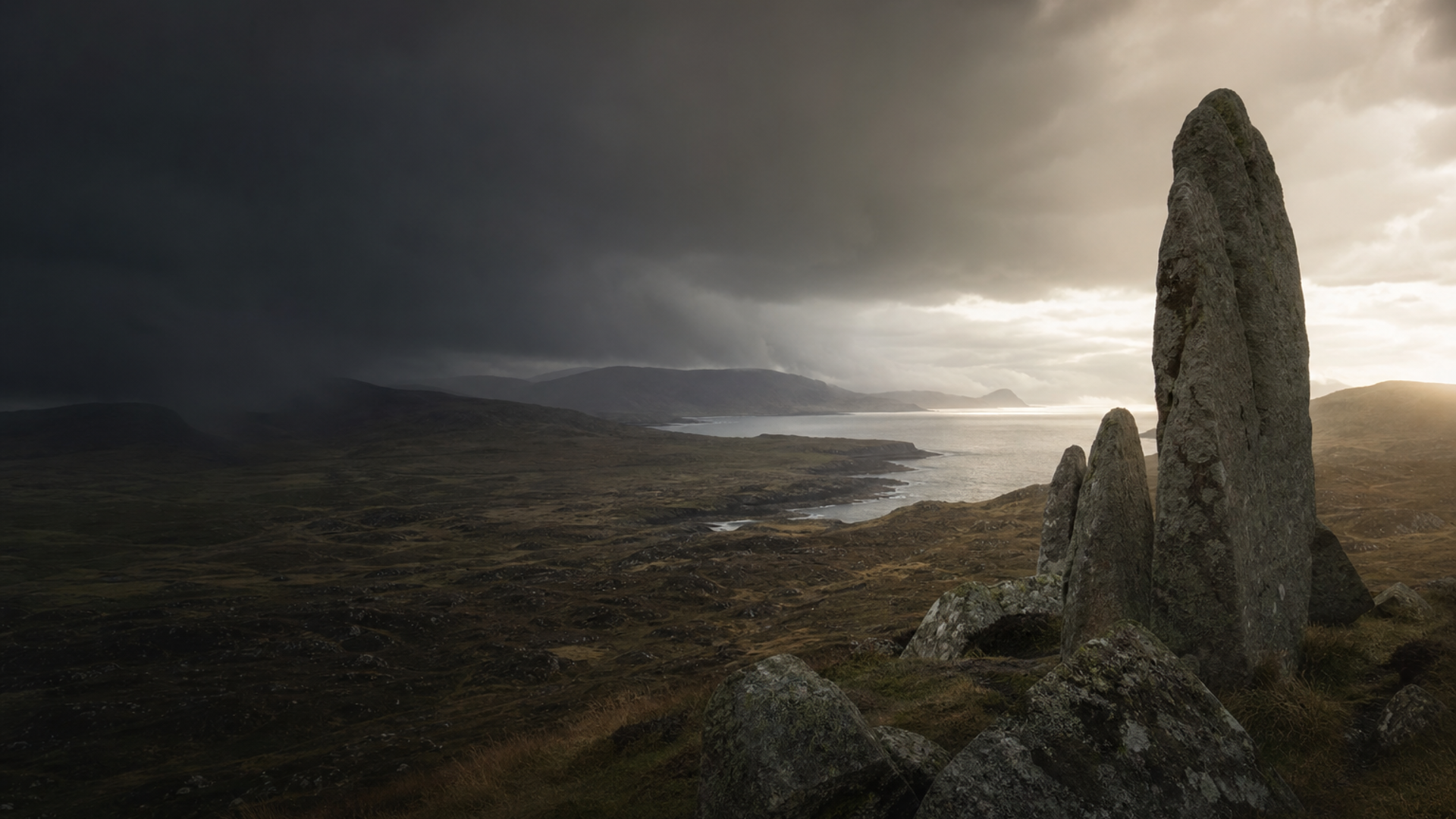
Megalithic Scotland: Orkney to Balintore

下载的 PDF 是图像副本。如需可选中文本及更好的辅助技术支持,请使用打印功能。

Megalithic Scotland: Orkney to Balintore

揭开一个失落的文明

正在加载考古记录……

正在收集古代记录

跳转到主内容
Megalithic Scotland: Orkney to Balintore
文明焦点

Megalithic Scotland: Orkney to Balintore

Stone chambers and faint genetic echoes reveal kin networks in northern Scotland, 3623–3102 BCE

3623 CE - 3102 BCE
Scotland (Ross & Cromarty; Orkney)
滚动开始
Chapter I

剧情

了解 Megalithic Scotland: Orkney to Balintore 文化

Four ancient genomes from Orkney and Ross & Cromarty (3623–3102 BCE) link megalithic monuments to a male lineage dominated by Y-haplogroup I. Archaeological context and DNA suggest local continuity with mixed maternal ancestry, but conclusions remain preliminary.

Time Period

3623–3102 BCE

Region

Scotland (Ross & Cromarty; Orkney)

Common Y-DNA

I (3 of 4 samples)

Common mtDNA

H1, H, K, U (each observed once)

Chapter II

时间线

这种文化历史上的关键时刻

3600 BCE

Active construction and use of chambered cairns

Construction and repeated burial at chambered cairns in Orkney and northern Scotland mark communal memory and territorial claims.

Chapter III

Origins & Emergence

Across windswept promontories and fertile lowlands, the stone architecture of northern Scotland crystallized in the late fourth and early third millennia BCE. Archaeological data indicates activity at chambered cairns and ritual sites in Orkney (Rousay: Midhowe; Knowe of Lairo) and in Ross & Cromarty (Balintore). These monuments anchor a material tradition often grouped as Megalithic Scotland, where monumental burial and ceremonial landscapes express community identities at a grand scale.

Genetically, four dated individuals (3623–3102 BCE) from these locales form a small but suggestive dataset. The predominance of Y-haplogroup I among three male individuals is consistent with patterns seen elsewhere in northern and Atlantic Europe, where certain I-lineages persisted from earlier Mesolithic populations or became regionally entrenched after the Neolithic transition. Maternal lineages observed—H1, H, K, and U—point to a mixture of ancestries: H and K commonly rise with farming communities, while U is frequently associated with local hunter-gatherer ancestry in northern Europe.

Limited evidence suggests this is a picture of local continuity with incoming influences rather than wholesale population replacement. However, with only four samples, any reconstruction of demographic processes is provisional: additional genomes are required to test whether these patterns reflect broader regional demography or family-level patterns tied to particular tombs.

  • Megalithic monuments in Orkney and Ross & Cromarty between 3623–3102 BCE
  • Y-haplogroup I dominates male lineages in this small sample
  • mtDNA diversity (H1, H, K, U) suggests mixed local and incoming maternal ancestries
Chapter IV

Daily Life & Society

The granite light of northern Scotland would have caught on polished stone and bone tools, while communities balanced farming, pasturage, and maritime resources. Archaeological evidence from Orkney chambered cairns and surrounding settlements points to organized labor capable of moving and erecting large stones, long-distance exchange of raw materials, and ritualized burial practices that enshrined ancestral memory.

Social life likely revolved around kin groups tied to specific monuments. Monument construction implies leadership or coordinated working groups, and repeated interment within cairns suggests enduring claims to place. Middens, pottery fragments, lithics, and faunal remains recovered near sites indicate mixed subsistence: cultivated cereals and domesticated animals alongside marine and wild resources. Craft skills—stone-working, bone and antler tools, textile production inferred from impressions—would have been central to daily life and identity.

Archaeological data indicates that tombs like Midhowe functioned not only as repositories for the dead but as communal theaters where lineage, memory, and land rights were enacted. Such practices would interact with marriage, inheritance, and alliance-building, dynamics that also leave signatures in the small set of ancient genomes available for this region.

  • Mixed farming, pastoralism, and strong maritime resource use
  • Monumental construction indicates organized labor and enduring kin claims
Chapter V

Genetic Profile

The genetic dataset for Scotland_Megalithic comprises four individuals dated between 3623 and 3102 BCE from Balintore (Ross & Cromarty) and two Orkney locations (Rousay: Midhowe; Knowe of Lairo). Three of the four males belong to Y-haplogroup I, indicating a pronounced male-line signal in this small sample. Haplogroup I is historically widespread in northern and western Europe and has been associated in some studies with Mesolithic and later Neolithic groups in Atlantic and North Sea regions.

Mitochondrial haplogroups are diverse in this set: H1, H, K, and U each appear once. Haplogroup H and its sublineages are common across later Neolithic and Bronze Age Europe and frequently appear in farming communities; K likewise is often tied to Neolithic expansions. Haplogroup U, particularly U5 and related clades, is often interpreted as a marker of indigenous hunter-gatherer ancestry in Europe. Together, this mix suggests local admixture between resident hunter-gatherer lineages and populations carrying Neolithic maternal signatures.

Crucially, with only four genomes, patterns may reflect local kin groups or tomb-specific burial practices rather than wide-scale demographics. Any inference about population structure, migration, or social organization must therefore remain tentative. Future sampling across more sites and a larger temporal span will be required to test whether the predominance of Y-haplogroup I here represents a regional trend during the megalithic era in northern Scotland.

  • Three of four sampled males carry Y-haplogroup I — suggests male-line continuity or local founder effects
  • mtDNA diversity (H1, H, K, U) indicates admixture of hunter-gatherer and Neolithic maternal ancestries
Chapter VI

Legacy & Modern Connections

The stones of Orkney and northern Scotland continue to shape modern identity and scientific inquiry alike. Archaeologically, these monuments anchor community memory and landscape organization for millennia; genetically, ancient genomes provide windows into the biocultural threads that tied people to place. The prevalence of Y-haplogroup I in this tiny dataset gestures toward long-term male-line continuities that may echo in modern populations, but translating ancient patterns into modern ancestry requires caution.

Contemporary residents of the Scottish isles and mainland may carry fragments of these lineages, yet thousands of years of migration, isolation, and admixture have reshaped genetic landscapes. The present results are evocative: they invite richer sampling and community-engaged research that couples excavation, careful radiocarbon dating, and broader ancient DNA surveys. Such work can illuminate how kinship, monumentality, and mobility wove together to produce the enduring cultural horizons we now call Megalithic Scotland.

  • Stones preserve communal memory; ancient DNA offers new, cautious insights into ancestry
  • Current conclusions are provisional — expanded sampling can reveal population-scale patterns
AI 电源

AI 助手

就 Megalithic Scotland: Orkney to Balintore 文化提问

AI 助手 由DNAGENICS公司制作

解锁此特性
Ask questions about the Megalithic Scotland: Orkney to Balintore culture. Our AI assistant can explain genetic findings, historical context, archaeological evidence, and modern connections.
AI 样本分析

Megalithic Scotland: Orkney to Balintore 文化是人类历史中值得了解的一章……

遗传分析揭示了与早期种群的联系,同时显示了独特的适应和文化创新的证据。 古代DNA样本提供了对迁徙模式、社会结构以及古代种群之间的生物关系的深刻见解。

这是人工智能分析的预览。 解锁全AI 助手, 以探索关于:

  • 遗传组成和祖先
  • 移徙模式和起源
  • 日常生活和文化习俗
  • 现代遗传遗产

探索更古老的文化

揭开古代世界文明的故事

使用优惠码 可减免 35% • 11月12日 到期