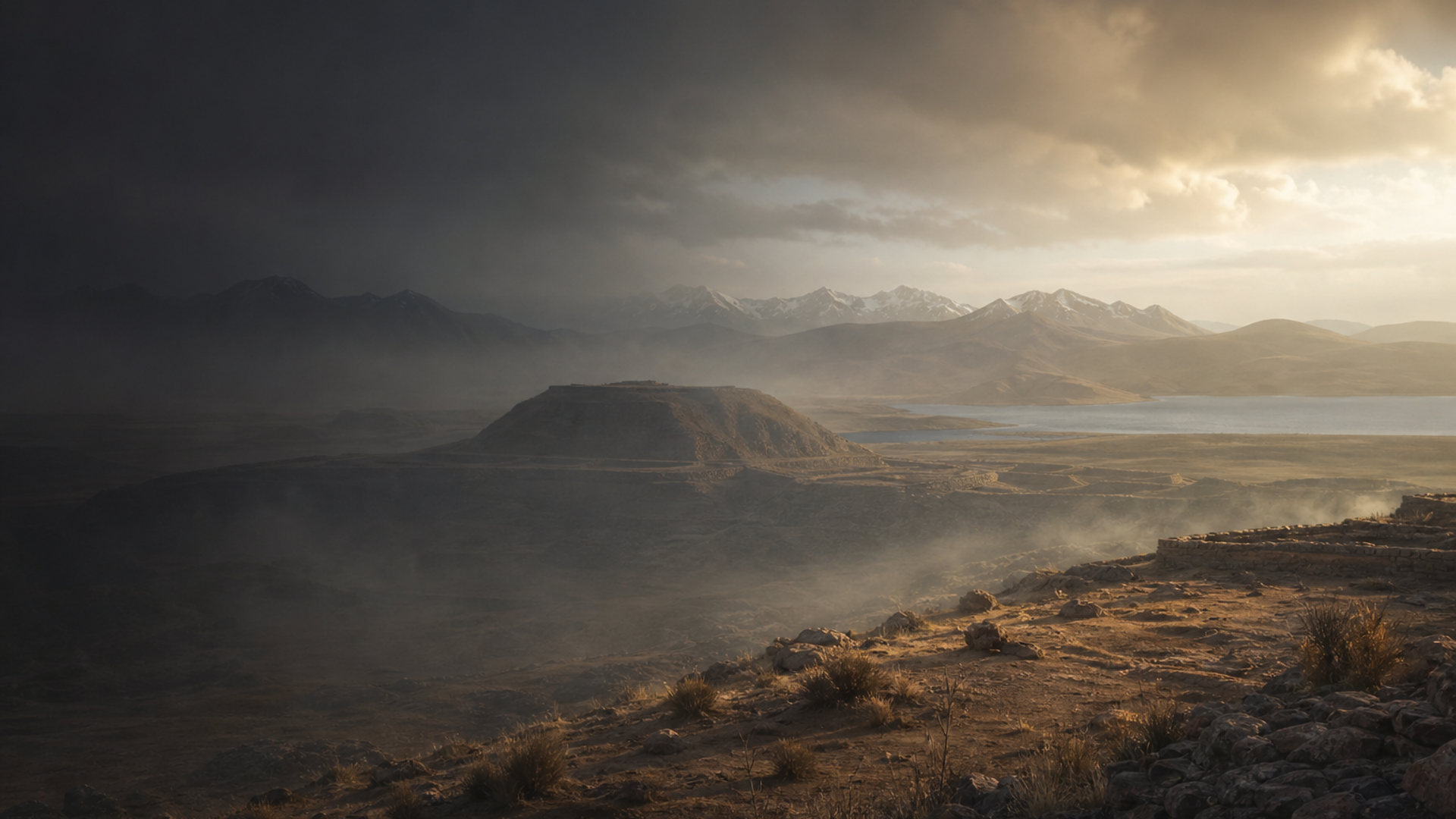
Putuni Tiwanaku — Altiplano Maternal Echo

下载的 PDF 是图像副本。如需可选中文本及更好的辅助技术支持,请使用打印功能。

Putuni Tiwanaku — Altiplano Maternal Echo

揭开一个失落的文明

正在加载考古记录……

正在收集古代记录

跳转到主内容
Putuni Tiwanaku — Altiplano Maternal Echo
文明焦点

Putuni Tiwanaku — Altiplano Maternal Echo

A single ancient genome from Putuni offers a cautious window into Tiwanaku-era life on the Lake Titicaca altiplano.

675 CE - 831 CE
Putuni, Lake Titicaca basin, Bolivia
滚动开始
Chapter I

剧情

了解 Putuni Tiwanaku — Altiplano Maternal Echo 文化

Genomic and archaeological data from a single Putuni (Bolivia) burial dated 675–831 CE link a Tiwanaku-era individual to Indigenous South American maternal lineages (mtDNA C1c). Limited evidence highlights continuity in the Lake Titicaca basin while emphasizing the need for more samples.

Time Period

675–831 CE

Region

Putuni, Lake Titicaca basin, Bolivia

Common Y-DNA

No data / not reported

Common mtDNA

C1c (1 sample)

Chapter II

时间线

这种文化历史上的关键时刻

500 CE

Tiwanaku cultural expansion

Ceremonial core near Lake Titicaca grows as a regional integrative center, influencing surrounding communities.

675 CE

Putuni individual dated

Burial from Putuni later yielding mtDNA C1c is radiometrically dated within this interval (675–831 CE).

1000 CE

Regional transformations

Tiwanaku political and settlement networks undergo major restructuring across the basin.

Chapter III

Origins & Emergence

Beneath the thin air of the altiplano, stone and earth mark centuries of human endeavor. Archaeological data indicates that the Tiwanaku cultural sphere — centered on the monumental city of Tiwanaku near modern-day Lake Titicaca — expanded across the southern basin from roughly 500 CE onward. Putuni, a locality within this broader landscape in present-day La Paz department, yields material traces that align with Tiwanaku craft traditions: polished stonework, fine-capacitated ceramics and ritual deposits visible in household and public contexts.

The single ancient sample from Putuni is dated to between 675 and 831 CE, placing it within the Middle-to-Late Tiwanaku horizon when regional integration and long-distance exchange intensified. Limited evidence suggests Putuni participated in the economic and ritual networks that radiated from the Tiwanaku civic-ceremonial core, though the scale and nature of its ties remain under study. Archaeologists emphasize stratigraphic context and associated artifacts to situate human remains within local chronologies, but preservation varies widely across sites on the altiplano. As with many highland loci, the picture of emergence at Putuni is pieced together from architecture, ceramics, earthworks, and now a nascent body of ancient DNA.

  • Putuni sample dated 675–831 CE within Tiwanaku horizon
  • Material culture at Putuni aligns with Tiwanaku practices
  • Evidence of regional integration but local variation persists
Chapter IV

Daily Life & Society

The windswept altiplano shaped daily life: resilient crops, camelid herding, and craft specialization adapted to high-elevation realities. Archaeological remains from Tiwanaku contexts show elaborate agricultural engineering — raised fields (suka kollus) and drainage systems — that increased food security and supported population concentrations around the lake. At Putuni, household assemblages and funerary deposits suggest a mix of domestic production and ritualized practice, though extensive excavations are limited.

Material culture points to skilled textile production, ceramic varieties used for storage and feasting, and stone toolkits suited to pastoral and agricultural tasks. Faunal remains elsewhere in the region emphasize llamas and alpacas as both transport and subsistence animals. Social life likely combined household-level economies with participation in broader ceremonial cycles centered at Tiwanaku city. Yet archaeological data indicates local differentiation: not every community mirrored the civic grandeur of the metropolis. Preservation biases and limited sampling at Putuni mean reconstructions of daily life remain provisional and benefit from integrated archaeobotanical, zooarchaeological, and isotopic studies.

  • Agricultural engineering (raised fields) sustained dense populations
  • Textiles, ceramics, and camelid economy evident; local variation common
Chapter V

Genetic Profile

The genetic evidence from Putuni is slender but evocative: one individual yielded mitochondrial haplogroup C1c, a lineage widely distributed among Indigenous populations of South America. mtDNA traces maternal ancestry and its presence at Putuni aligns with expectations for Andean maternal lineages during the first millennium CE. Crucially, no Y‑chromosome haplogroup is reported for this sample, and nuclear-genome data (which could reveal admixture, kinship, or high-altitude adaptations) are either absent or not published alongside the mitochondrial result.

Because the sample count is one, conclusions must be cautious. Limited evidence suggests maternal continuity in the Lake Titicaca basin, but a single mtDNA match cannot quantify population structure, migration, or social practices such as patrilocality or matrilocality. Comparative ancient and modern datasets from the Andes show regional genetic continuity punctuated by episodes of mobility and gene flow; the Putuni mtDNA fits within this broader pattern but does not resolve it. Future sampling of multiple individuals, combined nuclear data, and close archaeological context at Putuni will be required to move from suggestive signal to robust demographic inference.

  • mtDNA C1c indicates Indigenous South American maternal ancestry
  • One sample only — findings are preliminary and not population-representative
Chapter VI

Legacy & Modern Connections

The legacy of Tiwanaku-era communities like those around Putuni echoes in the living cultures of the Andean highlands. Linguistic, cultural, and genomic threads hint at deep connections between past and present, but scientific rigor requires humility: while mtDNA C1c at Putuni resonates with modern Indigenous diversity, it is not proof of direct, uninterrupted lineage for any particular group.

Archaeology coupled with ancient DNA opens cinematic vistas onto human stories: seasonal labor, ritual journeys across the lake, and the resilient know-how of highland farmers. Ethical collaboration with descendant communities, increased sampling, and multidisciplinary analyses will refine how genetic signals are read alongside material traces. Until then, Putuni offers a careful reminder — a single voice from stone and bone that invites deeper listening rather than definitive claims.

  • C1c links Putuni to broader Andean maternal diversity
  • Further sampling and community collaboration needed to clarify continuity
AI 电源

AI 助手

就 Putuni Tiwanaku — Altiplano Maternal Echo 文化提问

AI 助手 由DNAGENICS公司制作

解锁此特性
Ask questions about the Putuni Tiwanaku — Altiplano Maternal Echo culture. Our AI assistant can explain genetic findings, historical context, archaeological evidence, and modern connections.
AI 样本分析

Putuni Tiwanaku — Altiplano Maternal Echo 文化是人类历史中值得了解的一章……

遗传分析揭示了与早期种群的联系,同时显示了独特的适应和文化创新的证据。 古代DNA样本提供了对迁徙模式、社会结构以及古代种群之间的生物关系的深刻见解。

这是人工智能分析的预览。 解锁全AI 助手, 以探索关于:

  • 遗传组成和祖先
  • 移徙模式和起源
  • 日常生活和文化习俗
  • 现代遗传遗产

探索更古老的文化

揭开古代世界文明的故事

使用优惠码 可减免 35% • 11月12日 到期