Roopkund A: Himalayan Burial Assemblage

下载的 PDF 是图像副本。如需可选中文本及更好的辅助技术支持,请使用打印功能。

Roopkund A: Himalayan Burial Assemblage

揭开一个失落的文明

正在加载考古记录……

正在收集古代记录

跳转到主内容
Roopkund A: Himalayan Burial Assemblage
文明焦点

Roopkund A: Himalayan Burial Assemblage

Medieval skeletons at Roopkund reveal a surprising mix of South and West Eurasian ancestries.

674 CE - 993 CE
Uttaranchal (Uttarakhand), Himalaya, India
滚动开始
Chapter I

剧情

了解 Roopkund A: Himalayan Burial Assemblage 文化

Roopkund A (674–993 CE) comprises 23 medieval individuals from Roopkund lake, Uttarakhand, India. Archaeology and ancient DNA show mixed maternal and paternal lineages—regional South Asian mtDNA alongside West Eurasian signals—offering a vivid, though still provisional, glimpse of medieval Himalayan mobility.

Time Period

674–993 CE

Region

Uttaranchal (Uttarakhand), Himalaya, India

Common Y-DNA

R (5), H (4), J (3), E (1)

Common mtDNA

M (8), U (5), M30 (1), HV (1), M3 (1)

Chapter II

时间线

这种文化历史上的关键时刻

800 CE

Roopkund A burials (radiocarbon cluster)

A radiocarbon cluster between 674–993 CE identifies 23 individuals (Roopkund A) at Roopkund lake, indicating a medieval episode of deaths or burials at high altitude.

Chapter III

Origins & Emergence

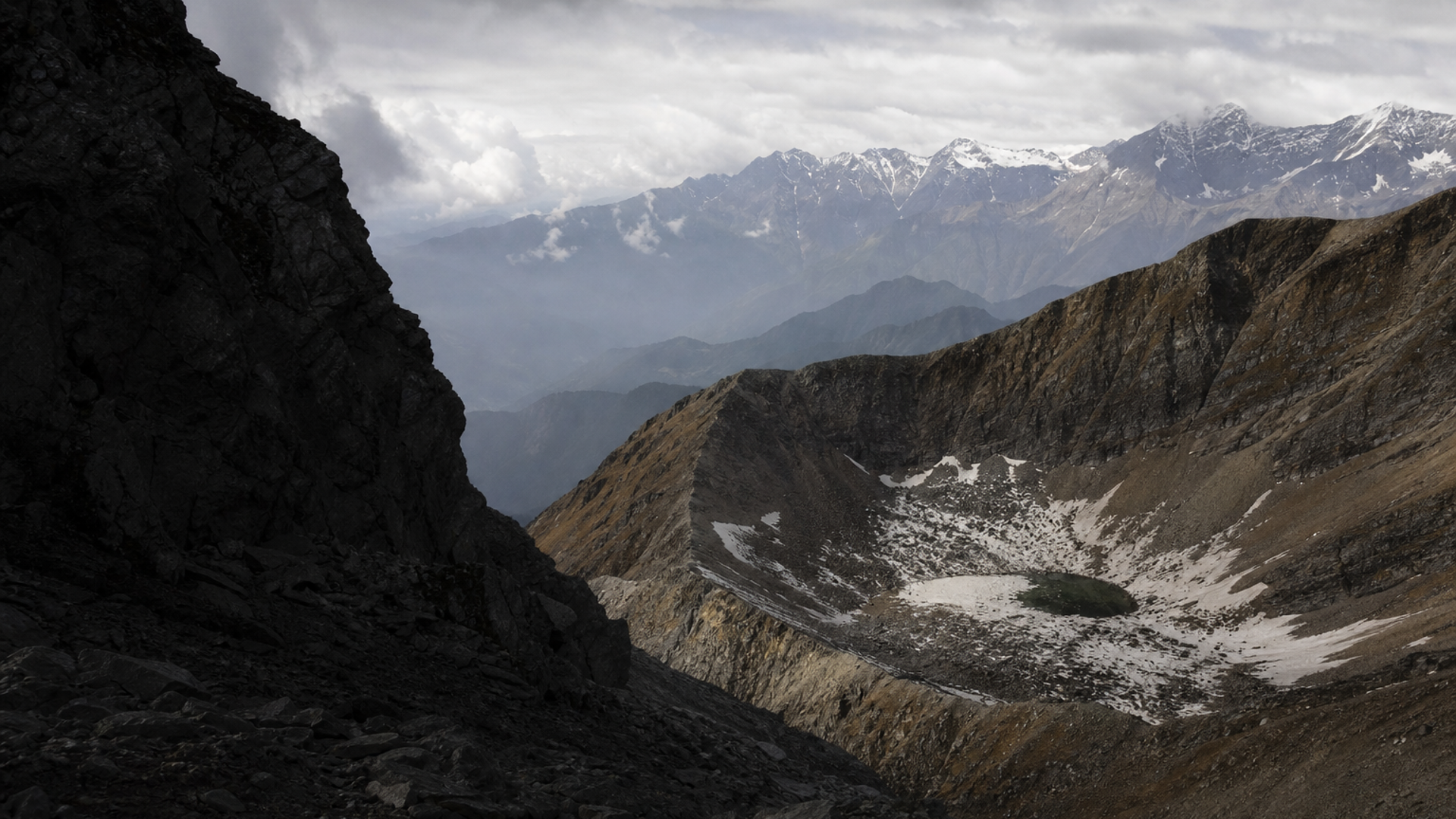
The Roopkund A assemblage is anchored to a high‑altitude glacial basin above 5,000 m in the Uttarakhand Himalaya. Radiocarbon dates from this cluster fall between 674 and 993 CE, placing these individuals in the medieval era of South Asia. Archaeological surveys at Roopkund have long noted dense concentrations of skeletal remains along the lake margin; careful stratigraphic work and AMS dating have shown that the famous ‘skeleton lake’ does not represent a single event but multiple episodes through time. The Roopkund A group appears as one such discrete episode: a temporally clustered set of burials or deaths with a particular genetic signature.

Archaeological data indicates sparse associated material culture at the site—organic preservation is uneven at high altitude—and therefore interpretations lean heavily on osteological and molecular evidence. Limited evidence suggests these individuals were not all local high‑altitude specialists: isotopic and genetic signals hint at diverse geographic origins. Because the number of samples (23) is modest for population‑level claims, conclusions about social identity, migration, or ritual practice remain provisional. Nonetheless, Roopkund A provides a striking example of medieval Himalayan connectivity, where pilgrims, traders, and travelers could converge under hazardous conditions.

  • Radiocarbon-dated cluster: 674–993 CE
  • High-altitude site: Roopkund, Uttarakhand, India
  • Assemblage shows multiple depositional episodes; Roopkund A is one distinct cluster
Chapter IV

Daily Life & Society

Archaeological traces for daily life among the Roopkund A individuals are scarce because of exposure, freeze–thaw cycles, and past disturbance at the lake; the site preserves human remains far better than portable culture. Nonetheless, the context evokes a dramatic human story: people traveling or residing at extreme altitude, exposed to sudden weather and environmental hazards. Contemporary Himalayan routes were used by pilgrims, traders, and trans‑Himalayan parties—archaeological parallels from passes and shrines suggest both religious travel and long‑distance exchange were possible in the medieval period.

Skeletal evidence can hint at activities: patterns of wear, healed trauma, and nutritional indicators (where measured) may reflect strenuous travel, periodic food stress, or episodic violence, but for Roopkund A such analyses are still limited. Material culture recovered from the broader Roopkund complex over the decades—fragments of cloth, wooden objects, and occasional metal—indicate that some visitors carried possessions, but preservation is uneven so archaeological interpretation must be cautious. In short, Roopkund A offers a frozen tableau of people exposed to the Himalayan elements, whose everyday lives likely combined local mountain economies with broader regional mobility.

  • Site context implies travel or pilgrimage across high mountain routes
  • Material culture is sparse; osteological markers may hint at strenuous travel
Chapter V

Genetic Profile

Ancient DNA from 23 Roopkund A individuals reveals a mixed paternal and maternal picture that illuminates medieval human mobility into the high Himalaya. Y‑chromosome haplogroups observed include R (5 individuals), H (4), J (3), and E (1). These broad haplogroups span a wide geography: H is frequently associated with South Asian paternal lineages, R occurs widely across Eurasia and has South Asian and West Eurasian subbranches, while J and E often indicate West Asian or Near Eastern connections. On the maternal side, mtDNA is dominated by haplogroup M (8 individuals) — a major South and East Eurasian maternal lineage — alongside U (5), and singletons such as M30, HV, and M3.

Taken together, the genetic mix suggests that the Roopkund A group included both local South Asian lineages (notably maternal M and paternal H) and lineages with stronger affinities to West Eurasia (U, J, E). This pattern is consistent with a population that was not genetically homogenous: individuals may represent different geographic origins, episodes of long‑distance movement, or mingled communities. Because sample size is moderate (n=23) and genome‑wide coverage varies across individuals, interpretations remain provisional: future dense sampling and broader comparative datasets are needed to test models of pilgrimage, trade‑era mobility, or episodic migration. Still, the aDNA paints a vivid portrait of medieval connectivity at a remote alpine crossroads.

  • Mixed paternal lineages: R, H, J, E suggest South and West Eurasian inputs
  • Maternal profile dominated by M with substantial U — indicating mixed maternal ancestries
Chapter VI

Legacy & Modern Connections

Roopkund A offers a poignant archaeological and genetic snapshot of medieval Himalayan entanglement. For modern populations, the assemblage suggests genetic threads linking contemporary South Asian groups (through mtDNA M and Y H) with broader West Eurasian lineages (mtDNA U and Y J/E/R). This does not imply direct ancestry for any single modern community; instead, it highlights long‑standing corridors of movement across South Asia and into the high mountains.
Archaeologically, the site underscores how extreme landscapes can concentrate people from diverse backgrounds into a single, archaeologically visible event. Genetically, Roopkund A reinforces the importance of combining aDNA with careful excavation and contextual study: together they reveal both the shadow of personal stories—travelers, pilgrims, traders—and the larger demographic processes at work in medieval South Asia. Continued sampling and integrated isotopic, osteological, and genomic analyses will be essential to move from evocative glimpses to robust historical narratives.

  • Shows long-distance connectivity in medieval South Asia
  • Signals mixture that could reflect pilgrimage, trade, or episodic migration
AI 电源

AI 助手

就 Roopkund A: Himalayan Burial Assemblage 文化提问

AI 助手 由DNAGENICS公司制作

解锁此特性
Ask questions about the Roopkund A: Himalayan Burial Assemblage culture. Our AI assistant can explain genetic findings, historical context, archaeological evidence, and modern connections.
AI 样本分析

Roopkund A: Himalayan Burial Assemblage 文化是人类历史中值得了解的一章……

遗传分析揭示了与早期种群的联系,同时显示了独特的适应和文化创新的证据。 古代DNA样本提供了对迁徙模式、社会结构以及古代种群之间的生物关系的深刻见解。

这是人工智能分析的预览。 解锁全AI 助手, 以探索关于:

  • 遗传组成和祖先
  • 移徙模式和起源
  • 日常生活和文化习俗
  • 现代遗传遗产

探索更古老的文化

揭开古代世界文明的故事

使用优惠码 可减免 35% • 11月12日 到期




