Samdzong Tomb People (200–700 CE)

下载的 PDF 是图像副本。如需可选中文本及更好的辅助技术支持,请使用打印功能。

Samdzong Tomb People (200–700 CE)

揭开一个失落的文明

正在加载考古记录……

正在收集古代记录

跳转到主内容
Samdzong Tomb People (200–700 CE)
文明焦点

Samdzong Tomb People (200–700 CE)

Himalayan burials where mountain lifeways meet East Asian genetic threads

200 CE - 700 CE
Samdzong Tomb, Nepal (Himalaya)
滚动开始
Chapter I

剧情

了解 Samdzong Tomb People (200–700 CE) 文化

Archaeological and aDNA evidence from four burials in the Samdzong Tomb (Nepal) dated to 200–700 CE reveal a mix of Y-lineages O and D and maternal M and F haplogroups. Limited samples suggest connections across Himalayan, South, and East Asian gene pools; conclusions remain preliminary.

Time Period

200–700 CE

Region

Samdzong Tomb, Nepal (Himalaya)

Common Y-DNA

O (2), D (1), 1 unassigned

Common mtDNA

M (2), F1d (1), F (1)

Chapter II

时间线

这种文化历史上的关键时刻

200 CE

Earliest dated Samdzong interments

Initial burials at Samdzong Tomb begin around 200 CE, marking the earliest secure dates for the site.

450 CE

Peak use of the cemetery (archaeological phase)

Archaeological stratigraphy suggests continued use of the Samdzong burial locale through the mid-first millennium CE.

700 CE

Latest dated interments

The most recent radiocarbon ranges place the final Samdzong tomb interments at around 700 CE.

Chapter III

Origins & Emergence

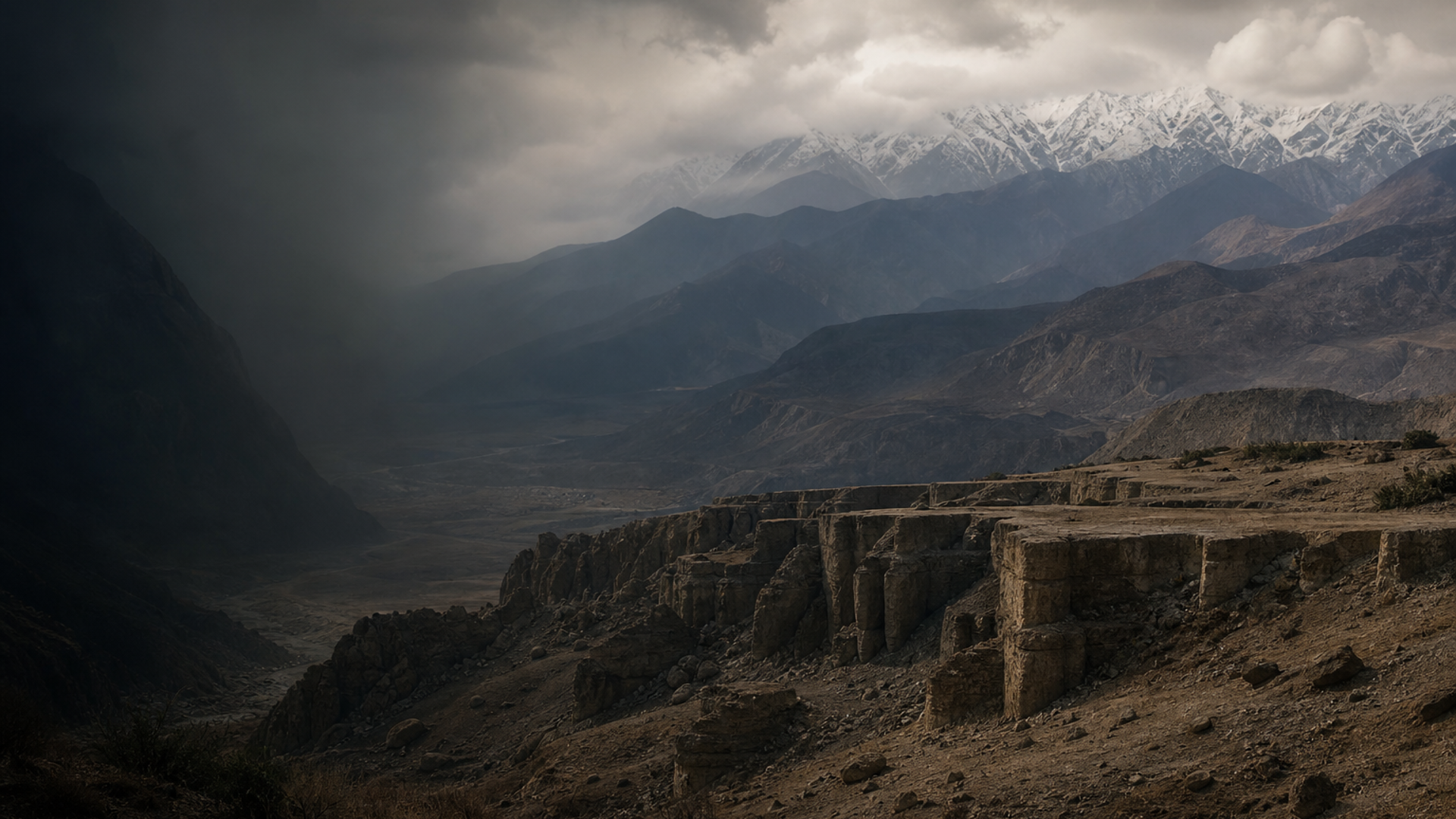
Set high in the shadow of Himalayan ridgelines, the Samdzong Tomb site (Nepal) preserves a brief, luminous glimpse of mountain communities between roughly 200 and 700 CE. Archaeological data indicates the site is primarily funerary in character: human remains recovered from discrete tomb contexts speak to small, localized burial practices in an upland environment. The dating—based on contextual stratigraphy and associated radiocarbon ranges—places these interments in the early medieval horizon of South Asia, a period of shifting trade routes, mobile pastoralism, and growing interregional contacts.

Limited evidence suggests that the Samdzong assemblage reflects bodies of people adapted to high-elevation life: the burials are few and tightly clustered, implying either a small community or a specialized cemetery used intermittently. The Samdzong population emerges at a crossroads: geographically anchored in Nepal but culturally and biologically linked to broader Himalayan and East Asian networks. Because the sample count is small (four individuals), arguments about wide-scale population movements or cultural transformations must remain tentative. Still, the funerary record at Samdzong provides a focal point for exploring how mountain landscapes channeled connections across South, Central, and East Asia during the first millennium CE.

  • Samdzong Tomb: funerary site in Nepal, dated 200–700 CE
  • Small, clustered burials suggest a localized cemetery or community
  • Context sits at an ecological and cultural crossroads in the central Himalaya
Chapter IV

Daily Life & Society

Archaeological signals from Samdzong are subtle but evocative. The tomb contexts suggest a society organized around small kin groups with strong ties to place—seasonal mobility is possible, but the presence of formal interments points to local ritual investment in the landscape. Limited evidence suggests subsistence strategies adapted to high elevation: pastoralism, small-scale cultivation in valley niches, and strategic use of alpine pastures are plausible models, though direct botanical or faunal evidence from the site remains sparse.

Social organization may have been compact and kin-centered. Burial spacing and treatment imply recognition of lineage or household identity within a shared mortuary place. Cultural exchange across mountain passes could have brought objects, ideas, and people into Samdzong’s orbit, but the archaeological record currently lacks abundant grave goods or long artifact sequences that would firmly track trade or craft specialization. In short, the material traces at Samdzong paint a picture of resilient upland lifeways—intimate, place-focused, and engaged with broader Himalayan networks in subtle ways.

  • Burials indicate household- or lineage-scale ritual investment
  • Subsistence likely included pastoralism and localized cultivation (evidence limited)
Chapter V

Genetic Profile

Ancient DNA from four individuals recovered at Samdzong Tomb provides a preliminary genetic window into this Himalayan community. Y-chromosome results include two individuals assigned to haplogroup O, one to D, and one male whose Y lineage could not be confidently resolved with the available data. Haplogroup O is widespread across East and Southeast Asia and appears in many historic and modern populations; its presence here suggests paternal links or gene flow along east–west corridors. Haplogroup D is characteristic of highland East Asian and Tibetan-associated lineages and has been observed in Himalayan and some East Asian groups, signaling deep regional continuity or long-term residence in mountainous zones.

Mitochondrial profiles are diverse: two individuals carry haplogroup M (a broad maternal lineage common across South and Central Asia and the Himalaya), one carries F1d, and one carries F. Haplogroups F and its sublineages (including F1d) are often associated with East and Southeast Asian maternal ancestries. The combined pattern—East-associated paternal markers (O), a Himalayan-deep lineage (D), and mixed maternal M/F lineages—suggests a mosaic ancestry, with contributions from both southward and eastward gene pools. However, with only four samples, these signals are provisional: small-n sampling increases the chance that observed haplogroup frequencies do not represent the full ancient population. Larger, better-dated datasets would be needed to resolve sex-biased gene flow, continuity with modern Nepali groups, or the timing of admixture events.

  • Y-DNA: O (2), D (1) — suggests East Asian and Himalayan paternal affinities
  • mtDNA: M (2), F1d (1), F (1) — maternal diversity linking South and East Asia; conclusions preliminary
Chapter VI

Legacy & Modern Connections

The Samdzong Tomb individuals form a fragile thread in the deep tapestry of Himalayan population history. Their genetic signatures resonate with patterns seen today among Tibeto-Burman and Himalayan populations, but direct continuity cannot be assumed from four samples alone. Archaeological data indicates localized mortuary traditions that may have persisted or been transformed by later social changes, trade intensification, and demographic shifts across the early medieval period.

For modern ancestry studies, Samdzong emphasizes two lessons: first, mountain communities can carry mixed ancestries reflecting both long-term highland residency and episodic contact; second, small ancient sample sizes require cautious interpretation. As additional samples from Nepal and adjacent highlands are analyzed, researchers will be better able to place Samdzong within regional genetic clines and cultural histories. For now, these burials offer a cinematic glimpse—stone, bone, and DNA—into lives lived on the knife-edge of the Himalaya.

  • Genetic signals hint at links with modern Himalayan and Tibeto-Burman groups—yet are tentative
  • Additional sampling across Nepal is needed to test continuity and reveal broader demographic patterns
AI 电源

AI 助手

就 Samdzong Tomb People (200–700 CE) 文化提问

AI 助手 由DNAGENICS公司制作

解锁此特性
Ask questions about the Samdzong Tomb People (200–700 CE) culture. Our AI assistant can explain genetic findings, historical context, archaeological evidence, and modern connections.
AI 样本分析

Samdzong Tomb People (200–700 CE) 文化是人类历史中值得了解的一章……

遗传分析揭示了与早期种群的联系,同时显示了独特的适应和文化创新的证据。 古代DNA样本提供了对迁徙模式、社会结构以及古代种群之间的生物关系的深刻见解。

这是人工智能分析的预览。 解锁全AI 助手, 以探索关于:

  • 遗传组成和祖先
  • 移徙模式和起源
  • 日常生活和文化习俗
  • 现代遗传遗产

探索更古老的文化

揭开古代世界文明的故事

使用优惠码 可减免 35% • 11月12日 到期




