Sandby Borg: Öland’s Late Iron Age Echo

下载的 PDF 是图像副本。如需可选中文本及更好的辅助技术支持,请使用打印功能。

Sandby Borg: Öland’s Late Iron Age Echo

揭开一个失落的文明

正在加载考古记录……

正在收集古代记录

跳转到主内容
Sandby Borg: Öland’s Late Iron Age Echo
文明焦点

Sandby Borg: Öland’s Late Iron Age Echo

A terse genetic and archaeological snapshot from southern Sweden, ca. 450–500 CE

450 CE - 500 CE
Sandby Borg, Öland (Mörbylånga), Kalmar län, Sweden
滚动开始
Chapter I

剧情

了解 Sandby Borg: Öland’s Late Iron Age Echo 文化

Seven individuals from Sandby Borg (Öland, Kalmar län) dated 450–500 CE offer a preliminary window into Southern Swedish Pre‑Viking lifeways. Y haplogroups N and I appear commonly; mtDNA is dominated by H. Limited sample size makes conclusions tentative.

Time Period

c. 450–500 CE (Late Iron Age / Pre‑Viking)

Region

Sandby Borg, Öland (Mörbylånga), Kalmar län, Sweden

Common Y-DNA

N (3), I (3)

Common mtDNA

H (3), J, K2a, I, R1b (each 1)

Chapter II

时间线

这种文化历史上的关键时刻

2500 BCE

Bronze Age maritime exchange accelerates

Rising seafaring and exchange across the Baltic create long‑term networks that later Iron Age communities inherit.

Chapter III

Origins & Emergence

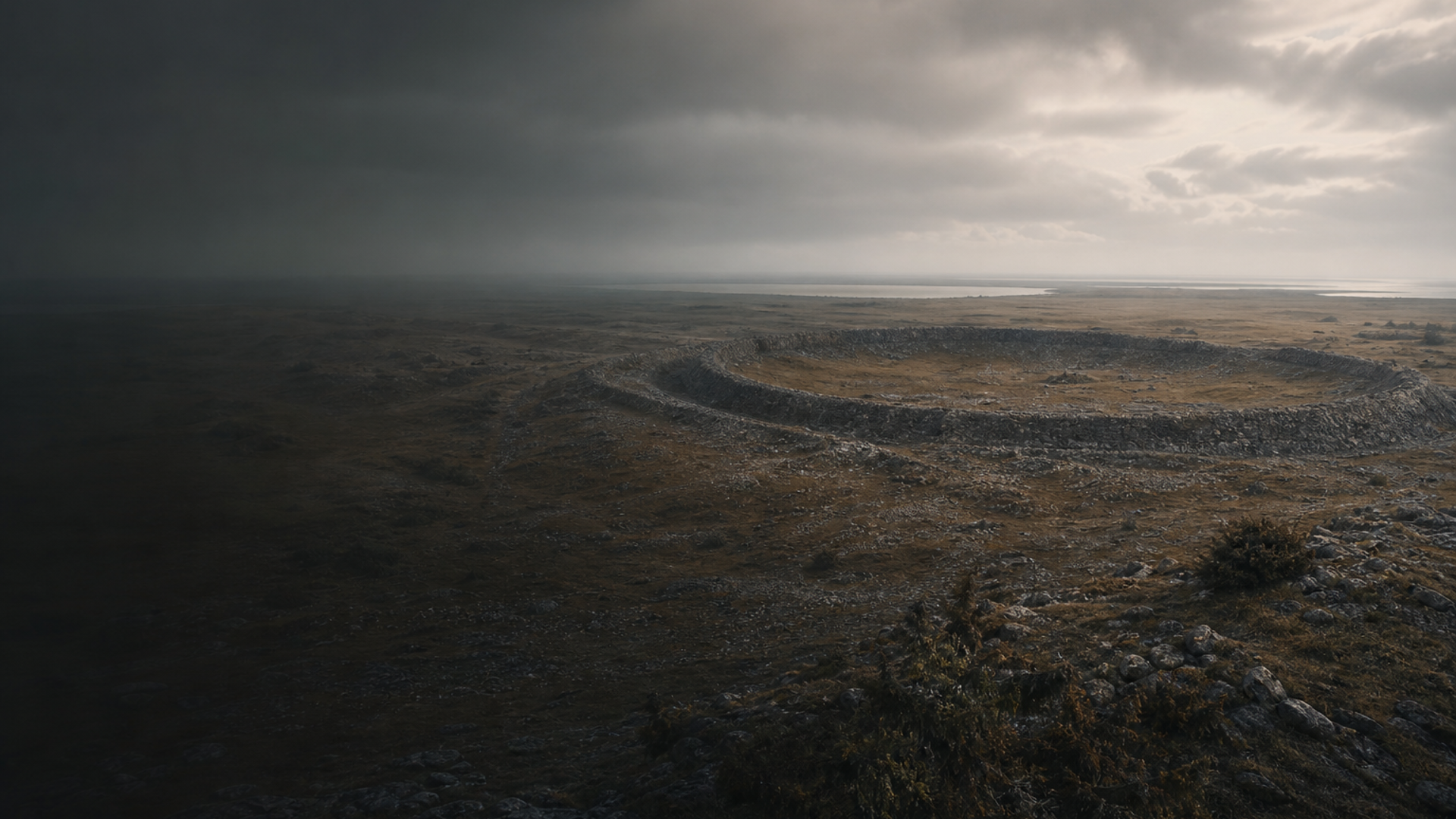
Sandby Borg sits like a weathered jewel on the southern shore of Öland, a ringfort whose frozen moment of violence and abandonment has allowed archaeologists to peer into a single dusk of the Late Iron Age. Archaeological data indicates occupation and dramatic upheaval in the mid‑fifth century CE (around 450–500 CE), placing these deposits firmly within the Southern Swedish Pre‑Viking cultural horizon.

The material landscape—fortified earthworks, house platforms and domestic debris—speaks to coastal communities that balanced farming, craft, and seafaring. This region formed part of a network of Baltic contacts: trade, raiding and the movement of people and objects threaded Öland to the Swedish mainland and across the sea to the Baltic rim.

Limited evidence suggests continuity from earlier Migration Period traditions, but also local adaptations visible in fortification styles and household assemblages. The archaeological record at Sandby Borg preserves a compressed story: occupation, conflict, and abandonment. That narrative provides a rare anchor for genetic samples dating to the same narrow window, offering complementary temporal precision to the material sequence.

Because the genetic dataset here comprises only seven individuals, any reconstruction of origins must be cautious. These remains give a vivid, cinematic glimpse, but they are a small collection from a single place and time—not a comprehensive population survey.

  • Site: Sandby Borg ringfort, Öland (Mörbylånga), Kalmar län
  • Date: c. 450–500 CE, Late Iron Age / Pre‑Viking
  • Context: Fortified settlement with evidence of sudden violence and abandonment
Chapter IV

Daily Life & Society

Archaeological traces from Southern Swedish Pre‑Viking sites like Sandby Borg evoke a community shaped by the sea and the land. Household archaeology indicates mixed economies: small‑scale cereal agriculture and animal husbandry paired with marine resources and coastal craft. Roofed timber houses clustered within the fort’s ramparts sheltered families, tools and portable wealth.

Artifactual assemblages from comparable regional excavations show domestic pottery, iron tools, combs, beads and personal ornaments—items that suggest skilled craft, long‑distance exchange and social differentiation. Fortifications imply a concern for defense: community gatherings inside ramparts could reflect both seasonal congregation and strategic refuge.

Osteological evidence at Sandby Borg documents abrupt mortality by violence for multiple individuals, leaving bodies in domestic spaces rather than formal cemeteries. That violent snapshot changes how we read everyday life: these were communities with ordinary rhythms—work, kinship, feasting—that could be disrupted rapidly by interpersonal or intergroup conflict.

Archaeological data indicates active maritime links; boats and seafaring knowledge shaped mobility, trade and cultural exchange along the Baltic coasts. As with genetic evidence, these social reconstructions benefit from restraint: a single catastrophic event at one site cannot alone describe the diversity of Southern Swedish lifeways.

  • Mixed economy: agriculture, animal husbandry, and marine resources
  • Domestic artifacts and fortifications reflect craft, exchange, and social tension
Chapter V

Genetic Profile

The DNA snapshot from Sandby Borg (seven individuals dated to 450–500 CE) supplies a direct biological link to Late Iron Age inhabitants of southern Sweden. Among individuals with recoverable Y‑chromosome data, haplogroups N and I each appear three times. Haplogroup I is long associated with Scandinavian and wider northern European ancestries, often tracing deep Mesolithic and Neolithic legacies in the region. Haplogroup N has a stronger modern frequency in northeastern Europe and among Uralic‑speaking groups; its presence in southern Sweden at this date suggests complex regional contacts and gene flow across the Baltic.

Mitochondrial lineages in the sample are dominated by H (three individuals), with single occurrences of J, K2a, I and a lineage labeled R1b. Note: R1b is conventionally a Y‑chromosome designation; the appearance of “R1b” within the mtDNA list may reflect labeling conventions in the dataset and should be interpreted cautiously.
Taken together, these genetics hint at a mixed ancestry—local Scandinavian components alongside eastern or northeastern affinities—but this interpretation is strongly provisional. With only seven samples, statistical power is limited. Archaeogenetic conclusions must therefore be framed as preliminary: they identify plausible ancestries and contacts, but cannot define population structure for all of southern Sweden. Future sampling across more sites and individuals will be required to test whether the patterns at Sandby Borg represent a local anomaly, a regional norm, or part of broader Migration Period dynamics.

  • Y‑DNA in this dataset: N (3) and I (3) among male‑line samples
  • MtDNA shows dominance of H (3); presence of diverse maternal lineages and labeling cautions
Chapter VI

Legacy & Modern Connections

The echoes of Sandby Borg reach into the genomes of modern northern Europe: haplogroups such as I and H persist in Scandinavian populations today, hinting at threads of continuity. The occurrence of haplogroup N in this late‑fifth‑century coastal sample underscores how the Baltic Sea functioned as a conduit for people and genes long before the Viking Age reshaped Europe.

Culturally, the material and genetic snapshot from Sandby Borg contributes to a layered narrative—one in which local identities, long‑distance ties and episodes of violence all shaped community memory. For modern descendants in southern Sweden and the Baltic region, these data provide a scientific mirror, not a direct pedigree: genetic affinities point to shared deep ancestries rather than one‑to‑one familial links.

Given the very small sample (n = 7), any statements about broader population continuity or replacement must remain tentative. These remains are valuable precisely because they anchor archaeological events to biological data; they invite more extensive sampling that can transform preliminary impressions into robust regional histories.

  • Some genetic lineages from Sandby Borg continue among modern northern European populations
  • Small sample size means modern connections are indicative, not definitive
AI 电源

AI 助手

就 Sandby Borg: Öland’s Late Iron Age Echo 文化提问

AI 助手 由DNAGENICS公司制作

解锁此特性
Ask questions about the Sandby Borg: Öland’s Late Iron Age Echo culture. Our AI assistant can explain genetic findings, historical context, archaeological evidence, and modern connections.
AI 样本分析

Sandby Borg: Öland’s Late Iron Age Echo 文化是人类历史中值得了解的一章……

遗传分析揭示了与早期种群的联系,同时显示了独特的适应和文化创新的证据。 古代DNA样本提供了对迁徙模式、社会结构以及古代种群之间的生物关系的深刻见解。

这是人工智能分析的预览。 解锁全AI 助手, 以探索关于:

  • 遗传组成和祖先
  • 移徙模式和起源
  • 日常生活和文化习俗
  • 现代遗传遗产

探索更古老的文化

揭开古代世界文明的故事

使用优惠码 可减免 35% • 11月12日 到期




