Shahr‑i Sokhta Bronze Age Mosaic

下载的 PDF 是图像副本。如需可选中文本及更好的辅助技术支持,请使用打印功能。

Shahr‑i Sokhta Bronze Age Mosaic

揭开一个失落的文明

正在加载考古记录……

正在收集古代记录

跳转到主内容
Shahr‑i Sokhta Bronze Age Mosaic
文明焦点

Shahr‑i Sokhta Bronze Age Mosaic

A desert metropolis in Seistan whose bones and genomes trace Bronze Age connections

3330 CE - 2000 BCE
Seistan, Shahr‑i Sokhta, Iran
滚动开始
Chapter I

剧情

了解 Shahr‑i Sokhta Bronze Age Mosaic 文化

Shahr‑i Sokhta (Seistan, Iran; 3330–2000 BCE) was a flourishing Bronze Age city. Archaeological layers and 11 ancient genomes reveal a population with Near Eastern Y lineages (J), South/Central connections (Y‑H, P) and diverse maternal lineages (U, W, T, R7), suggesting complex regional networks.

Time Period

3330–2000 BCE

Region

Seistan, Shahr‑i Sokhta, Iran

Common Y-DNA

J (4), H (1), P (1) — 11 samples total

Common mtDNA

U (2), W (2), T (1), R7 (1), W6 (1)

Chapter II

时间线

这种文化历史上的关键时刻

2500 BCE

Height of urban activity

Shahr‑i Sokhta flourishes with dense occupation, specialized crafts, and long‑distance exchange networks.

Chapter III

Origins & Emergence

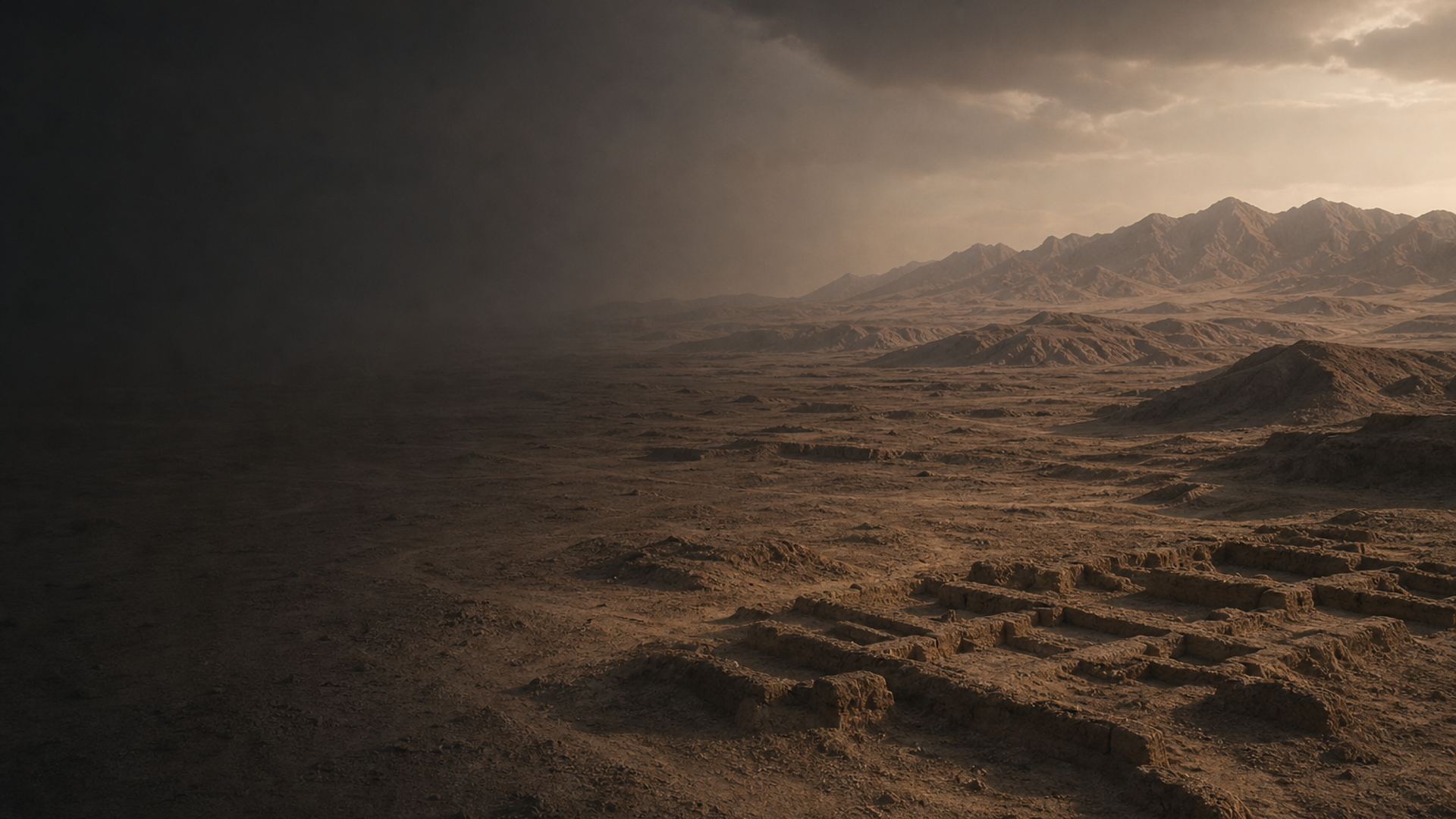
In the burned layers of Shahr‑i Sokhta (literally “Burnt City”), archaeologists uncover an urban organism that emerged in the early third millennium BCE on the flat, saline plains of Seistan. Radiocarbon and stratigraphic sequences place continuous occupation between roughly 3330 and 2000 BCE, a span that overlapped with contemporary developments in the Iranian plateau, the Indus periphery and the Oxus world. The city’s mudbrick architecture, craft districts and cemetery complexes record a trajectory from village aggregation to planned urban quarters, with phases of expansion and disruption recorded as burned horizons. Material culture — painted pottery, steatite and faience beads, copper tools, and seals — testifies to long‑distance exchange: lapis lazuli from Badakhshan, shell from the Arabian littoral, and stylistic affinities that link Shahr‑i Sokhta to both eastern Iranian and South Asian traditions.

Archaeological data indicate specialized workshops and centralized production by the mid‑third millennium BCE, suggesting social differentiation and coordinated labor. The site preserves exceptional biological remains and rare finds — including innovative prosthetic and dental evidence — which together with human remains give us an unusually rich window into Bronze Age lifeways in southeastern Iran. While the archaeological record is robust, integrating ancient DNA from 11 individuals allows new, but still cautious, insight into population composition and interactions across a vibrant frontier of Bronze Age networks.

  • Urban occupation: ca. 3330–2000 BCE
  • Located in Seistan (Burnt City), key crossroad of exchange
  • Evidence for craft specialization and long‑distance trade
Chapter IV

Daily Life & Society

Daily life at Shahr‑i Sokhta unfolded amid sun‑baked streets, courtyard houses, and clustered workshops. Excavations reveal domestic pottery kilns, bead‑making furnaces, metallurgical debris and food remains that reconstruct a mixed economy of dryland farming, irrigation agriculture and craft production. Faunal assemblages indicate herding of sheep, goats and cattle; botanical remains point to cereals and pulses adapted to an arid environment. Burials range from modest interments to richly furnished graves, showing social differentiation: certain cemeteries contain ornaments, seals and exotic materials that bespeak status and far‑reaching connections.

Craftspeople worked with copper alloys, bone, shell and imported stones; artisans’ marks and standardized forms imply knowledge transmission and workshop traditions. Public and ritual spaces, visible in larger compounds and depositional practices, suggest community rituals tied to life‑cycle events and perhaps to exchange institutions. Skeletal analyses show a population experiencing the stresses and adaptations of urban life — workload markers on bone, childhood stress indicators, and variable health outcomes — that together humanize the archaeological remains. Archaeological data indicates a society that balanced local resource management with participation in regional circuits of goods and ideas, producing an urban culture both rooted in Seistan and entangled with neighboring worlds.

  • Mixed economy: irrigation agriculture, herding, crafts
  • Burials and grave goods indicate social differentiation
Chapter V

Genetic Profile

Eleven genomes sampled from Shahr‑i Sokhta (3330–2000 BCE) provide a first genetic snapshot of a southeastern Iranian Bronze Age community. The Y‑chromosome distribution includes J in four individuals, H in one, and P in one; mitochondrial lineages include U (2), W (2), T (1), R7 (1) and W6 (1). These results suggest a tapestry of ancestral inputs rather than genetic uniformity. Haplogroup J on the Y‑line is well‑documented across the Iranian plateau and Near East and may reflect continuity with regional male lineages or the impact of Neolithic and Bronze Age west‑Asian pastoral and farmer-derived ancestry.

The presence of Y‑H, a lineage today concentrated in South Asia and parts of Central Asia, and mitochondrial R7 — often associated with South/Central Asian maternal ancestry — points to possible gene flow or long‑distance connections toward the east and south. Haplogroup P on the Y is less common in West Asia and may reflect deep Eurasian lineages or downstream branches (R/Q) not fully resolved in all datasets; alternate explanations include limited marker resolution or rare local persistence. Maternal haplogroups U, W and T are widespread in western Eurasia and indicate mitochondrial continuity with broader West Eurasian pools.

Interpretation must remain cautious: 11 samples give informative but incomplete coverage of a multi‑century city. Archaeological and isotopic data combined with larger aDNA datasets will refine models of mobility, sex‑biased gene flow and the balance between local continuity and incoming ancestry. Limited evidence suggests Shahr‑i Sokhta was a genetic crossroads mirroring its material interconnectedness.

  • Y: J (x4) dominant; H and P present, indicating mixed male ancestry
  • mtDNA: mix of West Eurasian (U, W, T) and South/Central signals (R7)
Chapter VI

Legacy & Modern Connections

Shahr‑i Sokhta’s legacy endures in the archaeological imagination and in genomic traces detectable across Southwest and South Asia. The blend of maternal and paternal lineages observed in these eleven Bronze Age individuals echoes broader patterns of interaction on the Iranian plateau: cultural innovations, trade networks, and intermittent movements of people that helped shape later population structure. Archaeological motifs, craft techniques and exchange ties visible at Shahr‑i Sokhta reappear in subsequent cultural horizons across southeastern Iran and into the Indus periphery, suggesting continuity of networks if not direct lineage.

From a genetic perspective, the results underscore the region’s role as a conduit between western Eurasia and South/Central Asia. While modern populations in Iran and neighboring regions have undergone additional admixture events over millennia, these Bronze Age genomes offer anchor points for tracing lineages that contributed to the genetic mosaic of later peoples. Further sampling and integrated archaeological study will sharpen how Shahr‑i Sokhta connects to the human stories of the wider Bronze Age world.

  • Reflects a conduit role between the Iranian plateau and South/Central Asia
  • Provides anchor points for tracing later regional genetic continuity
AI 电源

AI 助手

就 Shahr‑i Sokhta Bronze Age Mosaic 文化提问

AI 助手 由DNAGENICS公司制作

解锁此特性
Ask questions about the Shahr‑i Sokhta Bronze Age Mosaic culture. Our AI assistant can explain genetic findings, historical context, archaeological evidence, and modern connections.
AI 样本分析

Shahr‑i Sokhta Bronze Age Mosaic 文化是人类历史中值得了解的一章……

遗传分析揭示了与早期种群的联系,同时显示了独特的适应和文化创新的证据。 古代DNA样本提供了对迁徙模式、社会结构以及古代种群之间的生物关系的深刻见解。

这是人工智能分析的预览。 解锁全AI 助手, 以探索关于:

  • 遗传组成和祖先
  • 移徙模式和起源
  • 日常生活和文化习俗
  • 现代遗传遗产

探索更古老的文化

揭开古代世界文明的故事

使用优惠码 可减免 35% • 11月12日 到期




