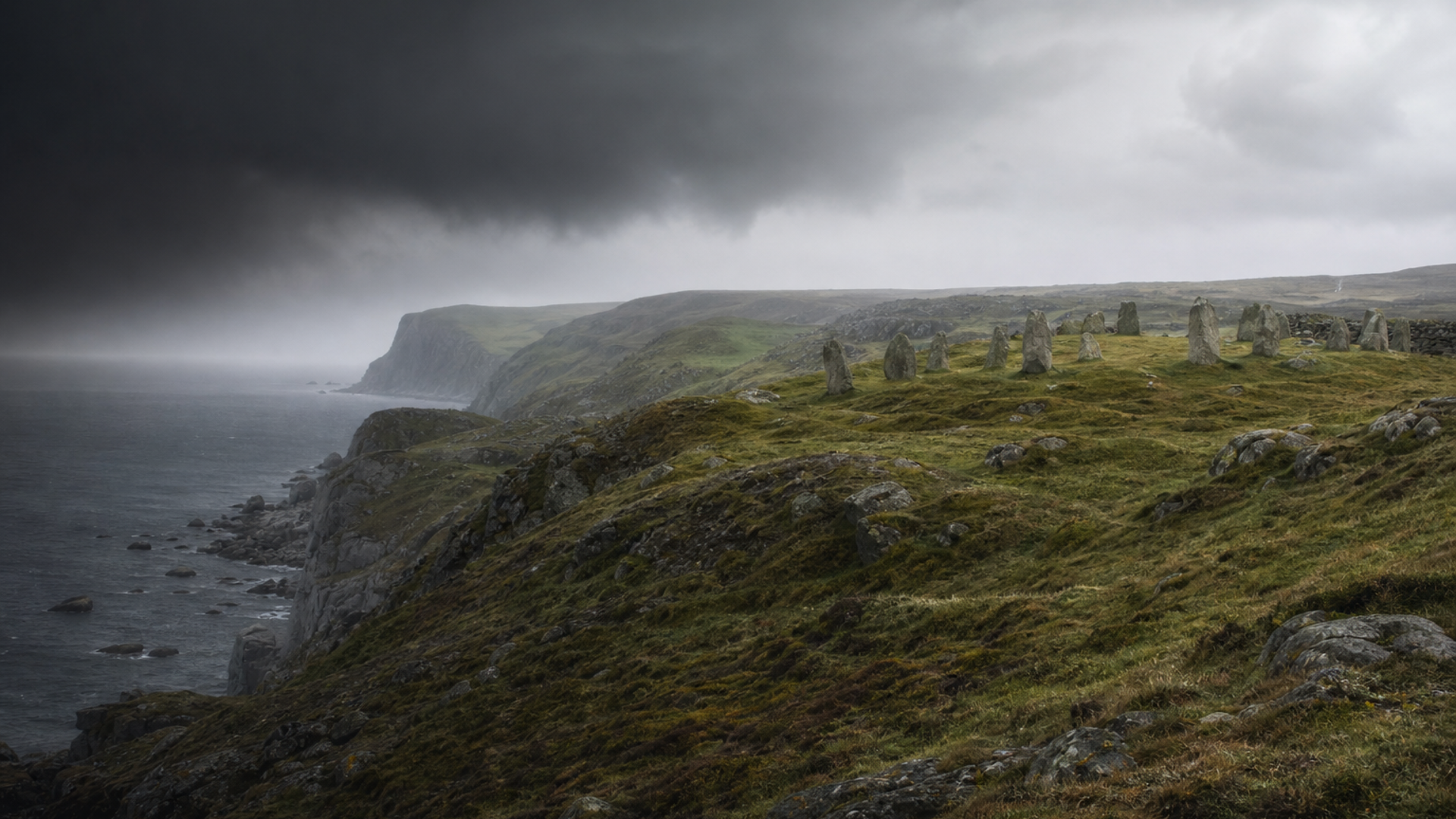
Shorelines of Bronze: England LBA

下载的 PDF 是图像副本。如需可选中文本及更好的辅助技术支持,请使用打印功能。

Shorelines of Bronze: England LBA

揭开一个失落的文明

正在加载考古记录……

正在收集古代记录

跳转到主内容
Shorelines of Bronze: England LBA
文明焦点

Shorelines of Bronze: England LBA

Late Bronze Age communities across England, revealed by archaeology and ancient DNA.

1259 CE - 798 BCE
England (United Kingdom)
滚动开始
Chapter I

剧情

了解 Shorelines of Bronze: England LBA 文化

Archaeology and ancient DNA from 28 Late Bronze Age English sites (1259–798 BCE) reveal maritime trade, regional continuity, and a genetic profile dominated by R haplogroups with diverse maternal lineages. Findings are regionally rich but require broader sampling.

Time Period

1259–798 BCE

Region

England (United Kingdom)

Common Y-DNA

R (8), P1 (1)

Common mtDNA

H (5), U (4), J (3), T (2), K (2)

Chapter II

时间线

这种文化历史上的关键时刻

1000 BCE

Late Bronze Age regional networks

Cultural and exchange networks along coasts and rivers connect communities in England; sampled individuals date to this interval (1259–798 BCE).

Chapter III

Origins & Emergence

Across the rolling chalk downs, estuarine muds and folded ridges of Bronze Age England, the centuries around 1259–798 BCE were a time of layered continuity rather than abrupt replacement. Archaeological data indicates long-lived settlement patterns in lowland England: burials, metalwork hoards, and cereal agriculture tie communities at sites such as Potterne (Blackberry Field, Wiltshire), North Ferriby (Melton Quarry, East Riding), and Raven Scar Cave (Ingleton, North Yorkshire) into a network of local traditions and long-distance exchange.

Material culture — decorated metalwork, socketed axes, and regional pottery styles — suggests intense connections along rivers and coasts. Coastal sites like Cliffs End Farm and Coldean Lane reveal seafaring routes that funneled raw materials and ideas from the Atlantic and North Sea margins. Limited evidence suggests social hierarchies were expressed through burial goods and hoarding practices, but regional variability is strong: the archaeological record in Kent looks different from that in North Yorkshire.

Radiocarbon dates from the sampled individuals cluster within the Late Bronze Age window (1259–798 BCE), providing a well-timed cross-section. While these sites form a compelling mosaic, they represent a selective sample of landscapes and social contexts; broader sampling is required before asserting island-wide uniformity.

  • Sites sampled include Potterne (Wiltshire), North Ferriby, Raven Scar Cave, Cliffs End Farm, and Coldean Lane.
  • Material culture indicates coastal and riverine exchange networks across England.
  • Regional continuity is visible, but local diversity remains strong.
Chapter IV

Daily Life & Society

Daily life in Late Bronze Age England unfolded in a world of seasonal rounds, close-quartered farmsteads, and coastal movement. Archaeobotanical remains and animal bone assemblages from related sites indicate mixed farming — barley, wheat and pulses alongside cattle, sheep and pigs — underpinning a diet that shifted with tides and markets. Flint tools and metalworking debris found at locations such as Biddenham Loop (Bedfordshire) and Margetts Pit (Kent) speak to localized craft production and the circulation of bronze as both tool and prestige good.

Communities were anchored to the landscape: temporary enclosures, field systems and trackways tie settlements to consumo of local resources. Burial practices remain variable; some individuals were interred with ornaments or weapons, others without grave goods, reflecting social differentiation that is archaeologically visible but not fully understood. Coastal and intertidal sites like North Ferriby connect inland economies to maritime exchange, moving copper and tin across long distances. Archaeological evidence indicates both household-level craft and specialists producing for wider networks.

Interpretations of social organization must remain cautious: preservation biases and the uneven distribution of excavated sites leave gaps. Nonetheless, the combined archaeological and genetic record increasingly portrays Late Bronze Age England as a patchwork of connected yet distinct local communities.

  • Mixed farming dominated, supported by local craft production and metalworking.
  • Burial variability suggests social differentiation but with regional variation.
Chapter V

Genetic Profile

Twenty-eight ancient individuals dated to 1259–798 BCE provide a measurable genetic snapshot of Late Bronze Age England. Y-chromosome diversity in this sample is dominated by haplogroup R (8 individuals) with a single instance of P1; mitochondrial haplogroups show broader maternal diversity (H, U, J, T, K). Archaeogenetic patterns fit a narrative of continued ancestry from earlier Bronze Age populations with substantial Steppe-derived ancestry retained in male lineages — R haplogroups are commonly associated in Europe with Steppe-related expansions — while mitochondrial diversity indicates ongoing female-mediated gene flow and local continuity.

Genome-wide analyses (where available) tend to show that these individuals cluster with other British and Irish Bronze Age populations rather than forming a separate genetic cluster, consistent with archaeological signals of cultural continuity and regional interaction. However, sample size and geographic spread matter: 28 genomes give reliable local insights but cannot capture the full demographic complexity of the island.

Caveats: because many sites sampled are coastal or riverine, there may be a bias toward mobile, trade-linked groups. Low counts of particular lineages (for example, only one P1) mean those observations should be treated as preliminary. Future sampling from inland and under-represented regions will refine our understanding of sex-biased mobility, kinship structures, and the fine-scale distribution of haplogroups.

  • Male lineages dominated by R (8), with a single P1 — consistent with Steppe-derived ancestry patterns.
  • Maternal lineages are diverse (H, U, J, T, K), indicating continued local female continuity and admixture.
Chapter VI

Legacy & Modern Connections

The people sampled from Late Bronze Age England are part of a deep heritage that threads into later Iron Age and historic populations. Genetic continuity observed in these samples suggests that many modern inhabitants of Britain inherit a substantial portion of their ancestry from Bronze Age predecessors, though subsequent migrations and social changes layered new genetic signals onto this base.

Archaeologically, the networks of exchange and coastal connections that shaped the Late Bronze Age set the stage for later regional identities. In genetic terms, the prominence of R-lineages in male ancestry echoes broader northwest European patterns, while the mix of maternal haplogroups highlights sustained local roots and mobility. These individuals thus illuminate how landscapes, seaways and social ties combined to craft the ancestral mosaic of modern Britain.

All conclusions remain open to refinement as additional samples — especially from underrepresented inland zones and female burials — are brought into the dataset.

  • Genetic continuity links Late Bronze Age peoples to later British populations.
  • Maritime exchange networks helped shape regional identities and genetic mixing.
AI 电源

AI 助手

就 Shorelines of Bronze: England LBA 文化提问

AI 助手 由DNAGENICS公司制作

解锁此特性
Ask questions about the Shorelines of Bronze: England LBA culture. Our AI assistant can explain genetic findings, historical context, archaeological evidence, and modern connections.
AI 样本分析

Shorelines of Bronze: England LBA 文化是人类历史中值得了解的一章……

遗传分析揭示了与早期种群的联系,同时显示了独特的适应和文化创新的证据。 古代DNA样本提供了对迁徙模式、社会结构以及古代种群之间的生物关系的深刻见解。

这是人工智能分析的预览。 解锁全AI 助手, 以探索关于:

  • 遗传组成和祖先
  • 移徙模式和起源
  • 日常生活和文化习俗
  • 现代遗传遗产

探索更古老的文化

揭开古代世界文明的故事

使用优惠码 可减免 35% • 11月12日 到期