Tasmola Steppe: Mounds of Central Kazakhstan

下载的 PDF 是图像副本。如需可选中文本及更好的辅助技术支持,请使用打印功能。

Tasmola Steppe: Mounds of Central Kazakhstan

揭开一个失落的文明

正在加载考古记录……

正在收集古代记录

跳转到主内容
Tasmola Steppe: Mounds of Central Kazakhstan
文明焦点

Tasmola Steppe: Mounds of Central Kazakhstan

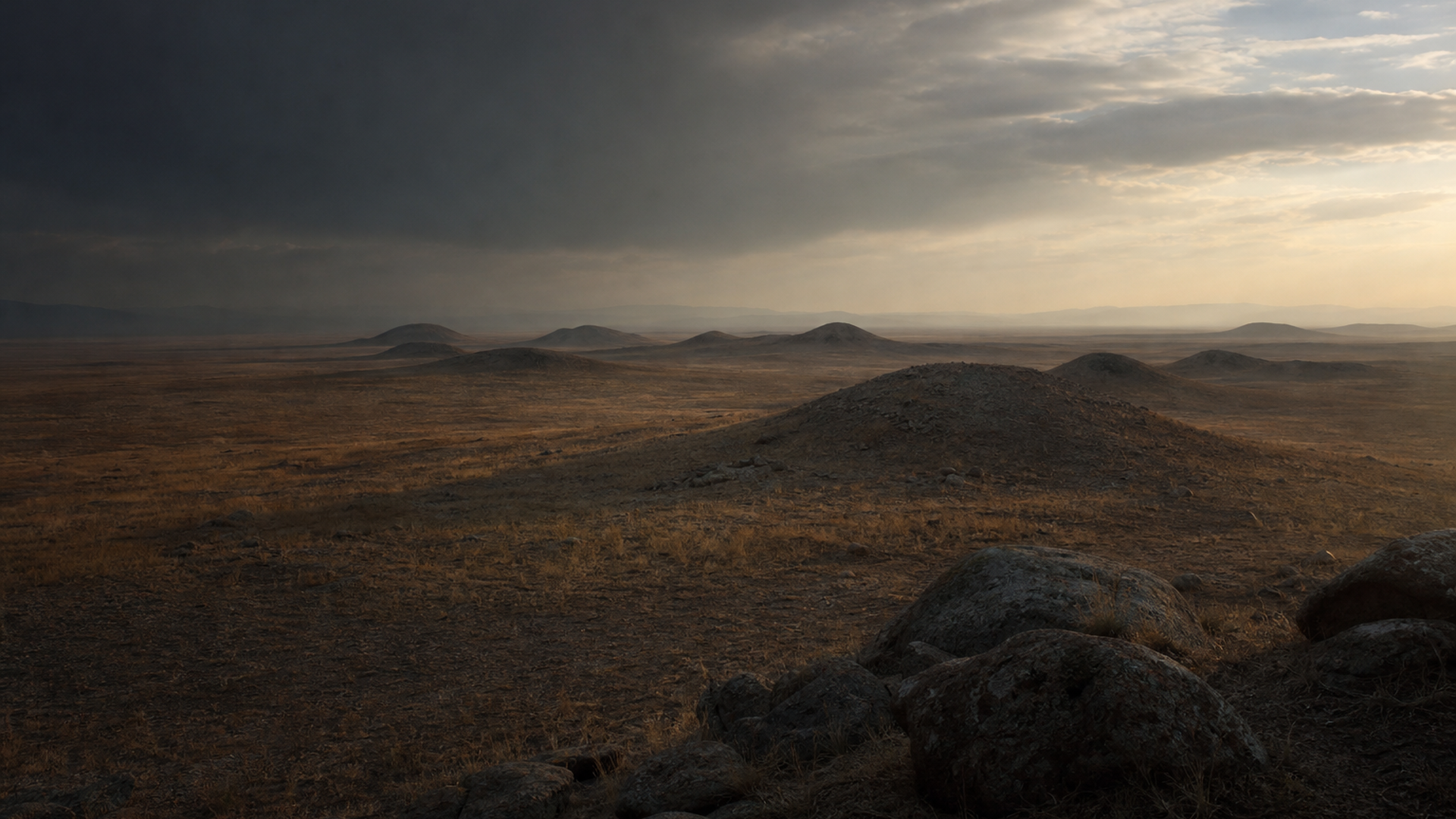
A cinematic glimpse into Early Iron Age life where kurgans pierce the endless steppe

898 CE - 300 BCE
Central Kazakhstan (Akbeit I, Karashoky, Karakemer, Kyzylshilik, Begazy)
滚动开始
Chapter I

剧情

了解 Tasmola Steppe: Mounds of Central Kazakhstan 文化

Archaeological and genetic evidence from 17 Early Iron Age Tasmola burials (898–300 BCE) in central Kazakhstan reveals a steppe society with predominantly West Eurasian maternal and paternal lineages alongside eastern influences — suggesting regional admixture and mobile pastoral lifeways.

Time Period

898–300 BCE

Region

Central Kazakhstan (Akbeit I, Karashoky, Karakemer, Kyzylshilik, Begazy)

Common Y-DNA

R (≈10/17), C (1), Q (1)

Common mtDNA

H (5), U (3), C (2), I (2), D4i (1)

Chapter II

时间线

这种文化历史上的关键时刻

800 BCE

Tasmola cultural florescence

Kurgan cemeteries across central Kazakhstan are actively used, marking a distinct Early Iron Age Tasmola horizon with increasing regional connectivity.

Chapter III

Origins & Emergence

The Tasmola horizon emerges across the rolling steppes of central Kazakhstan in the Early Iron Age, roughly between the 9th and 3rd centuries BCE. Archaeological data indicates a distinctive burial practice centered on small to medium‑sized kurgans (mounds) and mound cemeteries visible at Akbeit I (mound 1), Karashoky I and VI (mounds 1, 6, 8), Karakemer (mound 3), Bektauata (mound 1) and Kyzylshilik (mounds 2 and 8). These funerary monuments rise like solitary echoes on the horizon, preserving traces of a mobile pastoral society.

Material culture associated with Tasmola sites — pottery fragments, metalwork, and the spatial arrangement of burials — suggests continuity with preceding Bronze Age steppe traditions (including regional Begazy‑Dandybai elements) while also reflecting new social formations in the Early Iron Age. Limited evidence suggests intensified interaction across the steppe: metal objects imply long‑distance contacts, and settlement/seasonal use patterns hint at herd mobility between summer and winter pastures.

Genetically, the Tasmola assemblage shows a composite ancestry consistent with steppe populations that had absorbed both West Eurasian and eastern components over preceding centuries. Archaeological data indicates a cultural horizon that is both locally rooted and open to wide networks — a living landscape of migration, exchange, and adaptation.

  • Distinctive kurgan cemeteries across central Kazakhstan (e.g., Akbeit I, Karashoky, Karakemer)
  • Material culture shows continuity with Bronze Age steppe traditions and wider steppe connections
  • Archaeological evidence indicates mobile pastoralism and long‑distance interaction
Chapter IV

Daily Life & Society

Archaeological contexts for the Tasmola culture convey a world of seasonal movement and ritualized burial. Excavated mounds often reveal central burial pits, isolated grave goods, and traces of perishable structures that once marked family or lineage memory on the landscape. While preservation is uneven, faunal remains and the placement of graves suggest an economy dominated by herding — sheep, goats, cattle and horses — with people moving across a mosaic of steppe pastures.

Social life likely revolved around kin groups whose status was inscribed in mortuary architecture rather than permanent monumental settlements. Metal ornaments, a small range of ceramics, and occasional weaponry recovered from mounds imply craft networks and both local and long‑distance social ties. Archaeological data indicates variability in grave wealth: some mounds contain modest goods, others more elaborate assemblages, which may reflect social differentiation or changing funerary practices through the Early Iron Age.

Environmental reconstructions point to a landscape of grasslands punctuated by river valleys (e.g., Karatal) that would have structured movement and seasonal camping. The cinematic scene — herds silhouetted at dawn, low mounds casting long shadows — fits the archaeological record, but many details of daily organization, belief, and material practice remain tentative because organic materials and many domestic sites are poorly preserved.

  • Economy centered on mobile pastoralism with seasonal transhumance
  • Mortuary variability suggests social differentiation and lineage memory
Chapter V

Genetic Profile

Seventeen Tasmola individuals sampled from central Kazakhstan provide a moderate dataset that begins to illuminate population dynamics on the steppe. Y‑chromosome data are dominated by haplogroup R lineages (≈10/17), with single instances of C and Q — paternal markers that together point to a primarily West Eurasian steppe male heritage with some eastern influences. Mitochondrial DNA is mixed: H (5) and U (3) are common West Eurasian maternal haplogroups, while C (2), I (2) and D4i (1) indicate East Eurasian maternal contributions. This maternal mix signals bi‑directional contacts and female‑mediated gene flow across broad steppe corridors.

Autosomal patterns (where available) are consistent with admixture between populations carrying West Eurasian steppe ancestry and eastern Eurasian components, reflecting centuries of movement and interaction across Central Asia. However, caution is warranted: while 17 samples give more confidence than very small series, the dataset remains regionally concentrated and temporally spread across six centuries, so fine‑scale demographic reconstructions are tentative. Limited evidence suggests continuity with earlier Bronze Age steppe groups alongside increasing eastern affinity that becomes clearer in later Iron Age contexts.

In short, the genetic portrait is one of a steppe community rooted in West Eurasian lineages yet open to eastern connections — a genomic palimpsest matching the archaeological picture of exchange and mobility.

  • Predominant Y‑DNA haplogroup R; isolated C and Q indicate eastern paternal inputs
  • mtDNA mix of West (H, U) and East Eurasian (C, D4i) maternal lineages
Chapter VI

Legacy & Modern Connections

The Tasmola horizon stands as a formative chapter in the deep history of the Kazakh steppe. Archaeological continuity in burial rites and shared material traditions links Tasmola communities to later Early Iron Age groups across Central Asia, including populations often associated with the Saka/Scythian cultural sphere. Genetic traces — the blend of West and East Eurasian lineages — resonate with the complex ancestry observed in many modern Central Asian populations.

However, direct lines of descent should be drawn carefully. Archaeological data indicates cultural persistence and transformation rather than simple replacement, and genetic continuity is likely mosaic and regionally variable. The 17 sampled individuals offer a valuable but geographically limited window: they suggest that the modern genetic landscape of Kazakhstan reflects both ancient steppe roots and millennia of mobility that reshaped local gene pools.

For museum visitors and descendants of the steppe, the Tasmola mounds are both monument and mirror — physical reminders of a people who navigated a vast landscape and of genetic currents that still ripple through Central Asia today.

  • Tasmola fits within a broader steppe tradition that influenced later Iron Age groups
  • Genetic admixture patterns echo in the diverse ancestries of modern Central Asian populations
AI 电源

AI 助手

就 Tasmola Steppe: Mounds of Central Kazakhstan 文化提问

AI 助手 由DNAGENICS公司制作

解锁此特性
Ask questions about the Tasmola Steppe: Mounds of Central Kazakhstan culture. Our AI assistant can explain genetic findings, historical context, archaeological evidence, and modern connections.
AI 样本分析

Tasmola Steppe: Mounds of Central Kazakhstan 文化是人类历史中值得了解的一章……

遗传分析揭示了与早期种群的联系,同时显示了独特的适应和文化创新的证据。 古代DNA样本提供了对迁徙模式、社会结构以及古代种群之间的生物关系的深刻见解。

这是人工智能分析的预览。 解锁全AI 助手, 以探索关于:

  • 遗传组成和祖先
  • 移徙模式和起源
  • 日常生活和文化习俗
  • 现代遗传遗产

探索更古老的文化

揭开古代世界文明的故事

使用优惠码 可减免 35% • 11月12日 到期