Voices of Urartu: Teishebaini's Buried Lives

下载的 PDF 是图像副本。如需可选中文本及更好的辅助技术支持,请使用打印功能。

Voices of Urartu: Teishebaini's Buried Lives

揭开一个失落的文明

正在加载考古记录……

正在收集古代记录

跳转到主内容
Voices of Urartu: Teishebaini's Buried Lives
文明焦点

Voices of Urartu: Teishebaini's Buried Lives

Archaeology and DNA from the necropolis of Karmir Blur illuminate the Urartian heartland

902 CE - 417 BCE
Karmir Blur / Teishebaini, Armenia
滚动开始
Chapter I

剧情

了解 Voices of Urartu: Teishebaini's Buried Lives 文化

Archaeological remains and nine ancient genomes from Karmir Blur (Teishebaini), Armenia (902–417 BCE) offer a preliminary glimpse into Urartian society — its fortified cities, diverse maternal lineages, and links across the Near East and Caucasus.

Time Period

902–417 BCE

Region

Karmir Blur / Teishebaini, Armenia

Common Y-DNA

Unknown / not reported

Common mtDNA

J1b (2), T, I, U, K

Chapter II

时间线

这种文化历史上的关键时刻

700 BCE

Teishebaini flourishes as Urartian stronghold

Archaeological evidence places Teishebaini (Karmir Blur) among major fortified centers of the Urartian state, with extensive fortifications, workshops, and a necropolis.

Chapter III

Origins & Emergence

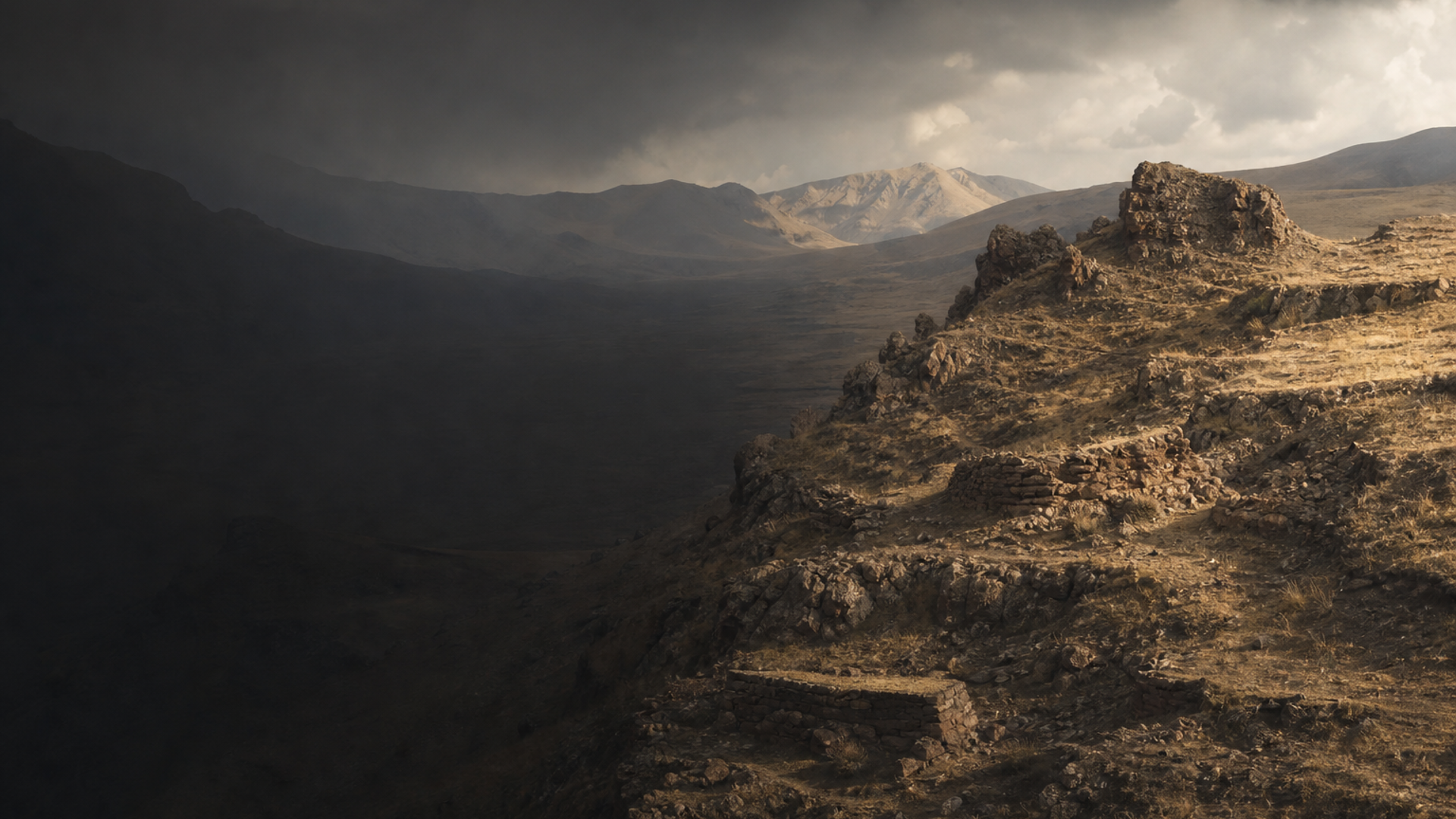
The Urartian world rose like a ring of stone around Lake Van and the Armenian highlands during the early first millennium BCE. Archaeological data indicates that Teishebaini (Karmir Blur), a heavily fortified urban center near modern Yerevan, functioned as a regional stronghold and administrative hub within the Urartian Empire between the 9th and 5th centuries BCE. Excavations at Karmir Blur have revealed concentric fortifications, workshops, and a necropolis whose burials preserve bioarchaeological material now subject to ancient DNA study.

Material culture — monumental stone architecture, glazed ceramics, bronze weaponry, and cuneiform inscriptions in the Urartian dialect — paints a picture of a literate, militarized polity engaged in state-sponsored irrigation, metalworking, and long-distance exchange. Genetic data from nine individuals excavated in the necropolis (902–417 BCE) provide a small but tangible bridge from bones to biographies. Limited evidence suggests a mix of maternal lineages with affinities both to the broader Near East and to the Caucasus. Because the sample size is under ten, any reconstruction of population origins or large-scale migrations must be regarded as preliminary.

  • Teishebaini (Karmir Blur): fortified Urartian city and necropolis
  • Material culture shows state organization, metallurgy, and literacy
  • Nine ancient genomes provide an initial genetic snapshot; evidence is preliminary
Chapter IV

Daily Life & Society

The streets of Teishebaini, as revealed by archaeology, would have been bounded by storehouses, workshops, and temples — places where artisans hammered bronze, potters shaped clay, and officials recorded transactions. Funerary deposits in the necropolis include personal ornaments, ceramics, and weaponry, suggesting that burial practices encoded status, craft identity, and possibly military roles. Osteological indicators show individuals who experienced both hard labor and occasional trauma, consistent with a frontier polity balancing agriculture, craft production, and defense.

Archaeobotanical and zooarchaeological remains indicate an economy based on irrigated agriculture and herding, augmented by trade networks that moved metal, precious stones, and pottery across the highlands. Inscriptions and administrative compilation imply centralized control over labor and resources; yet domestic artifacts attest to lived, local traditions within households. Together, these lines of evidence portray an urban society where state power and everyday life intertwined in stone, metal, and bone.

  • Necropolis burials show status differences through grave goods
  • Economy combined irrigation agriculture, herding, metallurgy, and trade
Chapter V

Genetic Profile

Nine mitochondrial genomes recovered from Karmir Blur (necropolis of Teishebaini) display haplogroups J1b (observed twice), T, I, U, and K. These maternal lineages are broadly distributed across the Near East and Eurasia: J and T are often associated with Neolithic and later Near Eastern populations, while I, U, and K appear frequently in European and Caucasian contexts. Archaeological data indicates long-standing connections across the highlands and into neighboring regions, and the mitochondrial diversity here is consistent with a crossroads population influenced by both local Caucasian ancestry and wider Near Eastern gene flow.

No consolidated Y-DNA profile is reported for these nine samples, so male-line inferences cannot be robustly drawn. Because the sample count is small (<10), statistical power is limited and patterns of continuity with modern Armenians or broader Urartian demographics remain provisional. Future sampling of additional individuals, combined with autosomal analyses, will be necessary to test hypotheses about population continuity, sex-biased migration, and the genetic impact of imperial administration. For now, the ancient mtDNA suggests a mosaic of maternal ancestries that matches the archaeological impression of a connected, multi-origin frontier society.

  • mtDNA: J1b (2), T, I, U, K — indicates Near Eastern and Caucasus affinities
  • Y-DNA: not reported; sample size (9) makes conclusions preliminary
Chapter VI

Legacy & Modern Connections

The Urartian legacy endures in the stone scars of fortresses and in toponyms preserved across the Armenian highlands. Archaeological continuity in settlement and craft traditions, combined with the mtDNA diversity from the Teishebaini necropolis, suggests that the people of the Urartian heartland were part of enduring networks that shaped later populations in the Caucasus. Limited genetic sampling prevents definitive statements about direct ancestry to modern Armenians, but the data point toward a tapestry of maternal lineages shared across the region.

As ancient DNA sampling expands, Teishebaini stands as a cinematic, tangible starting point: a place where statecraft, craft, and family intersected, and where bones whisper of connections between past peoples and present populations in the highland Caucasus.

  • Archaeological remains continue to shape regional identity in Armenia
  • Genetic links are suggestive but require larger samples for firm conclusions
AI 电源

AI 助手

就 Voices of Urartu: Teishebaini's Buried Lives 文化提问

AI 助手 由DNAGENICS公司制作

解锁此特性
Ask questions about the Voices of Urartu: Teishebaini's Buried Lives culture. Our AI assistant can explain genetic findings, historical context, archaeological evidence, and modern connections.

AI 样本分析

Voices of Urartu: Teishebaini's Buried Lives 文化是人类历史中值得了解的一章……

遗传分析揭示了与早期种群的联系,同时显示了独特的适应和文化创新的证据。 古代DNA样本提供了对迁徙模式、社会结构以及古代种群之间的生物关系的深刻见解。

这是人工智能分析的预览。 解锁全AI 助手, 以探索关于:

  • 遗传组成和祖先
  • 移徙模式和起源
  • 日常生活和文化习俗
  • 现代遗传遗产

探索更古老的文化

揭开古代世界文明的故事

使用优惠码 可减免 35% • 11月12日 到期




