Whispers of Copper: Bulgaria_C

下载的 PDF 是图像副本。如需可选中文本及更好的辅助技术支持,请使用打印功能。

Whispers of Copper: Bulgaria_C

揭开一个失落的文明

正在加载考古记录……

正在收集古代记录

跳转到主内容
Whispers of Copper: Bulgaria_C
文明焦点

Whispers of Copper: Bulgaria_C

A Chalcolithic tapestry from tells and river valleys, seen through bones and genomes

5468 CE - 4245 BCE
Bulgaria (Yunatsite, Sushina, Ivanovo, Smyadovo)
滚动开始
Chapter I

剧情

了解 Whispers of Copper: Bulgaria_C 文化

Archaeological remains dated 5468–4245 BCE from Bulgarian tells (Yunatsite, Sushina, Ivanovo, Smyadovo and others) reveal a Chalcolithic community with diverse maternal lineages (mtDNA K prominent) and mixed Y-DNA. Ancient DNA connects artifacts and migration hypotheses while emphasizing remaining uncertainties.

Time Period

5468–4245 BCE

Region

Bulgaria (Yunatsite, Sushina, Ivanovo, Smyadovo)

Common Y-DNA

R (2), G (1), F (1)

Common mtDNA

K (4), H1j, H7, N, U

Chapter II

时间线

这种文化历史上的关键时刻

5468 BCE

Earliest dated individuals

Earliest sampled individuals in the Bulgaria_C set date to 5468 BCE, from sites such as Sushina and Yunatsite, marking early Chalcolithic occupation in the region.

Chapter III

Origins & Emergence

The Bulgaria_C assemblage sits in the later Neolithic to Chalcolithic transition of the central Balkans (5468–4245 BCE). Archaeological contexts include tells and lowland settlements—Yunatsite, Sushina, Ivanovo, Smyadovo, Dzhulyunitsa, Samovodene and burials near Veliko Tarnovo—where stratified deposits record household craft, copper use and changing funerary practices. Ceramic styles and building traces point to long-term local development with contacts across the Danubian corridor and the Aegean fringe.

Skeletal remains from these sites provide the anatomical record that, when paired with ancient DNA, lets us ask who these people were and how they related to neighboring groups. Limited evidence suggests continuity with earlier Neolithic farming communities in the region, while material culture hints at new interactions in the Chalcolithic. Archaeological data indicates episodes of intensification in metallurgy and exchange, but the pace and scale of population movements remain debated. Genomic sampling (14 individuals) covers key sites but is not yet dense enough to resolve fine-grained demographic events.

Taken together, the archaeological and genetic record paints a picture of local communities adapting to technological change while remaining connected to wider networks across the Balkans. Where data are thin, interpretations remain provisional; hypotheses about migration and admixture should be evaluated as more samples and stratified contexts are analyzed.

  • Dates: 5468–4245 BCE across multiple Bulgarian tells
  • Sites include Yunatsite, Sushina, Ivanovo, Smyadovo, Dzhulyunitsa
  • Evidence of local continuity with expanding Chalcolithic contacts
Chapter IV

Daily Life & Society

Stone foundations and clay-walled houses excavated at Yunatsite and nearby tells suggest households organized around long-term site occupation. Pottery—both utilitarian and decorated—speaks to food storage, cooking and social display; archaeologists recover hearths, grinding stones and loom weights that imply mixed agriculture, dairying and textile production. Small copper objects and fragments of smelted metal appear in domestic and mortuary contexts, indicating early adoption of copper tools and ornaments during this period.

Burial evidence is variable: some individuals were interred within or near settlements, while others show secondary deposition practices. Funerary goods are modest but occasionally include copper beads or polished stone, suggesting status differentiation was emerging but not yet pronounced. Faunal remains indicate a mixed economy of domesticated cattle, sheep/goats and pigs, with supplemental hunting and freshwater resources exploited along river valleys.

Life in Bulgaria_C would have been bound to seasonal cycles, with households embedded in networks of exchange that facilitated raw materials (copper ore, stone) and ideas (ceramic forms, ritual practices). Archaeological interpretations emphasize continuity and adaptation, but precise social hierarchies and the extent of long-distance kinship ties remain open questions.

  • Mixed farming economy with household craft production
  • Early copper use alongside pottery and textile tools
Chapter V

Genetic Profile

Fourteen sampled individuals from Bulgaria_C offer a moderate snapshot of population genetics in the central Balkans during 5468–4245 BCE. Maternal lineages are dominated by mtDNA K (4 of 14), with single instances of H1j, H7, N and U; this maternal profile aligns with patterns seen in Neolithic and Chalcolithic Europe where haplogroup K is common among farming communities. On the paternal side the limited Y-chromosome diversity includes two individuals assigned to haplogroup R and single instances of G and F. The presence of R — in low frequency here — is notable because later prehistoric expansions into Europe often involve derivatives of R, but with only two R samples the connection is tentative.

Genetic data confirm that these people largely carried lineages associated with Neolithic farming populations, yet the mix of haplogroups indicates interaction and potentially subtle admixture with nearby groups. Genome-wide analyses (where available) often reveal components traceable to Anatolian farmers and local hunter-gatherers; in some Balkan Chalcolithic contexts minor influxes of new ancestry have been detected. For Bulgaria_C, the 14-sample size allows cautious statements: maternal haplogroup K is prominent, Y diversity is limited but mixed, and genome-wide inferences should be treated as provisional until larger, stratified samplings are available.
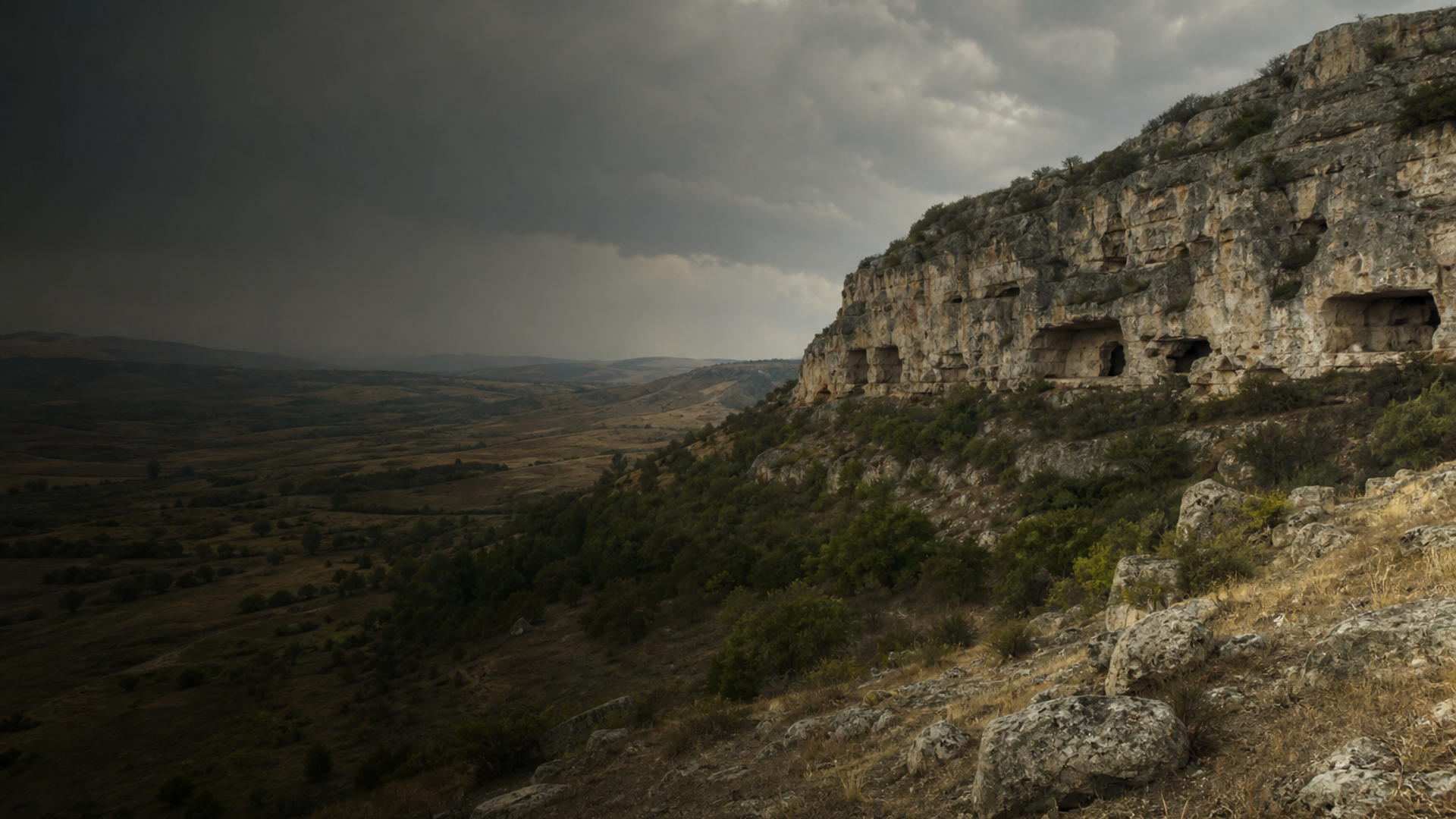

Overall, the genetic picture complements the archaeology: a community rooted in Neolithic farmer ancestry experiencing evolving social networks and occasional gene flow, but not yet showing large-scale demographic turnover within the sampled timeframe.

  • mtDNA dominated by K (4/14); other maternal lineages present
  • Y-DNA shows R (2), G (1), F (1) — limited paternal diversity
Chapter VI

Legacy & Modern Connections

The Bulgaria_C people contributed to the deep ancestral layers of the Balkans. Maternal signals—particularly multiple mtDNA K lineages—echo in later regional populations, suggesting continuity of maternal lineages through the Chalcolithic and beyond. The modest presence of Y haplogroup R hints at early threads that later become more prominent in Europe, but here they are sparse and should not be over-interpreted.

For modern genetic ancestry consumers, these samples underscore that contemporary Balkan genomes are palimpsests of many episodes: Neolithic farmer settlements, Chalcolithic social reorganization, and later Bronze Age and historic movements. Archaeology and ancient DNA together provide a cinematic but evidence-based view of continuity and contact; where data are limited, conclusions are cautious. As more genomes from stratified contexts in Bulgaria are sequenced, the nuanced story of how these early Chalcolithic communities contributed to later European genetic landscapes will become clearer.

  • Maternal continuity into later Balkan populations is suggested
  • Paternal signals (R) are present but sparse; broader sampling needed
AI 电源

AI 助手

就 Whispers of Copper: Bulgaria_C 文化提问

AI 助手 由DNAGENICS公司制作

解锁此特性
Ask questions about the Whispers of Copper: Bulgaria_C culture. Our AI assistant can explain genetic findings, historical context, archaeological evidence, and modern connections.
AI 样本分析

Whispers of Copper: Bulgaria_C 文化是人类历史中值得了解的一章……

遗传分析揭示了与早期种群的联系,同时显示了独特的适应和文化创新的证据。 古代DNA样本提供了对迁徙模式、社会结构以及古代种群之间的生物关系的深刻见解。

这是人工智能分析的预览。 解锁全AI 助手, 以探索关于:

  • 遗传组成和祖先
  • 移徙模式和起源
  • 日常生活和文化习俗
  • 现代遗传遗产

探索更古老的文化

揭开古代世界文明的故事

使用优惠码 可减免 35% • 11月12日 到期




