Whispers of Laramate, 900 BP

下载的 PDF 是图像副本。如需可选中文本及更好的辅助技术支持,请使用打印功能。

Whispers of Laramate, 900 BP

揭开一个失落的文明

正在加载考古记录……

正在收集古代记录

跳转到主内容
Whispers of Laramate, 900 BP
文明焦点

Whispers of Laramate, 900 BP

Six highland genomes from 750–1220 CE illuminate life in Peru’s Laramate uplands.

750 CE - 1220900 CE
Laramate Highlands, Peru
滚动开始
Chapter I

剧情

了解 Whispers of Laramate, 900 BP 文化

Archaeogenetic and archaeological evidence from six individuals (Botigiriayocc, Cueva Yacotogia, Tranca, Huayuncalla) dated 750–1220 CE reveals a highland Laramate population dominated by Y-haplogroup Q and maternal lineages B2, B2l, D1, C1b. Findings are preliminary but suggest deep Andean continuity.

Time Period

750–1220 CE (≈900 BP)

Region

Laramate Highlands, Peru

Common Y-DNA

Q (4 of 6 samples)

Common mtDNA

B2, B2l, D1, C1b (6 samples total)

Chapter II

时间线

这种文化历史上的关键时刻

900 CE

Highland occupations in Laramate

Archaeological and genetic data place sustained human activity in Laramate between 750–1220 CE, reflecting local adaptation during Middle Horizon to early Late Intermediate transitions.

Chapter III

Origins & Emergence

Perched in the thin air of the Laramate highlands, human presence between 750 and 1220 CE is heard in stone, pottery sherds and burial deposits. Archaeological data indicates communities occupied rocky slopes and sheltered caves at sites now recorded as Botigiriayocc, Cueva Yacotogia, Tranca and Huayuncalla. These loci sit within broader highland networks influenced by Wari-era expansion to the north and contemporaneous local developments.

The material traces — fragmentary ceramics, modified obsidian, and interment contexts reported at these sites — suggest lifeways adapted to steep terrain, with mixed cultivation of tubers and quinoa, camelid pastoralism, and seasonal mobility. Limited evidence suggests ritual use of caves and small-scale mortuary differentiation consistent with highland Andean traditions.

Chronologically the sample window spans late Middle Horizon influences into the early Late Intermediate period (regional chronologies vary). This transitional frame allows for interaction with larger polities while retaining strong local adaptations. Archaeology alone hints at a resilient mountain society; when combined with genetic data, a clearer picture of origin and continuity begins to emerge, though interpretations must remain cautious given the small sample size.

  • Sites: Botigiriayocc, Cueva Yacotogia, Tranca, Huayuncalla
  • Time frame crosses Middle Horizon into Late Intermediate (750–1220 CE)
  • Evidence for highland agriculture, camelid use, and cave-associated ritual
Chapter IV

Daily Life & Society

Life in the Laramate uplands was a daily negotiation with altitude and season. Archaeological data indicates terraced or bench agriculture in nearby valleys, complemented by hunting and herding on puna grasslands. Camelids (likely llamas and alpacas) provided meat, transport and fibre; grinding stones and charred plant remains at the sites point to tuber and cereal processing.

Socially, burials within caves and sheltered deposits suggest small kin groups with differentiated mortuary treatments. Portable items — utilitarian pottery and simple stone tools — dominated, while occasional exotic materials hint at long-distance exchange. The landscape itself shaped community rhythms: seasonal movement to lower fields in warmer months, storage and ritual observances in cool seasons.
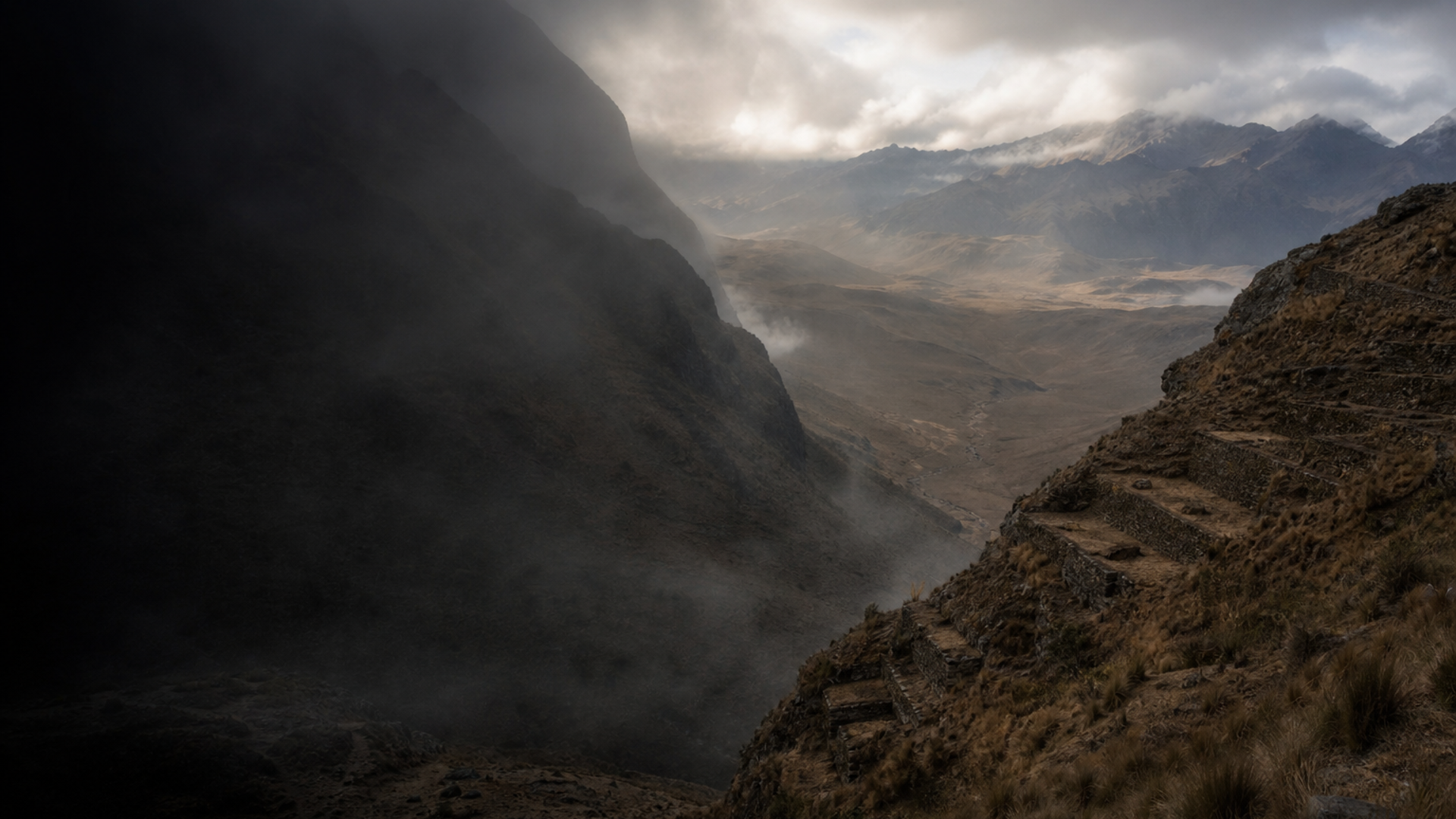

A cinematic image emerges from the remains: smoke curling from shelters, caravans of laden camelids negotiating narrow trails, and nightly gatherings where shared ancestry and landscape memory were expressed through domestic practice. Yet archaeological inference is tempered by fragmentary preservation and limited excavation scope; many reconstructions of daily life remain provisional.

  • Mixed agriculture and camelid pastoralism adapted to high altitudes
  • Small kin groups with cave-associated burials and variable material wealth
Chapter V

Genetic Profile

Six genomic samples from the Laramate assemblage provide a rare genetic window into a highland Andean population dated to 750–1220 CE. Y-chromosome haplogroup Q appears in four of the six male-associated samples — a pattern consistent with widespread Native American paternal lineages across South America. Maternal lineages recorded are B2 (three individuals), B2l (one), D1 (one), and C1b (one) — taxa frequently observed in ancient and modern Andean populations.

These mtDNA and Y-DNA signatures support archaeological suggestions of regional continuity: the Laramate genetic profile falls within the broad spectrum of Andean diversity rather than indicating major recent influxes from outside the highlands. However, the sample count is low (n=6); when sample size is under ten, population-level inferences must remain cautious. Limited sampling can overrepresent particular familial lineages or burial clusters.

Genetic affinities suggest connections to neighboring highland groups and potential continuity with present-day Andean communities, but robust conclusions require larger, spatially varied datasets. Future sampling across stratified contexts in Laramate and comparative analysis with coastal and valley genomes will refine models of migration, marriage networks, and demographic change during the Middle Horizon–Late Intermediate transition.

  • Predominant paternal lineage: Y-haplogroup Q (4/6)
  • Maternal diversity: B2, B2l, D1, C1b; consistent with Andean populations
Chapter VI

Legacy & Modern Connections

The genetic echoes of Laramate persist in modern Andean communities, reflected by shared haplogroups that span centuries. Archaeological continuity — in settlement patterns, agricultural strategies and ritual practice — aligns with genetic signals of deep regional roots. These threads suggest that despite political and climatic upheavals, local lineages endured in the highlands.

Yet the story is incomplete. With only six ancient genomes, conclusions about long-term population dynamics are preliminary. Conservatively, the Laramate data point to resilience and connection: people who shaped the highland terraces, tended camelids, and transmitted material and genetic heritage into later centuries. For present-day descendants, these findings offer a tangible, though partial, link to ancestors who inhabited Laramate’s windswept slopes.

  • Genetic continuity with broader Andean haplogroups suggests long-term regional roots
  • Small sample size means conclusions about demographic change are tentative
AI 电源

AI 助手

就 Whispers of Laramate, 900 BP 文化提问

AI 助手 由DNAGENICS公司制作

解锁此特性
Ask questions about the Whispers of Laramate, 900 BP culture. Our AI assistant can explain genetic findings, historical context, archaeological evidence, and modern connections.
AI 样本分析

Whispers of Laramate, 900 BP 文化是人类历史中值得了解的一章……

遗传分析揭示了与早期种群的联系,同时显示了独特的适应和文化创新的证据。 古代DNA样本提供了对迁徙模式、社会结构以及古代种群之间的生物关系的深刻见解。

这是人工智能分析的预览。 解锁全AI 助手, 以探索关于:

  • 遗传组成和祖先
  • 移徙模式和起源
  • 日常生活和文化习俗
  • 现代遗传遗产

探索更古老的文化

揭开古代世界文明的故事

使用优惠码 可减免 35% • 11月12日 到期




