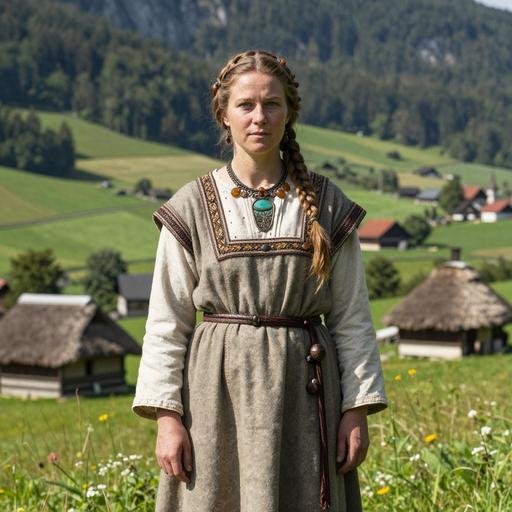
The Hallstatt Culture, named after the site at Hallstatt in modern-day Austria where rich archaeological finds were discovered, is an early Celtic culture that spanned from approximately 1200 to 500 BCE. It is generally divided into four phases (Hallstatt A, B, C, and D), with Hallstatt C and D being particularly significant to the development of Celtic Europe. This culture is considered a formative period in Celtic history, setting the stage for the later La Tène culture.
Geographical Spread
The Hallstatt Culture occupied a substantial portion of Europe, primarily centered in the regions that are today Austria, Switzerland, Germany, the Czech Republic, Slovakia, and parts of France and Italy. The culture's influence extended over a large portion of Central Europe, which allowed for interactions with other contemporary cultures, including influences from the Mediterranean civilizations.
Chronological Phases
Hallstatt A (c. 1200–1000 BCE): This phase shows a continuation from the Late Bronze Age, where societies were heavily reliant on long-distance trade and metalworking. The main burial practice at this time was cremation.
Hallstatt B (c. 1000–800 BCE): This period saw the emergence of elite leadership and a more structured society. Burials became more elaborate, indicating a rise in social stratification.
Hallstatt C (c. 800–600 BCE): This phase marks the transition from the Bronze Age to the Iron Age. Iron began to replace bronze in tools and weaponry. The so-called 'chieftain's graves' appear during this period, often richly equipped with weapons and locally made luxury goods.
Hallstatt D (c. 600–500 BCE): The society became even more hierarchical, characterized by richly furnished graves and larger fortified settlements. This period also reflects increased contact with Mediterranean cultures, visible in the imported goods found in elite graves, such as Greek pottery and Etruscan bronzes.
Material Culture
The Hallstatt Culture is known for its distinctive artifacts, such as decorated pottery, jewelry, and the celebrated Hallstatt 'C griffzeug,' a type of axe. They had intricate designs and demonstrated skilled craftsmanship. Ironworking was a significant technological advancement of this era, used for both tools and weapons, and significantly influenced societal changes.
Economy and Society
The Hallstatt economy was complex, relying heavily on agriculture, animal husbandry, and metalworking. Salt mining, especially around the Hallstatt region, played a crucial role in the development of trade networks. These networks facilitated the exchange of goods such as salt, metal, and crafted items across vast distances.
Social organization became more stratified, evident in burial practices. The emergence of a warrior class is visible in archaeological finds, with weapons such as swords and spears being common grave goods. These elites likely held power through control of trade routes and resources, particularly metal and salt.
Burial Practices
Hallstatt burial styles varied significantly but reflected the social hierarchy. Elite burials were often contained in tumuli (burial mounds) and included a wealth of grave goods, such as chariots, jewelry, weapons, pottery, and imported luxury items. Variations in burial customs between different regions indicate a complex social structure and localized practices.
Cultural Influences and Legacy
The Hallstatt Culture was influenced by and, in turn, influenced neighboring cultures. Contacts with the Italic and Greek worlds, especially during the later phases, introduced new artistic styles and technological innovations, seen in ceramics, decorative arts, and metalwork.
The Hallstatt period laid the groundwork for the subsequent La Tène culture, which is often recognized as the pinnacle of Celtic art and social organization. The societal structures, technological advancements, and trade networks developed during the Hallstatt period were crucial for the spread of Celtic influence throughout Europe.
In summary, the Hallstatt Culture represents a crucial stage in the development of early European societies, reflecting a complex interplay of technological innovation, social stratification, and cultural exchange. It set the foundation for what would become classical Celtic civilization, and its influence is still evident in the archaeological record and cultural narratives of early Europe.