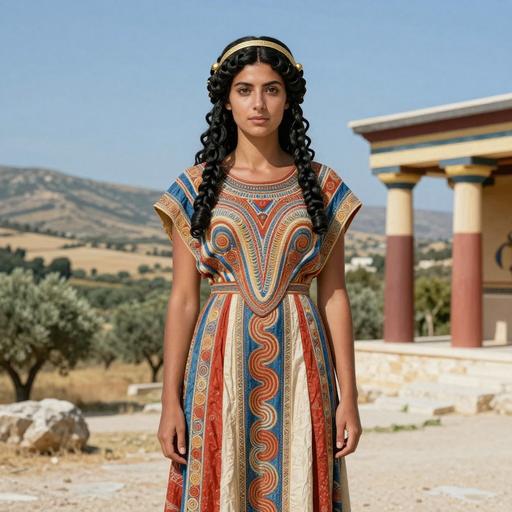
The Minoan civilization, named after the legendary King Minos, is one of the earliest recorded civilizations in Europe, flourishing on the island of Crete from approximately 2600 to 1100 BCE. Among the various regions where the Minoans established their society, Lassithi stands out as a significant area on the island of Crete, showcasing distinct characteristics and contributions to the broader Minoan culture.
Geographical Context
Lassithi is a high plateau located in the eastern part of Crete, surrounded by the Dikti Mountain range. Its unique geography provided a naturally fertile environment, making it suitable for agriculture, which played a central role in the Minoan economy. The plateau is also relatively isolated, which allowed the Minoans of Lassithi to develop some unique cultural traits while still being connected to the broader Minoan trading networks that crisscrossed the Aegean.
Architectural Achievements
The Minoans in Lassithi, like their counterparts elsewhere on Crete, are noted for their impressive architectural feats. While the most famous palaces like Knossos and Phaistos are not located directly within Lassithi, the region did host significant settlements and sanctuaries.
The Minoans constructed multi-storied buildings using advanced techniques for the time, incorporating materials such as timber, ashlar masonry, and mudbricks. The structures often included complex layouts with numerous rooms, elaborate staircases, and advanced plumbing systems that underscored their sophisticated understanding of construction and urban planning.
Economic Activities
The economy of Lassithi during the Minoan era primarily revolved around agriculture, thanks to its fertile lands. The Minoans cultivated a variety of crops, including grains, olives, and grapes. Additionally, they raised livestock such as sheep and goats.
Trade was also a significant part of Minoan life in Lassithi. The Minoans were excellent seafarers, establishing trade routes throughout the Aegean and beyond. They exchanged goods like ceramics, metals, and textiles with other ancient civilizations, including those in Egypt and the Near East.
Art and Culture
The Minoans are renowned for their vibrant and expressive art, much of which has been preserved in frescoes, pottery, and sculpture. In Lassithi, various artifacts have been discovered that reflect the broader Minoan artistic style, characterized by naturalistic themes, dynamic motion, and vivid colors. Common motifs included marine life, flora and fauna, and religious iconography.
Religion played a pivotal role in Minoan society. The Minoans practiced a form of religion that included goddess worship, with several deities linked to nature and fertility. Archaeological evidence suggests that Lassithi hosted sacred sites and peak sanctuaries where rituals and offerings took place.
Social Structure
The social structure of the Minoan civilization in Lassithi, like the rest of Crete, was complex, with evidence pointing towards a relatively peaceful society organized around palace centers. The administrative and religious elite lived in close proximity to these complex structures, from which they controlled both the economic activities and the spiritual life of the region.
Despite this hierarchical structure, Minoan society appears to have been relatively egalitarian compared to other ancient civilizations, as evidenced by the distribution of wealth and absence of fortifications, suggesting a society less concerned with warfare.
Decline and Legacy
The decline of the Minoan civilization around 1100 BCE is attributed to a combination of factors, including natural disasters such as earthquakes and volcanic eruptions—most notably the eruption of Thera (Santorini)—and invasions by the Mycenaeans from mainland Greece. Despite their decline, the Minoan civilization left a lasting legacy on Greek culture and mythology, influencing later Greek art, architecture, and religious thought.
In conclusion, Minoan Lassithi was an integral part of the larger Minoan civilization, marked by its unique geographical location, economic vitality, and rich cultural heritage. The achievements of the Minoans in Lassithi reflect the broader accomplishments of this remarkable civilization, offering valuable insights into the early development of human society in the Aegean region.