انتقل إلى المحتوى الرئيسي
ملفات الحمض النووي

Sealand Early Viking Echoes

Preliminary genetic snapshot from Tollemosegard and Hundstrup Mose (660–1000 CE)

660 CE - 1000 CE
Sealand, Denmark

القصة

Six Early Viking Age individuals from Sealand (Tollemosegard; Hundstrup Mose) offer a tentative view of local male lineages (I, I1) and diverse maternal haplotypes (H, J, HV6, V25, U). Limited samples mean conclusions are preliminary, but archaeological context links them to coastal Denmark’s changing world.

Time Period

660–1000 CE

Region

Sealand, Denmark

Common Y-DNA

I (3), I1 (1)

Common mtDNA

H (2), J, HV6, V25, U

الخط الزمني

660 CE

Earliest sampled individuals

Radiocarbon-calibrated remains from Sealand date to the late 7th century, marking the earliest samples in this set.

793 CE

Lindisfarne raid (start of Viking Age horizons)

The attack on Lindisfarne signaled growing maritime raiding and wider Scandinavian contact across Europe, contextualizing shifts in the period.

965 CE

Consolidation under Harald Bluetooth

Around the mid-10th century, rulers consolidated territories and Christianity spread, altering social landscapes in Denmark by century's end.

Origins & Emergence

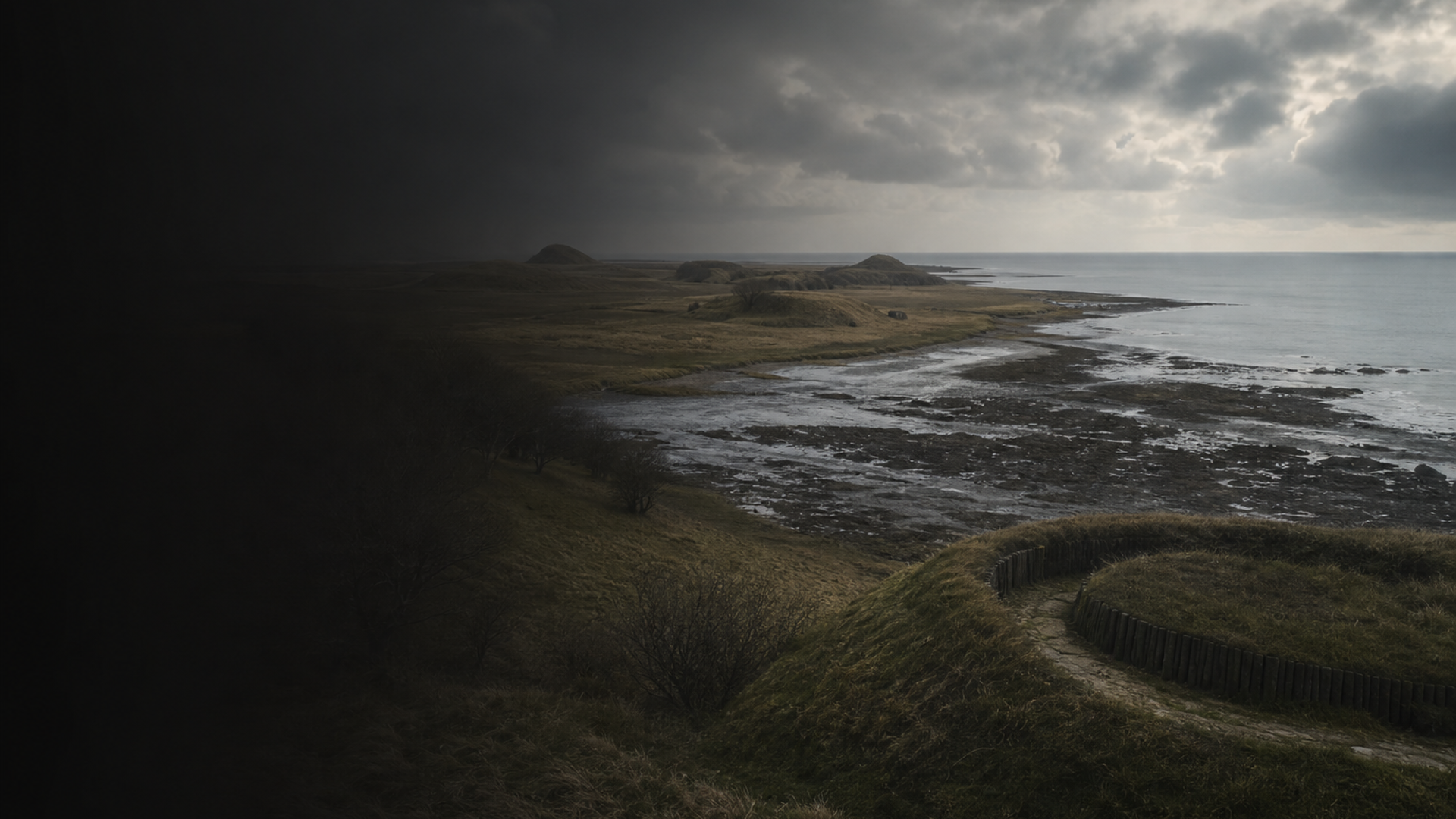
The bones and teeth recovered from Sealand — principally at Tollemosegard and Hundstrup Mose — speak in a quiet, peat-preserved voice about communities living on the edge of the Baltic. Archaeological data indicates activity at these localities spans the transition into the Viking Age. The date range for the genetic samples (660–1000 CE) covers the late Iron Age into the Early Viking Age, a period of intensifying maritime contact, craft specialization, and social reconfiguration across Denmark.

Limited evidence suggests these individuals derive largely from regional north-central European gene pools that had been established in Scandinavia for centuries. Material culture from coastal Zealand shows continuity in farming, fishing, and small-scale craft, even as long-distance voyages and raiding began to reshape political horizons after the late 8th century. Wetland contexts such as bogs on Sealand can preserve human remains and sometimes indicate ritual or depositional practices; however, without a larger comparative dataset, it remains uncertain whether these samples represent typical local inhabitants or unusual depositional events.

Because only six genomes are available, any model of population emergence must be cautious. These remains are a tantalizing glimpse — fragments of identity that, when placed alongside larger regional datasets, will refine our understanding of how local communities adapted and connected during the first centuries of the Viking expansion.

  • Samples dated 660–1000 CE bridge late Iron Age and Early Viking Age
  • Sites: Tollemosegard and Hundstrup Mose (Sealand), often wetland contexts
  • Small sample size means origins remain provisional

Daily Life & Society

Imagine a shoreline of salt wind and reed; farmers, fishers, and craftsmen tending fields and boats on Sealand. Archaeology from Zealand indicates mixed economies: cereal agriculture, animal husbandry, coastal fishing, and localized craft production. Settlements often cluster near waterways that served as highways for trade and seasonal mobility. Objects traded across the Baltic and North Sea — metalwork, glass bead fragments, and raw materials — hint at networks extending beyond Denmark.

Social life in Early Viking Denmark balanced kin-based obligations with growing opportunities for wealth accumulation through maritime ventures. Burials in the region vary from cremation to inhumation; ship burials are characteristic elsewhere in Scandinavia but are not ubiquitous. Wetland finds from sites like Hundstrup Mose sometimes reflect ritual deposition practices that coexisted with cemetery burials.

For the six individuals sampled, the archaeological contexts are key to interpreting their lives. If retrieved from bog deposits, they could represent special depositional contexts rather than routine burial. The small dataset cannot capture social stratification or gendered roles across Sealand, but it offers human faces to the artifacts and structures uncovered in excavations: people rooted in local landscapes even as horizons expanded.

  • Economy combined farming, fishing, and local crafts with long-distance exchange
  • Wetland contexts may indicate ritual deposition; burial practices were diverse

Genetic Profile

The genetic snapshot from Sealand is modest but revealing. Among six Early Viking Age individuals, uniparental markers show a majority of Y-chromosome haplogroups assigned to haplogroup I (three individuals), including one identified more specifically as I1 — a lineage today common across Scandinavia and often associated with long-standing northern European paternal ancestry. Maternal lineages are diverse: two individuals carry mtDNA H (a widespread West Eurasian lineage), and others fall into J, HV6, V25, and U subclades. This mix suggests maternal diversity consistent with regional populations of northern Europe.

These uniparental markers point toward continuity with preexisting Scandinavian gene pools rather than wholesale replacement by distant migrants, but the evidence is preliminary. With only six samples, frequency estimates are unstable and sensitive to sampling bias. The presence of I1 is notable because it frequently appears in later Scandinavian and Viking-associated datasets, potentially reflecting male-line continuity or drift.

Genome-wide data would be needed to resolve questions about ancestry proportions (local northern European hunter-gatherer/Neolithic farmer/steppe-related contributions) and to detect signatures of mobility, admixture, or sex-biased migration. Until more individuals from Zealand and neighboring regions are sequenced, interpretations remain cautious: these genomes are early threads in a larger tapestry that will require more sampling to fully weave.

  • Y-DNA dominated by haplogroup I (3 total); I1 present (1)
  • mtDNA supports maternal diversity: H (2), J, HV6, V25, U; conclusions preliminary

Legacy & Modern Connections

The genetic signals from these Sealand individuals resonate faintly in modern northern Europe. Haplogroup I1, observed among the Tollemosegard/Hundstrup Mose samples, remains common in contemporary Scandinavian populations and is often invoked as a marker of deep regional continuity. Likewise, mtDNA lineages such as H and U persist widely across Europe, reflecting long-term maternal chains.

Yet caution is essential. Six genomes cannot define population trajectories, nor can they map the full complexity of cultural change: conversion to Christianity, political consolidation under rulers like Harald Bluetooth in the 10th century, and intensifying long-distance contact all reshaped Denmark. These Early Viking Age genomes are evocative fragments — they remind us that modern Danes carry many ancestral threads, and that local continuity existed alongside mobility and exchange. As more ancient genomes from Zealand and adjacent regions accumulate, we will get a clearer, richer picture of how these early medieval communities connect to the present.

  • I1 presence suggests paternal continuity with later Scandinavian populations
  • Modern genetic similarities likely reflect long-term regional ancestry plus later admixture

مساعد الذكاء الاصطناعي

مساعد الذكاء الاصطناعي من DNA Genics

فتح هذه الميزة
اطرح أسئلة عن ثقافة Sealand Early Viking Echoes. يمكن للمساعد شرح النتائج الجينية والسياق التاريخي والأدلة الأثرية والصلات بالعصر الحديث.
مثال على تحليل بالذكاء الاصطناعي

لمحة عن ثقافة Sealand Early Viking Echoes

تساعد عينات الحمض النووي القديم الباحثين على دراسة أنماط الهجرة والعلاقات الجينية بين المجموعات السكانية القديمة.

هذه معاينة للتحليل. يتيح المساعد الكامل استكشاف الموضوعات التالية:

  • التركيب الجيني والأصول
  • أنماط الهجرة والأصول
  • الحياة اليومية والممارسات الثقافية
  • الإرث الجيني المعاصر