Baja Shores: Ancient Peninsula Peoples

Download PDF creates a visual, rasterized copy. Use Print for selectable text and better assistive-technology support.

Bericht wird vorbereitet

Verfügbare Informationen und Referenzen werden geladen

Verbindung mit dem archäologischen Quellenbestand...

Alte Quellen werden zusammengestellt

Zum Hauptinhalt springen
Baja Shores: Ancient Peninsula Peoples
Zivilisations-Spotlight

Baja Shores: Ancient Peninsula Peoples

Archaeology and DNA from Iron Springs and Comondú hint at long coastal lifeways on Baja.

3000 BCE - 1500 CE
Baja California, Mexico
Scrollen zum Start
Kapitel I

Die Geschichte

Die Baja Shores: Ancient Peninsula Peoples-Kultur verstehen

Preliminary archaeological and ancient DNA evidence from Iron Springs and Comondú, Baja California (3000 BCE–1500 CE) suggests long-standing coastal hunter-gatherer occupations. Small sample size (2) limits conclusions; genetic markers include Y‑DNA Q and mtDNA B and C.

Time Period

3000 BCE – 1500 CE

Region

Baja California, Mexico

Common Y-DNA

Q (observed)

Common mtDNA

B, C (observed)

Kapitel II

Zeitleiste

Zentrale Momente in der Geschichte dieser Kultur

2500 BCE

Early coastal occupation evidence

Radiocarbon and stratigraphic data indicate human presence along Baja shores—shell middens and hearths at sites like Iron Springs suggest sustained coastal use.

Kapitel III

Origins & Emergence

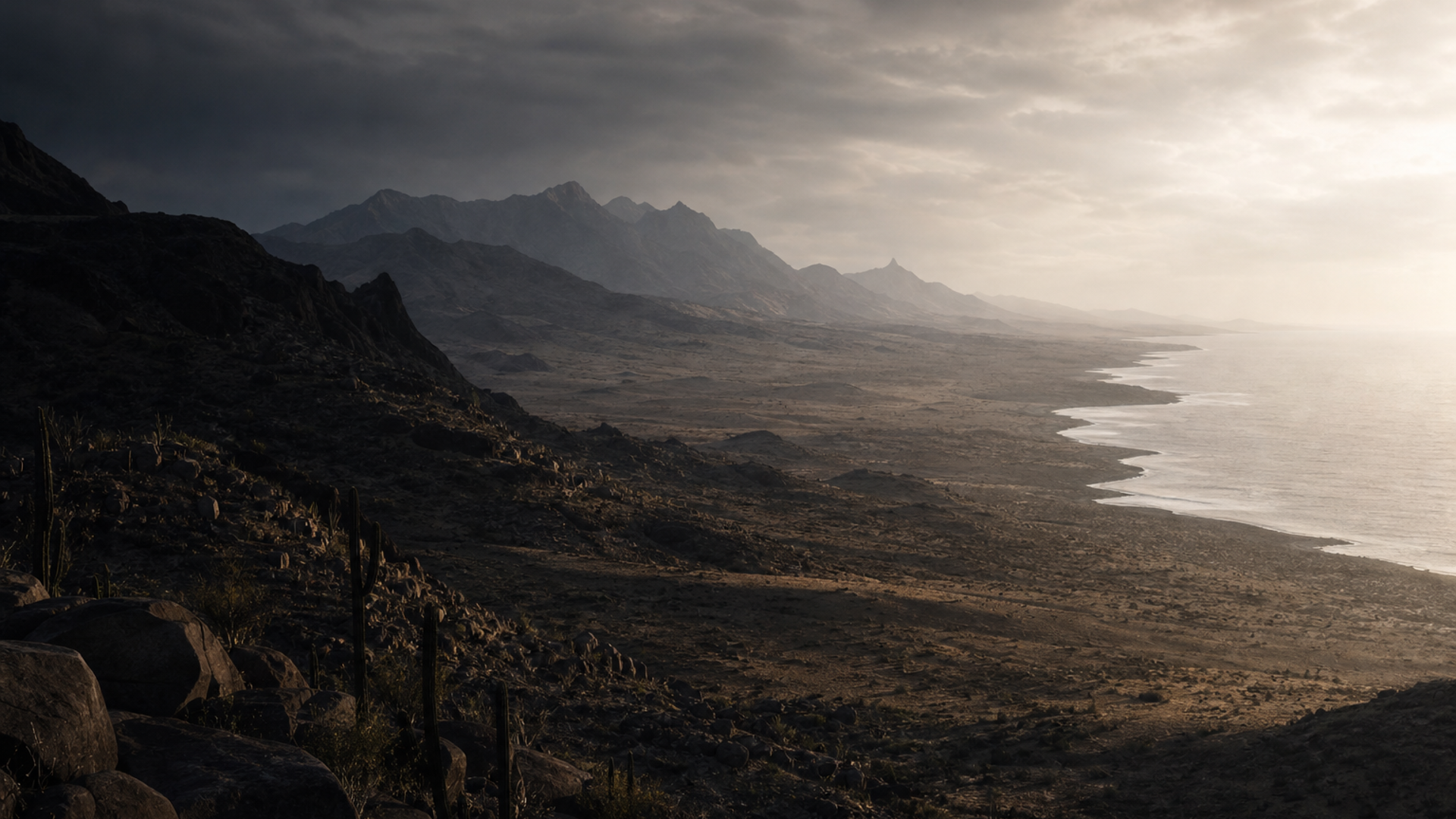
Along the ragged coastline of the Baja Peninsula, the archaeological record feels like an echo of waves—layers of shell, hearths, and scattered stone tools that speak to people tied to both sea and desert. Site assemblages at Iron Springs (northern Baja) and Comondú (central Baja) yield stratified deposits and radiocarbon dates spanning millennia, suggesting episodes of human presence between roughly 3000 BCE and the late first millennium CE. Archaeological data indicates sustained coastal foraging and adaptive strategies framed by seasonal calendrical rhythms.

Limited evidence suggests these communities were part of long-lived networks of mobility rather than dense agrarian settlements: middens rich in marine mollusks, fish bones, and occasional terrestrial faunal remains point to an economy tuned to shoreline resources. Lithic technology tends toward expedient flake tools and occasional ground stone—toolkits consistent with mobile hunter-gatherer lifeways seen elsewhere along northwest Mexico.

Genetic signals, while sparse, align with archaeological impressions of continuity. However, only two ancient DNA samples exist from these sites, so any model of emergence must remain provisional. The cinematic sweep of Baja’s cliffs and coves frames human stories that are visible in fragments; the combined view of artifacts, features, and genetics begins to outline how peoples first anchored themselves to this unique coastal margin.

  • Archaeological sites: Iron Springs and Comondú, Baja California
  • Occupation evidence between 3000 BCE and 1500 CE
  • Economy oriented to coastal foraging and mobility
Kapitel IV

Daily Life & Society

Daily life on the Baja shoreline was shaped by tide and season. Shell middens and hearth features excavated at Iron Springs and Comondú preserve a tangible diet: abundant marine shellfish, fish remains, and episodic terrestrial hunting. Archaeological data indicates small, mobile household groups exploiting rocky shorelines, estuaries, and intermittent freshwater sources. Sheltered coves would have served as temporary base camps for processing catches, repairing nets or lines, and social exchange.

Material culture is modest but expressive. Stone tools—small blades, scrapers, and ground stone fragments—speak to routine tasks: filleting fish, working hides, and preparing plant foods. Occasional ornaments and modified shells suggest personal adornment and social signaling. Spatial patterns of middens and hearths imply short-term aggregations rather than permanent nucleated villages, consistent with ethnographic analogues of coastal hunter-gatherers.

Social organization likely emphasized kin ties and flexible alliances, with mobility strategies tailored to tidal and seasonal productivity. Yet because excavation footprints are limited and ancient DNA samples are only two, reconstructions of social complexity remain tentative. The archaeological traces evoke a resilient human presence shaped by the light, wind, and sea of Baja’s shores.

  • Shell middens and hearths indicate coastal diets
  • Small, mobile groups with toolkits for marine resource processing
Kapitel V

Genetic Profile

Ancient DNA from the Baja sample set is extremely limited—only two individuals have yielded analyzable genetic data—so interpretations must be cautious. Both mitochondrial and Y-chromosome markers recovered align broadly with Native American genetic diversity. One individual carries a Y-DNA lineage assigned to haplogroup Q, a pan-American paternal lineage commonly observed across indigenous populations of the Americas. Mitochondrial haplogroups observed include B and C, both well-attested matrilineal clades within prehistoric and modern Native American datasets.

The presence of Q on the paternal side and B/C on the maternal side is consistent with continental-scale patterns of ancestry and does not, on its own, demonstrate unique migration events within Baja. Archaeological continuity seen at Iron Springs and Comondú pairs with this genetic pattern to suggest local persistence or repeated reoccupation by groups within the broader Native American gene pool. However, with n=2 samples, population-level inferences—such as continuity versus replacement, degrees of admixture, or microregional structure—are preliminary at best.

Future sampling across stratified contexts and additional genomic coverage could reveal whether Baja communities retained genetic continuity over millennia, show signals of coastal-specific adaptation, or reflect episodic gene flow from mainland regions. For now, the genetic data provide tantalizing, but tentative, anchors to the broader story written in shell and stone.

  • Y-DNA: haplogroup Q observed (1 sample)
  • mtDNA: haplogroups B and C observed (1 each); small sample size (2) limits conclusions
Kapitel VI

Legacy & Modern Connections

The human imprint on Baja is persistent: the same coves and rock shelters that preserved ancient middens remain part of coastal Indigenous geographies and memory. Archaeological remains from Iron Springs and Comondú connect to living cultures in northwestern Mexico through shared landscapes and subsistence traditions, even if direct genealogical links require more genetic and ethnographic study. Contemporary Indigenous communities and regional histories provide cultural continuity that complements and complicates archaeological narratives.

Genetically, the observed haplogroups link these ancient individuals to broader Native American lineages, reinforcing a deep, continent-wide heritage. Yet the scarcity of samples demands humility: current genetic signals are consistent with longstanding regional presence but cannot by themselves trace precise ancestries to modern groups. Ongoing collaboration with descendant communities, expanded sampling, and respectful integration of oral histories will be essential to fully illuminate Baja’s past and its living legacies.

  • Archaeology echoes in modern coastal Indigenous lifeways
  • Genetic links to broader Native American lineages, but conclusions are tentative
KI-gestützt

KI-Assistent

Stellen Sie Fragen zur Baja Shores: Ancient Peninsula Peoples-Kultur

KI-Assistent von DNAGENICS

Funktion freischalten
Stellen Sie Fragen zur Kultur Baja Shores: Ancient Peninsula Peoples. Unser KI-Assistent kann genetische Befunde, historischen Kontext, archäologische Belege und moderne Verbindungen erläutern.
Beispiel einer KI-Analyse

Die Baja Shores: Ancient Peninsula Peoples-Kultur ist ein faszinierendes Kapitel der Menschheitsgeschichte...

Genetische Analysen zeigen Übereinstimmungen mit früheren Populationen und Hinweise auf besondere Anpassungen und kulturelle Innovationen. Alte DNA-Proben liefern Einblicke in Migrationsmuster, soziale Strukturen und genetische Verbindungen zwischen Populationen.

Dies ist eine Vorschau der KI-Analyse. Schalten Sie den vollständigen KI-Assistenten frei, um detaillierte Einblicke zu erkunden:

  • Genetische Zusammensetzung und genetische Ähnlichkeit
  • Migrationsmuster und Ursprünge
  • Alltag und kulturelle Praktiken
  • Genetischer Bezug zu heutigen Populationen

Weitere antike Kulturen erkunden

Geschichten von Zivilisationen aus der antiken Welt entdecken

Use code for 35% off • Expires Nov 09




