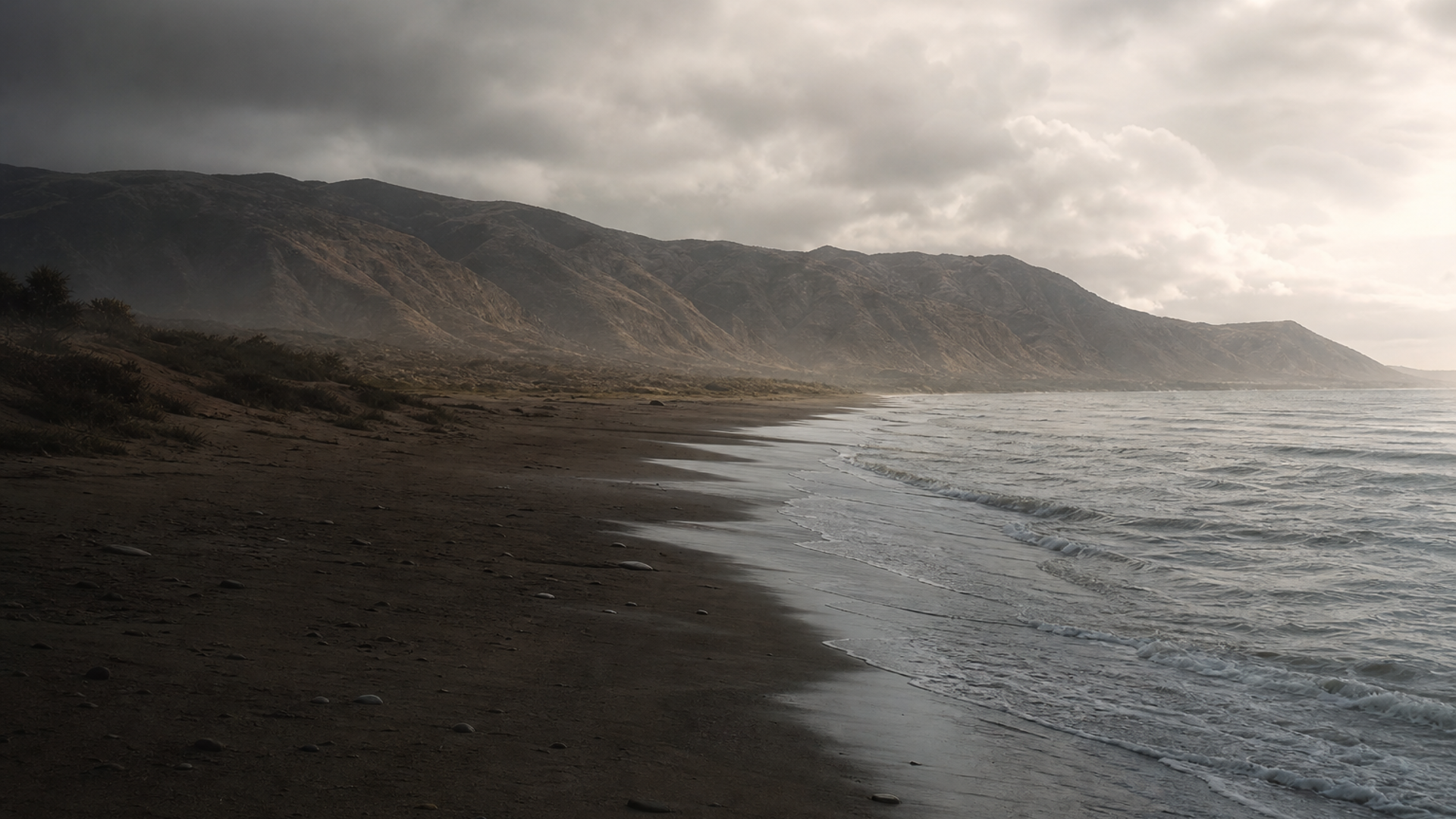
Carpinteria Shoreline, ca. 7000 BP

Download PDF creates a visual, rasterized copy. Use Print for selectable text and better assistive-technology support.

Bericht wird vorbereitet

Verfügbare Informationen und Referenzen werden geladen

Verbindung mit dem archäologischen Quellenbestand...

Alte Quellen werden zusammengestellt

Zum Hauptinhalt springen
Carpinteria Shoreline, ca. 7000 BP
Zivilisations-Spotlight

Carpinteria Shoreline, ca. 7000 BP

Early Holocene coastal people from CA-SBA-7 revealed by archaeology and DNA

5250 CE - 50007000 BCE
Carpinteria, California, USA (CA-SBA-7 / Mishopshnow)
Scrollen zum Start
Kapitel I

Die Geschichte

Die Carpinteria Shoreline, ca. 7000 BP-Kultur verstehen

Archaeological and genetic evidence from six individuals (CA-SBA-7, Carpinteria, Mishopshnow; 5250–5000 BCE) illuminates early Holocene coastal life in southern California and hints at links to later Chumash heritage. Limited samples make conclusions preliminary.

Time Period

5250–5000 BCE (≈7000 BP)

Region

Carpinteria, California, USA (CA-SBA-7 / Mishopshnow)

Common Y-DNA

Q (observed in 2/6)

Common mtDNA

A (5/6), B2b (1/6)

Kapitel II

Zeitleiste

Zentrale Momente in der Geschichte dieser Kultur

5250 BCE

Human remains sampled at CA-SBA-7

Six individuals dated to ~5250–5000 BCE were analyzed for ancient DNA at the Carpinteria site, providing preliminary genetic insights into early coastal populations.

Kapitel III

Origins & Emergence

Along the fog-silvered shores of what is now Carpinteria, Mishopshnow, a small group of coastal communities lived at the edge of ocean and land during the early Holocene (5250–5000 BCE). Archaeological data from CA-SBA-7 include human remains and associated coastal deposits that indicate sustained exploitation of marine and nearshore resources as sea levels and coastal ecologies stabilized after the last deglaciation. The landscape was a mosaic of kelp forests, estuaries, and rocky shores that shaped mobility, diet, and material culture.

Limited evidence suggests continuity of coastal lifeways in this region across millennia, and some traits observed at CA-SBA-7 resonate with later Chumash cultural patterns recorded ethnographically and archaeologically. However, only six individuals have been sampled from the site; with such a small dataset, any narrative of direct cultural descent remains provisional. Archaeological context combined with emerging ancient DNA creates a richer, though tentative, picture of how early southern California coastal populations organized themselves in a changing environmental setting.

  • Site: CA-SBA-7 (Carpinteria, Mishopshnow), southern California
  • Date range: 5250–5000 BCE (early Holocene)
  • Evidence: human remains and coastal deposits; small sample size limits broad inference
Kapitel IV

Daily Life & Society

Evocative shoreline scenes—shell middens, fish bones, and stone tools—frame how people at CA-SBA-7 likely lived. Archaeological indicators point to a diet rich in marine foods: fish, shellfish, and sea mammals would have been reliable resources. Tools and debris from processing seafood and plant materials suggest specialized seasonal activities and intimate knowledge of tidal rhythms.

Social life on the Carpinteria coast may have been organized in flexible, kin-based groups with mobility tuned to resource pulses. Ethnographic parallels with historic Chumash communities show complex social networks, craft specialization (e.g., basketry, shell bead production), and exchange along the coast; archaeological traces of such complexity at CA-SBA-7 are sparse but suggestive. Given the small number of recovered individuals and limited material remains, reconstructions of social structure must remain cautious and emphasize variability and adaptability to coastal environments.

  • Marine-focused subsistence with probable seasonal scheduling
  • Kin-based, mobile groups adapted to coastal resource patterns
Kapitel V

Genetic Profile

Six ancient individuals sampled from CA-SBA-7 provide the first glimpses of local genetic ancestry at ~7000 BP. Maternally, five individuals carry mtDNA haplogroup A, and one carries B2b. Haplogroup A is one of the founding Native American maternal lineages and its prevalence here aligns with broader patterns in coastal and inland populations of North America. The presence of B2b, while less common in this small set, adds to maternal diversity at the site.

Paternally, two of the six individuals carry Y-chromosome haplogroup Q, a Y-lineage frequently observed among Indigenous populations across the Americas. The remaining male lineages in this sample are either undetermined or not reported, so assessment of paternal diversity is limited. With only six genomes, statistical power is low: observed frequencies can reflect chance, kinship among sampled individuals, or real local structure. Archaeogenetic signals are promising for connecting CA-SBA-7 to regional ancestry patterns and later Chumash-related groups, but any inference about long-term continuity or migration must be framed as provisional until larger sample sets and broader geographic comparisons are available.

  • MtDNA dominated by haplogroup A (5/6), B2b present in 1 individual
  • Y-DNA Q observed in 2 individuals; sample size limits strong conclusions
Kapitel VI

Legacy & Modern Connections

The individuals of CA-SBA-7 occupy a cusp between archaeology and ancestry—tangible traces of lives lived on a dynamic coastline and genetic threads that echo in later southern California populations. Archaeological affinities and mtDNA patterns suggest potential connections to the cultural trajectory that includes Chumash peoples, yet continuity cannot be asserted definitively from six samples alone. Modern descendant communities and broader genetic datasets are essential for responsibly situating these early Holocene people within long regional histories.

These remains highlight the power of combining excavation context with ancient DNA: together they allow us to speak about mobility, kinship, and resilience in evocative but measured terms. Future sampling, respectful collaboration with Indigenous communities, and expanded regional analyses will be necessary to move from promising hints toward robust narratives of ancestry and cultural transformation.

  • Potential links to later Chumash cultural landscapes remain tentative
  • Broader sampling and Indigenous collaboration needed for fuller understanding
KI-gestützt

KI-Assistent

Stellen Sie Fragen zur Carpinteria Shoreline, ca. 7000 BP-Kultur

KI-Assistent von DNAGENICS

Funktion freischalten
Stellen Sie Fragen zur Kultur Carpinteria Shoreline, ca. 7000 BP. Unser KI-Assistent kann genetische Befunde, historischen Kontext, archäologische Belege und moderne Verbindungen erläutern.
Beispiel einer KI-Analyse

Die Carpinteria Shoreline, ca. 7000 BP-Kultur ist ein faszinierendes Kapitel der Menschheitsgeschichte...

Genetische Analysen zeigen Übereinstimmungen mit früheren Populationen und Hinweise auf besondere Anpassungen und kulturelle Innovationen. Alte DNA-Proben liefern Einblicke in Migrationsmuster, soziale Strukturen und genetische Verbindungen zwischen Populationen.

Dies ist eine Vorschau der KI-Analyse. Schalten Sie den vollständigen KI-Assistenten frei, um detaillierte Einblicke zu erkunden:

  • Genetische Zusammensetzung und genetische Ähnlichkeit
  • Migrationsmuster und Ursprünge
  • Alltag und kulturelle Praktiken
  • Genetischer Bezug zu heutigen Populationen

Weitere antike Kulturen erkunden

Geschichten von Zivilisationen aus der antiken Welt entdecken

Use code for 35% off • Expires Nov 09