Chacoan Voices of Pueblo Bonito

Download PDF creates a visual, rasterized copy. Use Print for selectable text and better assistive-technology support.

Zum Hauptinhalt springen
Zivilisations-Spotlight

Chacoan Voices of Pueblo Bonito

Genetic traces from Pueblo Bonito illuminate a storied Chaco Canyon community.

885 CE - 1154 CE
Chaco Canyon, New Mexico, USA

Die Geschichte

Archaeogenetic and archaeological evidence from Pueblo Bonito (885–1154 CE) ties Chacoan great-house life to Native American maternal and paternal lineages. Limited samples show mtDNA B2 and Y-DNA Q, suggesting regional continuity but requiring more data for firm conclusions.

Time Period

885–1154 CE

Region

Chaco Canyon, New Mexico, USA

Common Y-DNA

Q (observed in 2/5 samples)

Common mtDNA

B2 (observed in 5/5 samples)

Zeitleiste

1020 CE

Chacoan florescence at Pueblo Bonito

Major construction and peak use of Pueblo Bonito occurred during the 10th–11th centuries CE, marked by extensive masonry, great kivas, and regional exchange networks.

Origins & Emergence

The story of Chaco Canyon unfolds in layered stone and the quiet ledger of tree rings. Pueblo Bonito, the monumental great house at the heart of Chaco (New Mexico), grew between roughly 885 and 1154 CE into an architectural and ceremonial focus with multistory masonry, room suites, and large kivas. Archaeological data indicates that this florescence was the product of long-term regional aggregation: communities across the San Juan Basin participated in the construction of roads, great-house architecture, and ritual exchange networks.

Dendrochronology (tree-ring dating), stratigraphic excavation, and artifact typologies anchor Pueblo Bonito’s main construction phases to the late 9th through the 12th centuries CE. Radiocarbon and tree-ring dates place major building episodes and occupancy across this window, revealing periods of intensive construction around the 10th–11th centuries CE.

Limited evidence suggests Chaco functioned as a regional node for ceremonial activity, craft production, and long-distance exchange (turquoise, shell, timber). While the architectural spectacle implies centralized organization, archaeological patterns also point to complex, multi-scalar social relationships among households, ritual specialists, and visiting groups. The visible monuments at Pueblo Bonito thus reflect both local adaptation to the high desert and far-reaching social ties across the ancient Southwest.

  • Pueblo Bonito construction and use: c. 885–1154 CE
  • Anchored by dendrochronology, stratigraphy, and artifact typologies
  • Chaco as a regional ceremonial and exchange center

Daily Life & Society

Life in Chaco Canyon combined the quotidian rhythms of agriculture with the ritual choreography of large communal spaces. Households cultivated maize, beans, and squash on marginal high-desert fields and in small irrigated terraces; storage rooms and food caches in great houses point to seasonal planning and stockpiling. The monumental rooms and plazas at Pueblo Bonito hosted public ceremony, feasting, and craft activities that bound communities together.

Material culture—ceramics, masonry styles, turquoise ornaments, and imported marine shell—testifies to wide-ranging exchange networks. Artisans at Chaco likely specialized in masonry, woodworking (using timber from distant uplands), and fine pottery. The existence of great kivas and aligned architectural features suggests coordinated ritual practice and astronomical observation, but archaeological interpretations remain cautious about pinning down exact religious doctrines.

Socially, evidence supports differential access to space and resources: larger room suites and elite-associated artifacts indicate household variability, while communal structures and road systems emphasize shared ceremonial life. However, the lived experience of ordinary people—children, artisans, and farmers—remains piecemeal in the record, and many inferences rest on patterns rather than direct testimony.

  • Mixed farming economy with planned storage and seasonal mobility
  • Craft specialization, long-distance exchange, and communal ritual centers

Genetic Profile

Archaeogenetic sampling from Pueblo Bonito provides a rare window into the biological heritage of Chacoan inhabitants, but the dataset is small (five individuals) and must be treated as preliminary. All five mitochondrial genomes belong to haplogroup B2, a maternal lineage commonly found among Indigenous peoples throughout North, Central, and South America. This consistent presence of B2 across the sampled individuals suggests maternal continuity with Native American maternal lineages that are widespread in the Southwest and beyond.

On the paternal side, two of the male samples carry Y-chromosome haplogroup Q, a lineage that is likewise characteristic of Indigenous populations across the Americas and is often interpreted as reflecting deep precontact paternal ancestry. The co-occurrence of B2 (mtDNA) and Q (Y-DNA) aligns with expectations for local Indigenous ancestry in the prehistoric Southwest, but the small sample count (n = 5) constrains demographic inference.

Archaeogenetic signals here can indicate regional continuity, potential kin networks within great houses, or localized demographic patterns, but distinguishing among these scenarios requires far larger, geographically diverse samples and integration with osteological and archaeological context. In short: the genetic data are consistent with Native American ancestry patterns but are not yet robust enough to resolve migration, kinship structure, or fine-scale population dynamics at Chaco.
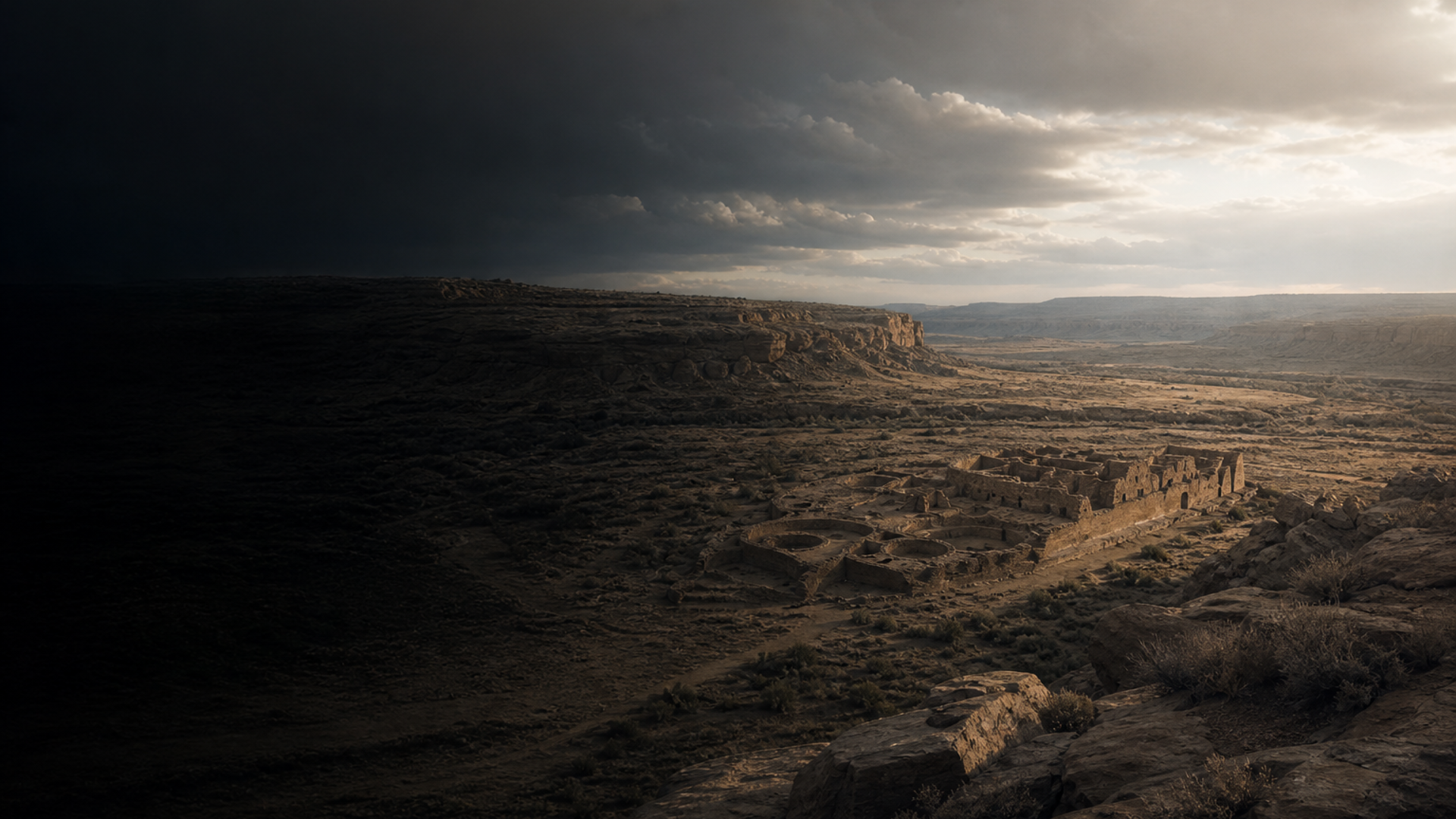

  • All five mtDNA samples: haplogroup B2 (maternal continuity signal)
  • Two Y-DNA samples: haplogroup Q (paternal lineages typical of the Americas)

Legacy & Modern Connections

The stone geometry of Pueblo Bonito endures as a cultural landmark for descendant communities and scholars alike. Genetic signals from a small set of ancient remains hint at continuity with Indigenous peoples of the Americas, but modern cultural and genetic identities arise from centuries of complex interaction, continuity, and change. Archaeological landscapes—roads, great houses, ceremonial kivas—remain places of memory and stewardship for contemporary Pueblo peoples.

Modern collaborations between tribes, archaeologists, and geneticists emphasize ethical engagement, repatriation, and the limits of what ancient DNA alone can tell us. While mtDNA B2 and Y-DNA Q in these samples are consistent with broader Native American ancestry, responsible interpretation centers community perspectives and recognizes that ancestral ties are expressed through language, ritual practice, oral history, and ongoing cultural life, not genetics alone.

  • Ancient DNA suggests regional Indigenous continuity but is not definitive
  • Ongoing collaboration and ethical stewardship are essential for interpretation

KI-Assistent

KI-Assistent von DNAGENICS

Funktion freischalten
Stellen Sie Fragen zur Kultur Chacoan Voices of Pueblo Bonito. Unser KI-Assistent kann genetische Befunde, historischen Kontext, archäologische Belege und moderne Verbindungen erläutern.
Beispiel einer KI-Analyse

Die Chacoan Voices of Pueblo Bonito-Kultur ist ein faszinierendes Kapitel der Menschheitsgeschichte...

Genetische Analysen zeigen Übereinstimmungen mit früheren Populationen und Hinweise auf besondere Anpassungen und kulturelle Innovationen. Alte DNA-Proben liefern Einblicke in Migrationsmuster, soziale Strukturen und genetische Verbindungen zwischen Populationen.

Dies ist eine Vorschau der KI-Analyse. Schalten Sie den vollständigen KI-Assistenten frei, um detaillierte Einblicke zu erkunden:

  • Genetische Zusammensetzung und genetische Ähnlichkeit
  • Migrationsmuster und Ursprünge
  • Alltag und kulturelle Praktiken
  • Genetischer Bezug zu heutigen Populationen
Use code for 30% off • Expires Nov 15




