Echoes of Emporion

Download PDF creates a visual, rasterized copy. Use Print for selectable text and better assistive-technology support.

Zum Hauptinhalt springen
Zivilisations-Spotlight

Echoes of Emporion

Greek voices on the Catalan shore revealed through archaeology and ancient DNA

752 CE - 350 BCE
Girona, Empúries (Spain)

Die Geschichte

Archaeological and genetic evidence from Empúries (Girona) illuminates Greek colonial presence in northeastern Iberia between 752–350 BCE. Ten genomes hint at a mixed community of Mediterranean and local ancestry; conclusions remain provisional given limited sampling.

Time Period

752–350 BCE

Region

Girona, Empúries (Spain)

Common Y-DNA

R (6/10)

Common mtDNA

U, HV, H, K

Zeitleiste

575 BCE

Founding of Empúries (Emporion)

Estimated foundation of the Greek trading emporium at Empúries, initiating sustained contact between Greek colonists and indigenous Iberian communities.

Origins & Emergence

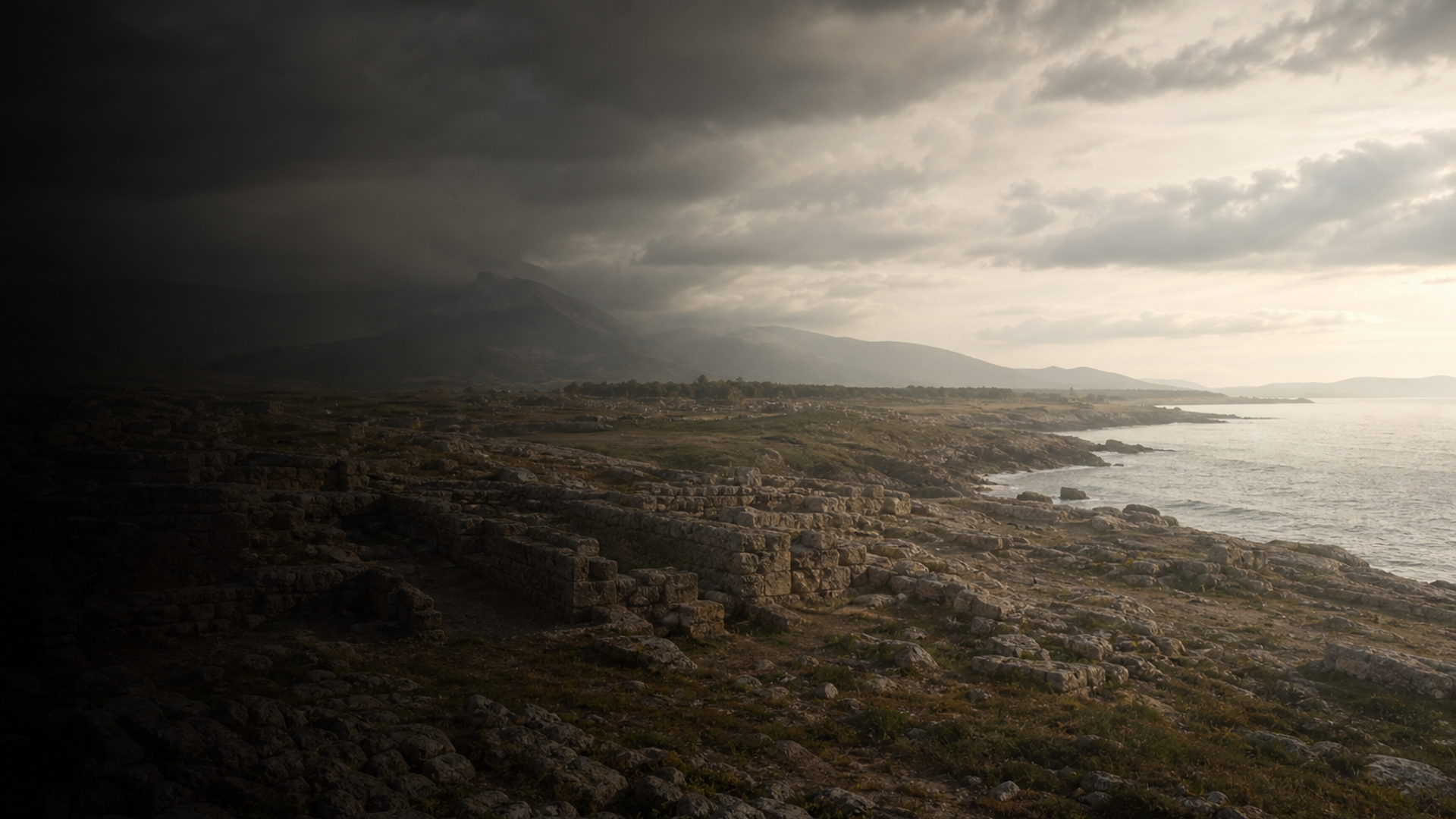
The Greek presence at Empúries (ancient Emporion) emerges in the archaeological record during the Archaic period of the Mediterranean. Classical sources and stratigraphy place initial Greek activity in the 6th century BCE, while the genomes sampled here span 752–350 BCE, concentrating on remains recovered from the necropolis near the Centre de Visitants in Empúries, Girona.

Archaeological data indicates a foundation tied to Greek colonists who maintained maritime trade networks across the western Mediterranean. Pottery styles (Corinthian and Attic imports), architectural fragments, and burial goods speak to Hellenic cultural practices layered onto an Iberian coastal landscape. Funerary contexts at the necropolis show both Mediterranean-style amphorae and locally produced pottery, suggesting interaction rather than wholesale replacement.

Limited evidence suggests that the early phase involved small numbers of migrants—traders, artisans, and their families—who created colonial enclaves that acted as cultural and economic bridges. Over time these enclaves became hybrid communities where Greek traditions were negotiated with indigenous Iberian practices. Given the modest sample size of ten genomes, the genetic picture must be regarded as provisional and reflective of community-level dynamics rather than comprehensive population histories.

  • Greek colonial activity documented at Empúries (Emporion) from the Archaic period
  • Material culture shows both imported Greek goods and local Iberian production
  • Small founding populations likely created long-term hybrid communities

Daily Life & Society

Life in and around Empúries would have been a tapestry of maritime trade, artisanal craft, and cultural exchange. Excavations in the Girona region and the necropolis at the Centre de Visitants reveal households engaged in commerce—amphorae and weights attest to oil, wine, and salted fish trade—while archaeobotanical remains point to a Mediterranean diet of cereals, legumes, olives, and grapes.

Burial customs recorded at the necropolis vary: some tombs include Greek-style grave goods and burial orientations, while others conform to regional Iberian practices. This funerary diversity suggests a community where identity was expressed through a plurality of rites. Craft workshops, inferred from slag, ceramic kilns, and spindle whorls, indicate local production interacting with imported techniques and styles. Street layouts and harbor installations emphasize Empúries' role as a trading entrepôt rather than a large polis.

Socially, the archaeological record implies a mixed population of locals and immigrants, with status signaled through imported luxuries in some graves and modest local goods in others. Ethnic boundaries were porous: intermarriage, economic alliances, and shared ritual space would have produced the blended daily life seen in the material remains.

  • Trade-centered economy with Mediterranean imports (amphorae, luxury pottery)
  • Burial variability reflects a mix of Greek and Iberian funerary practices

Genetic Profile

Genome-wide data from ten individuals sampled at the Empúries necropolis provide a window into the biological makeup of a Greek-period coastal community. The most common Y-DNA signal in this small set is haplogroup R (6/10), a lineage widespread in Western and Central Europe; on mtDNA, haplogroups include U (2), HV (2), H (2), K (1), and H1 (1). These maternal lineages are common across Europe and the Mediterranean, and their presence here indicates diverse maternal ancestries within the community.

Archaeogenetic patterns are consistent with a mixed population: paternal lineages dominated by R suggest links to broader continental European gene pools, while maternal haplogroups reflect both local Iberian and wider Mediterranean ancestries. This pattern is compatible with historical models in which male-mediated migration or elite mobility is coupled with assimilation of local women, but with only ten samples this interpretation is tentative rather than definitive.

Statistical comparisons to published reference panels (ancient and modern) indicate affinities both to Mediterranean Greek-related groups and to Iberian Iron Age populations, suggesting admixture between incoming Greek colonists and indigenous residents. Given the limited sample size, these results should be treated as preliminary snapshots that guide hypotheses for targeted future sampling and high-resolution chronological analysis.

  • Y-DNA dominated by haplogroup R in this sample set (6/10)
  • mtDNA diversity (U, HV, H, K) points to mixed maternal ancestry and regional connectivity

Legacy & Modern Connections

The archaeological and genetic traces from Empúries speak to a durable legacy: coastal Iberia became a corridor for ideas, goods, and genes. The material culture and DNA evidence together suggest that Greek colonization left measurable imprints on local communities but did so through centuries of interaction rather than sudden replacement.

For modern populations in Catalonia and northeastern Spain, genetic continuity likely reflects a palimpsest of multiple migrations and local persistence. The Empúries genomes show components shared with broader European and Mediterranean groups that persist today, but disentangling ancient Greek-specific ancestry from later historical movements requires larger comparative datasets. Thus, while Empúries is emblematic of Hellenic impact in Iberia, its genetic legacy is one strand within a complex tapestry of Mediterranean history.

  • Empúries illustrates cultural and genetic blending rather than population replacement
  • Modern regional genetics reflect layered ancestries; ancient Greek input is one component among many

KI-Assistent

KI-Assistent von DNAGENICS

Funktion freischalten
Stellen Sie Fragen zur Kultur Echoes of Emporion. Unser KI-Assistent kann genetische Befunde, historischen Kontext, archäologische Belege und moderne Verbindungen erläutern.
Beispiel einer KI-Analyse

Die Echoes of Emporion-Kultur ist ein faszinierendes Kapitel der Menschheitsgeschichte...

Genetische Analysen zeigen Übereinstimmungen mit früheren Populationen und Hinweise auf besondere Anpassungen und kulturelle Innovationen. Alte DNA-Proben liefern Einblicke in Migrationsmuster, soziale Strukturen und genetische Verbindungen zwischen Populationen.

Dies ist eine Vorschau der KI-Analyse. Schalten Sie den vollständigen KI-Assistenten frei, um detaillierte Einblicke zu erkunden:

  • Genetische Zusammensetzung und genetische Ähnlichkeit
  • Migrationsmuster und Ursprünge
  • Alltag und kulturelle Praktiken
  • Genetischer Bezug zu heutigen Populationen
Use code for 30% off • Expires Nov 15




