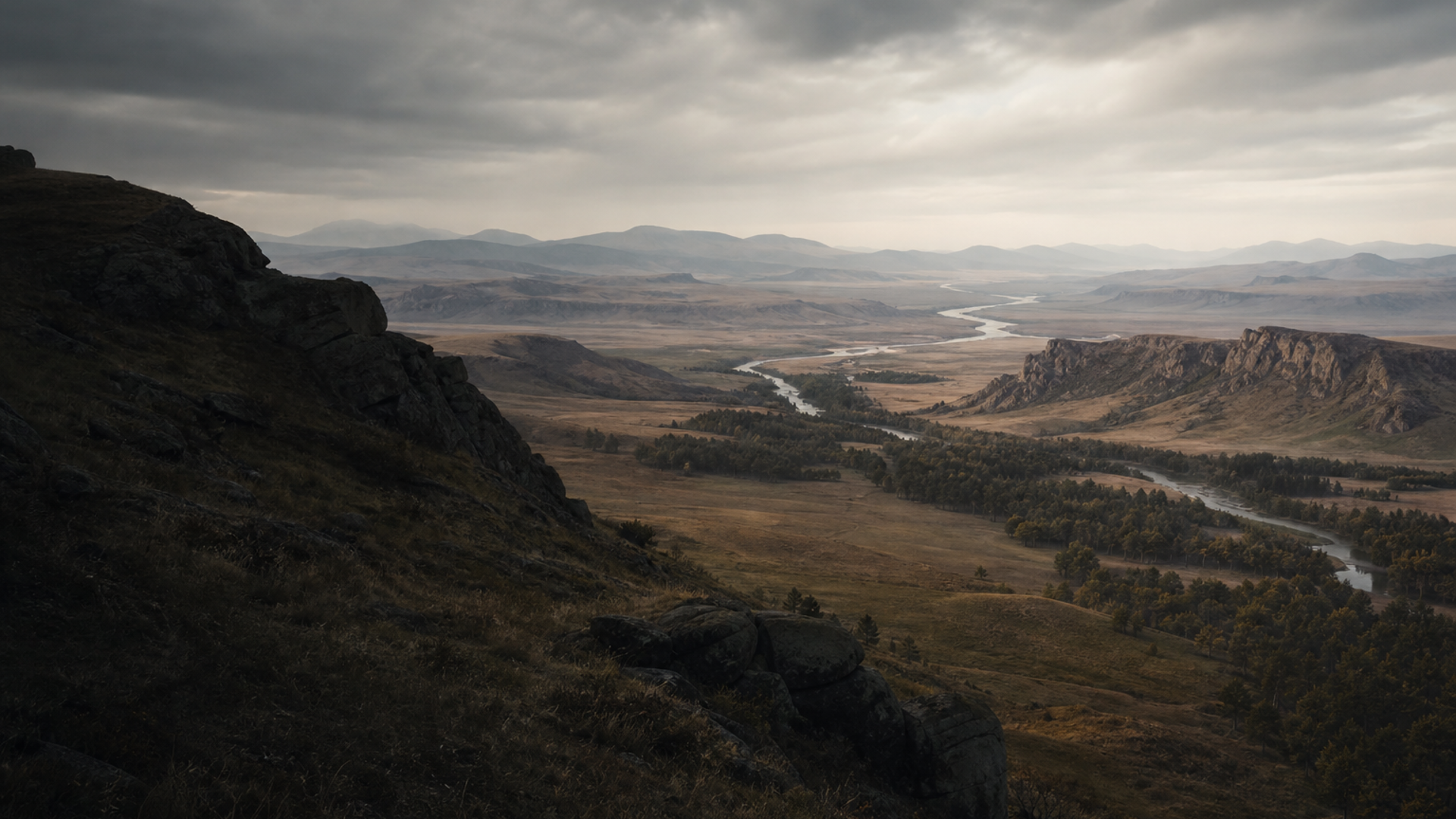
Echoes of Tagar: Siberian Steppe Forerunners

Download PDF creates a visual, rasterized copy. Use Print for selectable text and better assistive-technology support.

Zum Hauptinhalt springen
Zivilisations-Spotlight

Echoes of Tagar: Siberian Steppe Forerunners

Early Iron Age groups in the Minusinsk Basin—archaeology and DNA tell a mixed-steppe story

1000 CE - 800 BCE
Siberia (Minusinsk Basin, Tungus & Eastern Steppe, Russia)

Die Geschichte

Archaeological and genetic data from eight Russia_Tagar samples (1000–800 BCE) reveal a blend of west Eurasian and Siberian ancestries in the Minusinsk Basin and eastern steppe. Limited samples mean conclusions are preliminary but evocative.

Time Period

1000–800 BCE

Region

Siberia (Minusinsk Basin, Tungus & Eastern Steppe, Russia)

Common Y-DNA

R (3), Q (1) — limited sample

Common mtDNA

U (2), N (2), F (1), H (1), A (1)

Zeitleiste

1000 BCE

Early Tagar horizon appears in Minusinsk Basin

Regional burial mounds and timber graves in the Minusinsk Basin mark emerging Tagar traditions and increasing steppe connections.

Origins & Emergence

The cultural horizon represented by the Russia_Tagar identifier arises within the wider Tagar world of the Minusinsk Basin in southern Siberia. Archaeological data indicates occupation of river valleys and steppe edge landscapes between roughly 1000 and 800 BCE, a time of intensifying mobility, metallurgy and regional interaction. Burial mounds (kurgans), timber-lined graves and richly decorated bronzes attributed to Tagar contexts evoke a society engaged with both local forest-steppe traditions and broader steppe networks.

Material culture — weaponry, horse gear, and anthropomorphic stelae — signals shared stylistic affinities with contemporaneous steppe groups to the west and south, even as local variants persist. Limited evidence suggests that communities in the Tungus and eastern steppe margins maintained distinct funerary practices that blended cremation, inhumation and timber architecture.

Because the present dataset comprises only eight genetic samples, any model of population formation must remain provisional. Still, combining the archaeological picture with early aDNA results points to dynamic contacts: west Eurasian steppe lineages entering Siberian contexts, alongside persistence or incorporation of indigenous Siberian elements. This is consistent with an image of the early Tagar horizon as a mosaic—an emergent culture forged by travel, trade, and the exchange of ideas and people across the Minusinsk landscape.

  • Active occupation in the Minusinsk Basin and adjacent steppe, c. 1000–800 BCE
  • Material signs of steppe connectivity: horse gear, bronzes, kurgan burials
  • Small genetic dataset (n=8) makes population models preliminary

Daily Life & Society

Archaeology paints an evocative portrait of everyday life at the edge of Siberia's great openlands. Settlements near rivers and forest margins would have combined pastoralism, hunting and seasonal foraging with participation in long-distance exchange. Animal husbandry — especially horses and cattle — shaped mobility, economy and social display: horse trappings and bridles appear in burials and suggest mounted life was integral to identity.

Craft specialization appears in metalworking and textile production. Bronze tools and ornaments recovered from Tagar contexts demonstrate sophisticated alloying and decoration; wood and bone artifacts speak to local craft traditions adapted to a harsh climate. Funerary architecture is a key window into social structure: barrows and timber-chamber graves with grave goods suggest ranked communities where individuals were commemorated with weapons, harnesses and personal ornaments.

The interplay of local and imported styles implies households participated in networks that transmitted objects and people. Ritualized display in death — paired with the material markers of mobility — hints at societies where lineage, warrior status and connections across the steppe mattered. Yet, the small ancient DNA sample underlines that details about kinship and household composition remain uncertain and open to revision as more data emerge.

  • Mixed economy: pastoralism, hunting, craft specialization
  • Burials with horse gear and bronzes indicate social ranking and mobility

Genetic Profile

The Russia_Tagar genetic dataset consists of eight ancient individuals dated to 1000–800 BCE from Siberia's Tungus and eastern steppe sectors. Y-chromosome results include multiple R-lineages (three samples) and one Q-lineage. R is broadly associated with west Eurasian steppe populations (including diverse subclades), while Q has deep roots in northeastern Eurasia and is often linked to Siberian-speaking groups. On the maternal side, mitochondrial haplogroups recorded are U (2), N (2), F (1), H (1) and A (1), a mix of typically west Eurasian (U, H, N) and east Eurasian (A, F) maternal lineages.

This combination of Y and mtDNA diversity suggests a population history marked by admixture: male-mediated influxes from steppe-adjacent west Eurasian groups (reflected in R-lineages) alongside persisted or integrated east Eurasian maternal ancestries (A, F). The presence of N and U lineages further points to complex matrilineal inheritance and possible long-distance connections. Importantly, with fewer than ten samples, patterns like sex-biased migration, family structure, and the timing of admixture are tentative. Additional genomes, genome-wide autosomal data and radiocarbon paired dating will be required to test whether these eight individuals represent local community structure or a snapshot of highly mobile, interacting groups across the Minusinsk region.

In short: the genetics hint at a blended steppe–Siberian ancestry picture consistent with archaeological expectations, but results remain preliminary.

  • Y-DNA: R (3) and Q (1) indicate west Eurasian and Siberian paternal inputs
  • mtDNA: U, N, H (west Eurasian) and A, F (east Eurasian) suggest maternal diversity

Legacy & Modern Connections

The cultural and genetic traces of early Tagar-era communities linger in the archaeology of the Minusinsk Basin and in the broader story of steppe interactions. Material culture from kurgans and settlements influenced later Siberian and steppe artistic traditions; motifs and metalworking techniques ripple forward into subsequent Iron Age horizons.

Genetically, the blend of west Eurasian and Siberian lineages seen in these samples foreshadows the complex ancestry patterns observed across later Central Asian and Siberian populations. However, because the dataset is small, linking these eight individuals directly to specific modern groups would be premature. Instead, they provide a cinematic snapshot: a frontier where peoples met, mixed and created new local identities that would shape the human geography of the Eurasian steppe for centuries to come.

  • Material culture influenced later Siberian and steppe traditions
  • Genetic mix anticipates the layered ancestry of later Central Asian populations

KI-Assistent

KI-Assistent von DNAGENICS

Funktion freischalten
Stellen Sie Fragen zur Kultur Echoes of Tagar: Siberian Steppe Forerunners. Unser KI-Assistent kann genetische Befunde, historischen Kontext, archäologische Belege und moderne Verbindungen erläutern.
Beispiel einer KI-Analyse

Die Echoes of Tagar: Siberian Steppe Forerunners-Kultur ist ein faszinierendes Kapitel der Menschheitsgeschichte...

Genetische Analysen zeigen Übereinstimmungen mit früheren Populationen und Hinweise auf besondere Anpassungen und kulturelle Innovationen. Alte DNA-Proben liefern Einblicke in Migrationsmuster, soziale Strukturen und genetische Verbindungen zwischen Populationen.

Dies ist eine Vorschau der KI-Analyse. Schalten Sie den vollständigen KI-Assistenten frei, um detaillierte Einblicke zu erkunden:

  • Genetische Zusammensetzung und genetische Ähnlichkeit
  • Migrationsmuster und Ursprünge
  • Alltag und kulturelle Praktiken
  • Genetischer Bezug zu heutigen Populationen
Use code for 30% off • Expires Nov 15