Living Landscapes of Modern Pakistan

Download PDF creates a visual, rasterized copy. Use Print for selectable text and better assistive-technology support.

Bericht wird vorbereitet

Verfügbare Informationen und Referenzen werden geladen

Verbindung mit dem archäologischen Quellenbestand...

Alte Quellen werden zusammengestellt

Zum Hauptinhalt springen
Living Landscapes of Modern Pakistan
Zivilisations-Spotlight

Living Landscapes of Modern Pakistan

A contemporary portrait tying Lahore's streets to deep regional threads of ancestry

2000 CE
Pakistan — Punjab (Lahore)
Scrollen zum Start
Kapitel I

Die Geschichte

Die Living Landscapes of Modern Pakistan-Kultur verstehen

Modern Pakistan (2000 CE) samples from Punjab — focused on Lahore — reveal a tapestry of local continuity and layered admixture. Archaeological continuity and broad genetic signals together illuminate migration, urban life, and the limits of inference for modern populations.

Time Period

2000 CE (contemporary)

Region

Pakistan — Punjab (Lahore)

Common Y-DNA

Not specified in input; regional diversity expected

Common mtDNA

Not specified in input; mixed maternal lineages likely

Kapitel II

Zeitleiste

Zentrale Momente in der Geschichte dieser Kultur

2000 CE

Contemporary sampling and urban continuity

A dataset of 292 modern samples centered on Lahore captures recent population structure and ties to a long urban archaeological record.

Kapitel III

Origins & Emergence

The samples labeled Modern_Pakistan are firmly contemporary (c. 2000 CE) and centered on the Punjab region and the city of Lahore. Archaeological data indicates that Lahore occupies a palimpsest of human occupation — from early historic settlements and medieval forts to Mughal gardens and British colonial fabric — each layer contributing material traces to the modern urban landscape. In a cinematic sweep, the city’s stones and streets record centuries of trade, conquest, and cultural synthesis.

Genetically, modern populations of Pakistan do not derive from a single recent founder but reflect long-term local continuity combined with episodic influxes from neighbouring regions. Large-scale population genetics studies outside this specific dataset have documented components attributable to South Asian hunter‑gatherer ancestry, Iranian/Caucasus-related input, and varying amounts of Steppe-related ancestry in parts of northern Pakistan. However, archaeological continuity in places like Lahore suggests many inhabitants' lineages may trace to long‑standing regional founder populations, even while admixture reshaped frequencies over time.

Limited evidence directly ties these 2000 CE samples to excavated archaeological strata in Lahore; instead, the material record provides cultural context. Where genetic signals align with archaeological change, interpretations are strongest when supported by well‑dated ancient DNA. For modern cohorts, historical records, census data, and urban archaeology together frame likely demographic processes.

  • Samples concentrated in Punjab (Lahore) and reflect a contemporary snapshot
  • Archaeological layers in Lahore demonstrate long-term occupation and cultural layering
  • Genetic patterns likely combine local continuity with historic admixture events
Kapitel IV

Daily Life & Society

Modern daily life in Lahore and surrounding Punjabi communities is shaped by dense urban networks, marketplaces, mosques, and family compounds — an everyday archaeology visible in building typologies, pottery fragments in fill layers, and street plans that preserve older routes. Material culture in the modern city includes vernacular housing, artisan workshops, and marketplaces (bazaars) that continue traditions of craft and commerce. Archaeologists describe such urban palimpsests as places where the recent past is physically underfoot: reused bricks, remnant ceramics, and foundation trenches record continuous occupation.

Culturally, Punjabi language traditions, religious practices, and culinary habits reflect centuries of interaction — Mughal patronage, Sikh polities, and British colonial organization all left visible marks. Ethnographic and historical sources supplement archaeological observation to reconstruct social organization: kinship networks, trade guilds, and migration flows into the city. In interpreting modern DNA alongside these artifacts, it is important to remember that material culture can shift without complete population replacement; shared practices may persist even as genetic ancestries change incrementally.
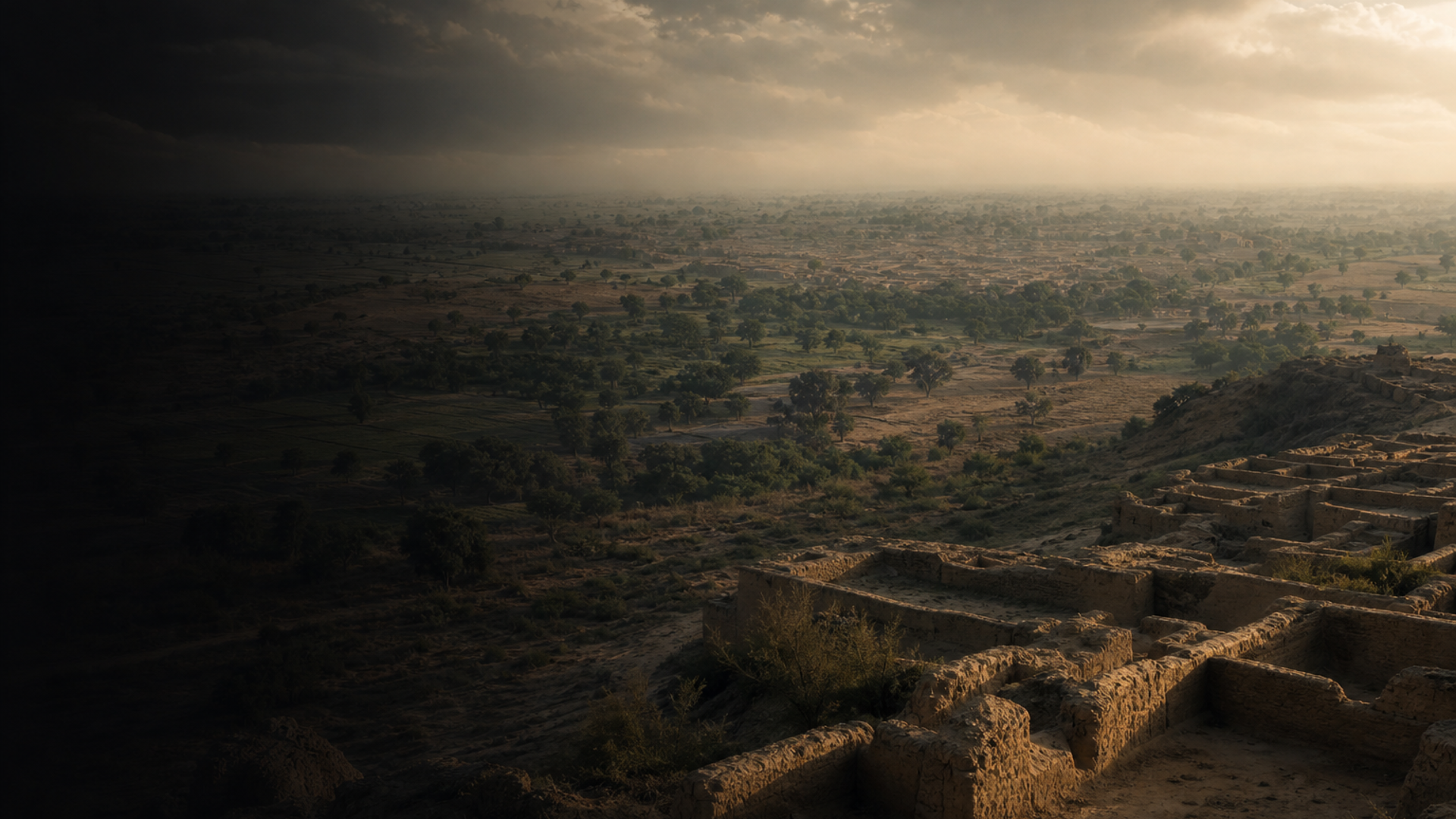

  • Urban palimpsest: reused materials and layered architecture in Lahore
  • Cultural continuity in crafts, markets, and social institutions shapes archaeological signal
Kapitel V

Genetic Profile

This dataset includes 292 modern samples from Pakistan (notably Punjab/Lahore), a substantive sample size for contemporary population inference. A sample count at this level allows statistical characterization of allele frequency variation within the sampled urban/regional population, improving confidence in autosomal ancestry components and fine-scale structure compared with very small datasets. However, the input did not list specific Y‑DNA or mtDNA haplogroups; therefore haplogroup‑level conclusions cannot be drawn from this metadata alone.

Population genetic research in South Asia shows that modern Pakistani groups typically carry a mosaic of ancestry components: a deep South Asian substratum, West Eurasian affinities related to Iranian plateau and Caucasus populations, and variable Steppe-derived input in northern areas. In the context of Lahore and Punjab, one can reasonably expect admixture signals reflecting historical trade, Islamic-era connectivity, and more recent colonial and modern migrations — but the precise proportions and haplogroup distributions require the underlying genotype or sequence data. Where sample provenance is urban and recent, signals of recent migration (internal rural‑to‑urban movement, South Asian diasporas) may be pronounced.

Because specific uniparental haplogroups were not provided, emphasize that autosomal analyses of these 292 samples would be robust for detecting common ancestry components and structure, while rare lineages or fine maternal/paternal lineage histories may require targeted haplogroup sequencing or ancient DNA comparators.

  • Sample count (292) is substantial for modern autosomal analyses
  • Specific Y/mtDNA haplogroups were not provided; conclusions on uniparental lineages are limited
Kapitel VI

Legacy & Modern Connections

Modern Pakistani genomes are living archives: they carry echoes of Bronze Age cities, medieval trade networks, and recent urban migrations. Archaeological continuity in settlement locations — especially in historic centers like Lahore — provides a landscape where cultural practices and demographic inputs have repeatedly layered. For individuals using DNA ancestry platforms, these 292 samples enhance resolution for identifying regional affinities in Punjab and for distinguishing broad West Eurasian versus South Asian autosomal components.

Yet caution is essential. Modern genetic profiles reflect centuries of movement and admixture; matching to a regional signature does not imply direct descent from a single ancient community. Limited archaeological sampling specific to contemporary individuals means that genetic matches should be interpreted alongside historical, linguistic, and material evidence. When used together, archaeology and genetics offer a cinematic but rigorously grounded story of persistence and change across the living landscapes of Pakistan.

  • Genomes reflect layered ancestry: ancient substrata plus historic inflows
  • Genetic matches are strongest when paired with archaeological and historical context
KI-gestützt

KI-Assistent

Stellen Sie Fragen zur Living Landscapes of Modern Pakistan-Kultur

KI-Assistent von DNAGENICS

Funktion freischalten
Stellen Sie Fragen zur Kultur Living Landscapes of Modern Pakistan. Unser KI-Assistent kann genetische Befunde, historischen Kontext, archäologische Belege und moderne Verbindungen erläutern.
Beispiel einer KI-Analyse

Die Living Landscapes of Modern Pakistan-Kultur ist ein faszinierendes Kapitel der Menschheitsgeschichte...

Genetische Analysen zeigen Übereinstimmungen mit früheren Populationen und Hinweise auf besondere Anpassungen und kulturelle Innovationen. Alte DNA-Proben liefern Einblicke in Migrationsmuster, soziale Strukturen und genetische Verbindungen zwischen Populationen.

Dies ist eine Vorschau der KI-Analyse. Schalten Sie den vollständigen KI-Assistenten frei, um detaillierte Einblicke zu erkunden:

  • Genetische Zusammensetzung und genetische Ähnlichkeit
  • Migrationsmuster und Ursprünge
  • Alltag und kulturelle Praktiken
  • Genetischer Bezug zu heutigen Populationen

Weitere antike Kulturen erkunden

Geschichten von Zivilisationen aus der antiken Welt entdecken

Use code for 35% off • Expires Nov 09




