Nea Styra — Early Bronze Age Echoes

Download PDF creates a visual, rasterized copy. Use Print for selectable text and better assistive-technology support.

Bericht wird vorbereitet

Verfügbare Informationen und Referenzen werden geladen

Verbindung mit dem archäologischen Quellenbestand...

Alte Quellen werden zusammengestellt

Zum Hauptinhalt springen
Nea Styra — Early Bronze Age Echoes
Zivilisations-Spotlight

Nea Styra — Early Bronze Age Echoes

A coastal Euboean community (2851–2292 BCE) where archaeology meets early DNA glimpses

2851 CE - 2292 BCE
Nea Styra, Euboea & Central Greece (Greece)
Scrollen zum Start
Kapitel I

Die Geschichte

Die Nea Styra — Early Bronze Age Echoes-Kultur verstehen

Nea Styra_EBA (2851–2292 BCE): five Early Bronze Age individuals from Nea Styra, Euboea and Central Greece reveal mixed Y-DNA (J, I2, G, L) and limited maternal data (mtDNA U). Limited samples mean conclusions are preliminary, but ties to Neolithic farmers and local European lineages emerge.

Time Period

2851–2292 BCE

Region

Nea Styra, Euboea & Central Greece (Greece)

Common Y-DNA

J (2), I2 (1), G (1), L (1)

Common mtDNA

U (1)

Kapitel II

Zeitleiste

Zentrale Momente in der Geschichte dieser Kultur

2500 BCE

Nea Styra Early Bronze occupation

Archaeological evidence indicates active coastal settlement and burial activity at Nea Styra, reflecting mixed farming, craft production, and maritime exchange during the Early Bronze Age.

Kapitel III

Origins & Emergence

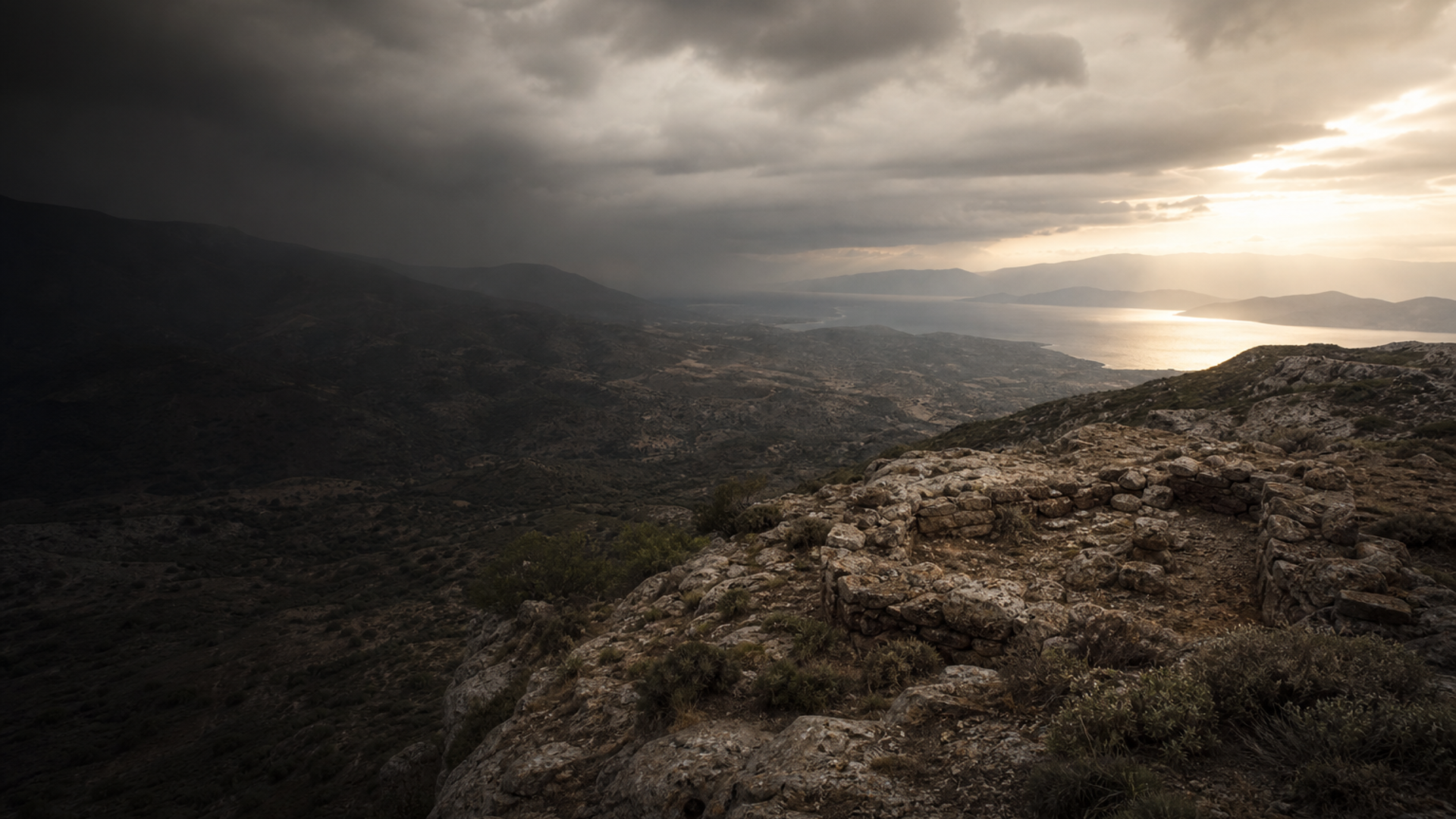
The rocky coast of Nea Styra on Euboea presides over a horizon of bronze — small harbors, scattered tombs, and pottery sherds that speak of a community adapting to new economies at the dawn of the Early Bronze Age (2851–2292 BCE). Archaeological data indicates continuity with Late Neolithic lifeways alongside innovations in metallurgy, craft specialization, and long-distance exchange. Excavations at Nea Styra reveal household ceramics and burial practices consistent with contemporaneous Aegean sites, suggesting integration into regional networks that connected the islands and mainland.

Cinematic imagery of salt-washed stone and hearth smoke gives way to measured inference: the limited burial assemblage and stratigraphic sequences imply a small, mobile population tied to both maritime routes and inland resources. Environmental evidence points to mixed agriculture and pastoralism, with seasonal exploitation of coastal fisheries.

Genetic signals from five individuals offer a new lens on emergence — one that must be read with caution. With only five samples, patterns are tentative, but they hint at a tapestry woven from local European lineages and ancestries linked to earlier Neolithic farmers. Limited evidence suggests Nea Styra was neither isolated nor a simple outpost; rather, it played a role in the shifting cultural landscapes of the Early Bronze Age Aegean.

  • Community active during 2851–2292 BCE at Nea Styra, Euboea
  • Material culture shows continuity with Late Neolithic and new Bronze Age practices
  • Site evidence indicates mixed agriculture, pastoralism, and maritime exchange
Kapitel IV

Daily Life & Society

Daily life at Nea Styra can be imagined through the intimate traces left behind: cooking hearths, chipped tools, and the broken rims of storage jars. Archaeological data indicates households practiced mixed farming—barley, pulses, and domestic animals—supplemented by coastal fishing. Craft activities, including simple metalworking and coarse pottery production, point to local skill sets rather than large-scale workshop economies.

Settlement patterns suggest small, nucleated hamlets rather than dense urban centers. Burials are modest; grave goods are few, implying social difference but not extreme inequality. The sea shaped lifeways — craft exchange and seasonal mobility likely connected Nea Styra to neighboring Euboean and mainland communities.

Because preservation varies and the sample of human remains is small, reconstructions of kinship structures and social hierarchy remain provisional. Nevertheless, the archaeological picture is of a resilient coastal community: adaptive, networked, and engaged with the broader currents of the Early Bronze Aegean.

  • Households engaged in mixed farming, pastoralism, and coastal fishing
  • Modest burials and local craft production suggest small-scale, networked society
Kapitel V

Genetic Profile

Five Early Bronze Age individuals from Nea Styra provide a slender but informative genetic snapshot. Y-chromosome lineages observed include J (2 individuals), I2 (1), G (1), and L (1). Maternal data are limited — one recorded mtDNA haplogroup U — and autosomal patterns are not specified here, so interpretations must remain cautious.

Haplogroup J and G are commonly associated with lineages expanding from Neolithic farmers in the Near East and into the Aegean; their presence at Nea Styra is consistent with archaeological evidence for enduring farmer-derived ancestry in the region. Haplogroup I2 is often linked to longstanding European hunter-gatherer-derived lineages and may reflect local continuity or admixture with indigenous populations. The single L lineage is unexpected in the Aegean context where L is usually rare; with only one sample, this could represent a low-frequency lineage, long-distance mobility, or a sampling artifact — more data are needed.

Because the total sample count is low (<10), conclusions about population structure, sex-biased migration, or the timing of incoming ancestries (for example, later Steppe-related inputs observed elsewhere in the Aegean) are preliminary. Archaeological context combined with these genetic hints suggests Nea Styra’s Early Bronze Age community carried a mosaic of ancestries, reflecting both local survival and connections that reached beyond the immediate coastline.

  • Y-DNA: J (2), I2 (1), G (1), L (1) — suggests farmer-linked and local European lineages
  • Small sample size (<10) makes interpretations preliminary; unexpected L haplogroup needs further study
Kapitel VI

Legacy & Modern Connections

Nea Styra’s genetic and archaeological echoes contribute to a larger story of continuity and change in the Aegean. The blend of Y-lineages tied to Near Eastern farmer ancestry and European hunter-gatherer-derived lineages resonates with broader patterns seen across Bronze Age Greece. While modern Greek populations reflect many layered inputs over millennia, these Early Bronze Age individuals underscore deep regional roots alongside intermittent long-distance contacts.

Importantly, the tiny sample set cautions against sweeping claims of direct descent. Instead, Nea Styra offers a vignette: a maritime community whose people were part of the mosaic that, over centuries, contributed to the genetic and cultural fabric of the eastern Mediterranean. Future sampling and comparison with contemporaneous mainland and island sites will refine how these early threads connect to later populations.

  • Reflects mixture of local European lineages and farmer-derived ancestries seen in the Aegean
  • Small dataset implies careful interpretation; future samples may clarify links to modern populations
KI-gestützt

KI-Assistent

Stellen Sie Fragen zur Nea Styra — Early Bronze Age Echoes-Kultur

KI-Assistent von DNAGENICS

Funktion freischalten
Stellen Sie Fragen zur Kultur Nea Styra — Early Bronze Age Echoes. Unser KI-Assistent kann genetische Befunde, historischen Kontext, archäologische Belege und moderne Verbindungen erläutern.
Beispiel einer KI-Analyse

Die Nea Styra — Early Bronze Age Echoes-Kultur ist ein faszinierendes Kapitel der Menschheitsgeschichte...

Genetische Analysen zeigen Übereinstimmungen mit früheren Populationen und Hinweise auf besondere Anpassungen und kulturelle Innovationen. Alte DNA-Proben liefern Einblicke in Migrationsmuster, soziale Strukturen und genetische Verbindungen zwischen Populationen.

Dies ist eine Vorschau der KI-Analyse. Schalten Sie den vollständigen KI-Assistenten frei, um detaillierte Einblicke zu erkunden:

  • Genetische Zusammensetzung und genetische Ähnlichkeit
  • Migrationsmuster und Ursprünge
  • Alltag und kulturelle Praktiken
  • Genetischer Bezug zu heutigen Populationen

Weitere antike Kulturen erkunden

Geschichten von Zivilisationen aus der antiken Welt entdecken

Use code for 35% off • Expires Nov 09




