Steppe Dawn: Russia Eneolithic Echoes

Download PDF creates a visual, rasterized copy. Use Print for selectable text and better assistive-technology support.

Bericht wird vorbereitet

Verfügbare Informationen und Referenzen werden geladen

Verbindung mit dem archäologischen Quellenbestand...

Alte Quellen werden zusammengestellt

Zum Hauptinhalt springen
Steppe Dawn: Russia Eneolithic Echoes
Zivilisations-Spotlight

Steppe Dawn: Russia Eneolithic Echoes

Early Eneolithic communities on the Russian steppe seen through bones and genomes

4994 CE - 4047 BCE
Piedmont, Russian Steppe (Russia)
Scrollen zum Start
Kapitel I

Die Geschichte

Die Steppe Dawn: Russia Eneolithic Echoes-Kultur verstehen

Archaeological and genetic glimpses from Piedmont (Progress 2, Vonjucka 1) spanning 4994–4047 BCE. Three genomes show Y-haplogroup R dominance and diverse maternal lines (I3a, H2, T). Limited samples make conclusions preliminary but suggest ties to broader steppe dynamics.

Time Period

4994–4047 BCE

Region

Piedmont, Russian Steppe (Russia)

Common Y-DNA

R (2 of 3 samples)

Common mtDNA

I3a, H2, T (each observed)

Kapitel II

Zeitleiste

Zentrale Momente in der Geschichte dieser Kultur

4500 BCE

Eneolithic occupation in Piedmont sites

Occupations at Piedmont Progress 2 and Vonjucka 1 date within the mid-5th millennium BCE, marking Eneolithic activity on the Russian steppe; evidence is fragmentary and interpretations remain preliminary.

Kapitel III

Origins & Emergence

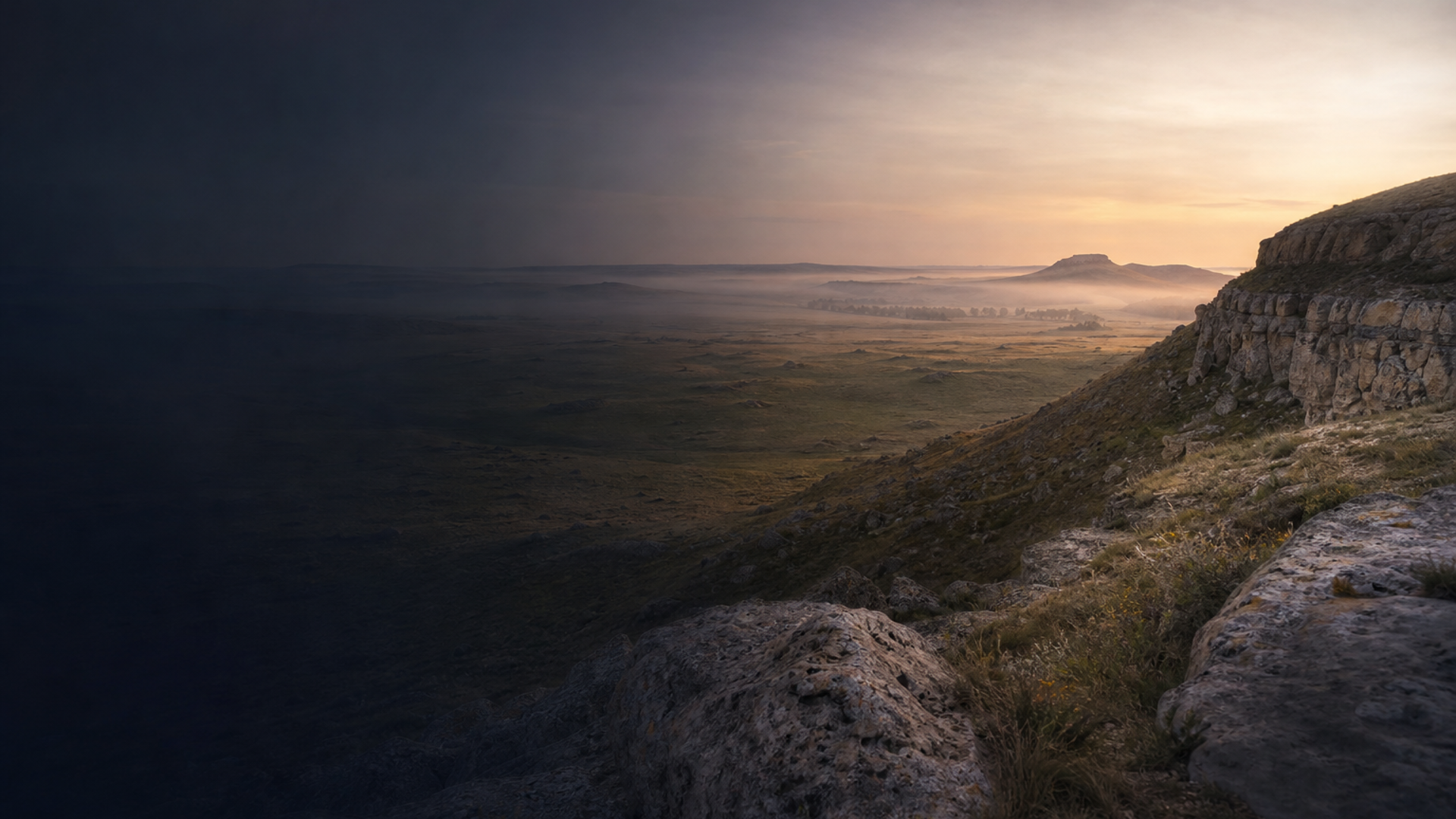
The Russia_Steppe_Eneolithic interval (c. 4994–4047 BCE) unfolds across the wide, wind-swept piedmonts where the steppe meets upland river systems. Archaeological data from the named sample loci — Piedmont. Progress 2 and Piedmont. Vonjucka 1 — are limited but evocative: scatterings of Eneolithic horizons hint at mobile lifeways, seasonal camps, and nascent herding strategies.

Landscape and mobility are central themes. The steppe's expanse favored transhumant practices and long-distance contacts; stone tools, fragments of pottery and hearth features recorded in nearby Eneolithic contexts indicate groups adapting to fluctuating resources and climatic variability. Material culture shows affinities with other Russian steppe Eneolithic assemblages, yet the sparse number of directly dated and sequenced burials makes regional generalizations tentative.

Limited evidence suggests that these communities were part of a broader web of interaction across the Pontic-Caspian fringe. The cinematic sweep of the steppe — grasses moving like an ocean — frames the slow emergence of social patterns that later intensify in the Bronze Age. In short: archaeological indicators point to a dynamic, mobile frontier community, but the picture remains preliminary pending more sites and genomes.

  • Occupation dated to 4994–4047 BCE at Piedmont Progress 2 and Vonjucka 1
  • Evidence points to mobile/seasonal strategies and early herding
  • Current archaeological sample size is small; broader patterns remain tentative
Kapitel IV

Daily Life & Society

Daily existence on the Eneolithic piedmont would have been shaped by movement, resource seasonality, and close attention to the land. Archaeological traces from nearby Eneolithic contexts—hearths, chipped stone, and ceramic sherds—suggest households oriented around mixed subsistence: hunting, foraging, and emerging herd management. Social life likely pivoted around kin groups whose seasonal circuits tied rivers, pastures, and salt sources together.

Burial evidence for this period across the steppe is uneven. Where funerary deposits survive, they often reflect variability: isolated interments, small cemeteries, or dispersed mortuary traces. Such patterns can indicate flexible social organization rather than rigid hierarchical burial rites. Tools of daily life—projectile points, grinding stones, and portable pottery—evoke a pragmatic material culture adapted to mobility.

The cinematic image is of small bands moving with herds and flocks beneath vast skies, punctuated by campfires and exchange. Yet archaeological data indicates caution: many assumptions about household structure and social ranking are built from analogies to better-sampled later periods. For Piedmont sites specifically, more excavation and contextual analysis are needed to reconstruct everyday practices with confidence.

  • Mixed subsistence likely: hunting, foraging, early herding
  • Fragmentary funerary evidence suggests flexible social organization
Kapitel V

Genetic Profile

Three genomes from the Piedmont sites provide a slender but informative genetic window. Two of the three male individuals carry Y-chromosome haplogroup R, while the maternal lineages observed are I3a, H2, and T—each recorded once. These markers echo broader steppe patterns in which R-lineages become prominent in later Eneolithic and Bronze Age horizons, although the specific R subclades are not robustly resolved here.
Genetic interpretation must be cautious: with only three samples, statistical power is low and conclusions are preliminary. Nonetheless, the predominance of R among males is consistent with male-line continuity seen in many steppe populations. Maternal diversity (I3a, H2, T) suggests a heterogenous mitochondrial landscape, compatible with mobility and female-mediated gene flow.

Comparative ancient-DNA studies often recover ancestry components described as Eastern Hunter-Gatherer (EHG) and Caucasus Hunter-Gatherer (CHG) in Eneolithic steppe groups. If the Piedmont individuals follow that broader pattern, their genomes might show a mixture of these components—but current data are insufficient to confirm such admixture here. In sum: the genetic signal is evocative and aligns with steppe affinities, yet the small sample count demands restraint and highlights the need for more genomes to clarify demographic processes.

  • Two of three male samples carry Y-haplogroup R; maternal haplogroups are I3a, H2, T
  • Sample count (<10) makes genetic conclusions preliminary and tentative
Kapitel VI

Legacy & Modern Connections

The echoes of Russia_Steppe_Eneolithic resonate into later millennia through genetic and cultural threads. Haplogroup R, prominent among the sampled males, becomes widespread in many Bronze Age and modern Eurasian populations, making these early Eneolithic signatures potentially important for understanding the diffusion of paternal lineages across the steppe. Maternal diversity points to long-standing networks of exchange and mobility that could seed later regional genetic mosaics.

For modern genetic ancestry platforms, these Piedmont genomes offer anchor points: they can help distinguish early steppe-related ancestry from later Bronze Age movements. However, because only three individuals are sequenced, the connections to contemporary populations should be presented as provisional. Archaeology and aDNA together suggest that the Eneolithic steppe was a crucible of mobility and mixture—an environment that would shape the demographic trajectories of Eurasia in the millennia to come.

  • Y-haplogroup R in early samples foreshadows broader steppe paternal influence
  • Genetic links to modern populations are possible but remain provisional given limited sampling
KI-gestützt

KI-Assistent

Stellen Sie Fragen zur Steppe Dawn: Russia Eneolithic Echoes-Kultur

KI-Assistent von DNAGENICS

Funktion freischalten
Stellen Sie Fragen zur Kultur Steppe Dawn: Russia Eneolithic Echoes. Unser KI-Assistent kann genetische Befunde, historischen Kontext, archäologische Belege und moderne Verbindungen erläutern.
Beispiel einer KI-Analyse

Die Steppe Dawn: Russia Eneolithic Echoes-Kultur ist ein faszinierendes Kapitel der Menschheitsgeschichte...

Genetische Analysen zeigen Übereinstimmungen mit früheren Populationen und Hinweise auf besondere Anpassungen und kulturelle Innovationen. Alte DNA-Proben liefern Einblicke in Migrationsmuster, soziale Strukturen und genetische Verbindungen zwischen Populationen.

Dies ist eine Vorschau der KI-Analyse. Schalten Sie den vollständigen KI-Assistenten frei, um detaillierte Einblicke zu erkunden:

  • Genetische Zusammensetzung und genetische Ähnlichkeit
  • Migrationsmuster und Ursprünge
  • Alltag und kulturelle Praktiken
  • Genetischer Bezug zu heutigen Populationen

Weitere antike Kulturen erkunden

Geschichten von Zivilisationen aus der antiken Welt entdecken

Use code for 35% off • Expires Nov 09




