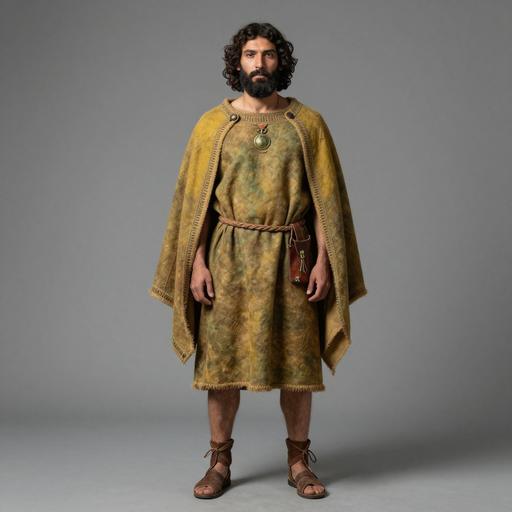
部门背景
mtDNA 谱系分支 J2B1E1 的历史背景
Origins and Evolution
mtDNA haplogroup J2B1E1 is a downstream lineage of J2B1E within the broader J2 branch, a maternal clade that is generally associated with post‑glacial and Neolithic expansions from the Near East into the Mediterranean and adjacent regions. Based on the phylogenetic position of J2B1E1 beneath J2B1E and coalescence estimates for neighboring J2 subclades, a mid‑ to late‑Holocene origin (approximately 4.5 kya) in the Near East or eastern Mediterranean is plausible. The timing and geographic context imply that J2B1E1 arose after the initial Neolithic farmer expansions but before or during later Chalcolithic–Bronze Age movements that reshaped Mediterranean maternal gene pools.
J2 lineages are often linked to Early Neolithic and post‑Neolithic demography in southern Europe and the Near East; J2B1E1 likely reflects a more localized daughter lineage that spread through a combination of overland and maritime contacts and subsequently underwent local drift and founder effects, especially on islands and coastal enclaves.
Subclades
As a relatively deep but regionally restricted terminal clade, J2B1E1 currently shows limited well‑characterized downstream diversity in published datasets. Where present, downstream substructure tends to be geographically localized (for example, private or near‑private lineages on Mediterranean islands or in small Caucasus populations). The scarcity of high‑resolution mitogenomes assigned to J2B1E1 makes it likely that additional fine‑scale subclades remain to be discovered with broader whole mitogenome sampling and targeted ancient DNA retrieval.
Geographical Distribution
The distribution of J2B1E1 is concentrated around the Mediterranean and adjacent regions. The haplogroup is observed at low to moderate frequencies in southern Europe (Italy, Greece and the Balkans), on Mediterranean islands (Sicily, Sardinia, Cyprus and the Balearics), in portions of the Near East (Anatolia, the Levant), along North African coastal areas, and in the Caucasus; occasional low‑frequency occurrences are reported in parts of Central Asia and among some Jewish communities (both Ashkenazi and Sephardi lineages observed at low frequency in specific studies).
This pattern is consistent with a Near Eastern origin followed by dispersal along coastal and island routes as well as inland corridors. Local demographic factors — small effective population sizes on islands, founder events associated with seaborne colonization, and later historical movements (Phoenician, Greek, Roman, medieval trade and migration) — can explain the patchy, often low‑frequency presence across these regions.
There is at least one archaeological (ancient DNA) sample attributable to the J2B1E clade in available databases, supporting a presence in past populations and validating its continuity in at least some areas through time.
Historical and Cultural Significance
Although J2B1E1 is not a high‑frequency haplogroup, its geographic pattern intersects with multiple culturally significant maritime and coastal networks of the later Holocene. Because it likely arose after the earliest Neolithic farmer expansions, its spread may be tied more strongly to Chalcolithic and Bronze Age coastal movements (including trade, colonization and population contacts) and to later historical episodes of mobility across the Mediterranean (e.g., Phoenician trade, Greek colonization, Roman connectivity). Its presence in island and coastal populations makes founder effects and genetic drift important drivers of modern distribution.
In Jewish populations, occurrences of J2B1E1 at low frequency are best interpreted as reflecting shared Near Eastern maternal ancestry or local admixture episodes during the long history of dispersion and integration in Mediterranean societies.
Conclusion
J2B1E1 is a localized, mid‑Holocene derivative of J2B1E whose distribution highlights the continued role of the Near East as a source of maternal diversity into the later Neolithic, Chalcolithic and Bronze Age periods. Its modern patchy presence in southern Europe, Mediterranean islands, the Levant, North Africa and the Caucasus is consistent with maritime and coastal dispersals followed by local drift and founder events. Broader whole‑mitogenome sampling and additional ancient DNA recovery will clarify its finer substructure and historical trajectories.
关键点
- Origins and Evolution
- Subclades
- Geographical Distribution
- Historical and Cultural Significance
- Conclusion