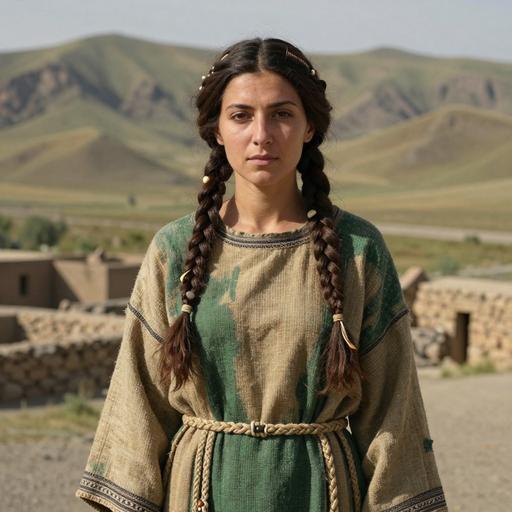
部门背景
mtDNA 谱系分支 K1A8 的历史背景
Origins and Evolution
mtDNA haplogroup K1A8 is a downstream branch of haplogroup K1A, itself a derivative of mtDNA haplogroup K. K1A likely diversified in the Near East / Anatolia during the Late Glacial to Early Holocene and became an important maternal lineage among populations that participated in early Neolithic expansions. K1A8 probably arose several thousand years after the initial K1A diversification — plausibly in the Neolithic or early post-Neolithic period (estimated here around ~7 kya) — as part of the regional diversification of maternal lineages within farming communities.
Like other K1A subclades, K1A8 is defined by a combination of control-region and coding-region mutations within the broader K1A motif; its pattern of diversity and geographic distribution indicate a Near Eastern origin followed by dispersal into Europe with agricultural expansions and later local founder events.
Subclades (if applicable)
K1A8 sits beneath K1A in the mtDNA phylogeny and may itself carry minor internal diversification visible in high-resolution sequencing studies, but it is typically treated as a relatively small, well-defined branch. When high-coverage mitogenomes are available, K1A8 can be split into finer sub-branches in specific regional samples (for example, island or community-specific variants), reflecting local founder effects. Because sampling density and naming conventions vary between studies, some downstream variants of K1A8 appear as locality-specific lineages in Mediterranean or Jewish population datasets.
Geographical Distribution
K1A8 shows a distribution consistent with Near Eastern origin and Neolithic dispersal into the Mediterranean and parts of Europe. It is observed at highest relative frequencies in populations with strong historical connections to Anatolia and the Levant, and at moderate-to-low frequencies across Southern Europe (Iberia, Italy, Greece), Mediterranean islands (including Sardinia and some Aegean islands), and in Ashkenazi Jewish maternal pools where specific founder lineages of K subclades are well documented. Low-level presence has been reported in parts of Western and Northern Europe, the Caucasus, coastal North Africa (where Near Eastern gene flow is prevalent), and occasionally in Central Asia as a consequence of later historical contacts.
The geographic pattern — concentration in the eastern Mediterranean with thinning westward and scattered pockets in Europe and North Africa — matches expectations for a lineage that expanded with Neolithic farmers and underwent later founder effects and local drift.
Historical and Cultural Significance
K1A8 participates in several historically important demographic processes:
- Neolithic spread of farming: As a K1A descendant, K1A8 likely rode the movement of early farmers from Anatolia into Europe, contributing maternal lineages to early Neolithic communities such as those related to the LBK horizon.
- Founder effects and community structure: The presence of K1A8 in Ashkenazi Jewish samples and in island/isolated Mediterranean populations points to later founder events and genetic drift amplifying its frequency locally. In such contexts, K1A8 lineages can serve as markers of historical bottlenecks or endogamous community histories.
- Cultural intersections: The distribution across Anatolia, the Levant, and Mediterranean Europe links K1A8 to a string of archaeological and historical cultures associated with agriculture, maritime exchange, and later historical movements across the Mediterranean basin.
Conclusion
mtDNA K1A8 is a Neolithic/post-Neolithic maternal lineage rooted in the Near East/Anatolia that spread into the Mediterranean and parts of Europe with farming populations and was later subject to localized founder effects (notably within Ashkenazi Jewish maternal lineages and isolated island communities). While not one of the most frequent European mtDNA clades overall, K1A8 provides useful insights into maternal ancestry, Neolithic demographic expansions, and community-specific histories when present in population or individual mitogenomes.
关键点
- Origins and Evolution
- Subclades (if applicable)
- Geographical Distribution
- Historical and Cultural Significance
- Conclusion