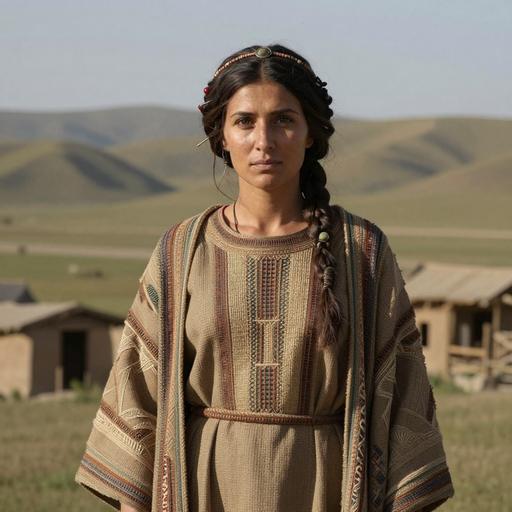
部门背景
mtDNA 谱系分支 N1B1A3 的历史背景
Origins and Evolution
Haplogroup N1B1A3 is a downstream branch of mtDNA haplogroup N1B1A, itself a sublineage of N1B1 within macro-haplogroup N. Based on the phylogenetic position of N1B1A3 beneath N1B1A and the established age estimate of N1B1A (~9 kya), N1B1A3 most plausibly arose during the mid-Holocene (several thousand years after the initial diversification of N1B1A), likely in the Near East or the adjacent Caucasus region. As a relatively recent branch within a Near Eastern-centered clade, N1B1A3 represents a regional maternal lineage that expanded locally and persisted through successive cultural horizons.
Mutational patterns that define N1B1A3 place it within the broader N1B1A topology; because it is rare, its internal diversity is low compared with older continental clades, which is consistent with a localized origin followed by limited expansions.
Subclades
Currently available population and aDNA surveys identify N1B1A3 as a terminal or near-terminal branch with limited well-documented downstream substructure. Where additional private mutations are observed in modern or ancient samples, they generally reflect recent, population-specific diversification rather than deep subclade branching. Continued high-resolution mitogenome sampling in the Near East, Anatolia and the Caucasus could reveal finer subclades within N1B1A3.
Geographical Distribution
N1B1A3 is best characterized as a Near Eastern/Caucasus-centered lineage with low-frequency presence across adjacent regions. Modern and ancient DNA evidence shows occurrences in:
- Levantine populations (Palestinians, Druze, Lebanese) where the lineage contributes to local maternal diversity and continuity.
- Anatolia / Turkey, reflecting the role of Anatolia as both a refuge and corridor for Holocene maternal lineages.
- Caucasus groups (Armenians, Georgians, Azeris), consistent with the parent clade's Caucasus ties.
- Iran and the Zagros region, showing eastward presence within West Asia.
- Northern Africa (coastal Egypt, Libya, Tunisia) at low frequencies, likely reflecting Mediterranean and historical contacts.
- Horn of Africa (Ethiopia, Somalia, Eritrea) in scattered occurrences, plausibly introduced by Holocene Red Sea/Arabian connections and later historic exchanges.
- Southern European Mediterranean populations (Italy, Greece, Sardinia) at very low levels, consistent with maritime mobility and historic gene flow.
- Jewish communities (Ashkenazi, Sephardic, Mizrahi) observed sporadically, indicating occasional incorporation into diaspora maternal pools.
A small number of archaeological samples (four in the available aDNA database for this lineage) document N1B1A3 in ancient contexts, supporting its presence in the Holocene population landscape of the Near East and surrounding regions.
Historical and Cultural Significance
Because N1B1A3 is relatively rare and regionally focused, its primary significance is as a marker of local maternal continuity and regional population structure in the Near East and adjacent areas during the Holocene. It likely rode demographic processes associated with:
- The spread and local diversification of Neolithic/early agricultural communities in Anatolia and the Levant, where many N-derived lineages expanded.
- Subsequent Chalcolithic and Bronze Age population movements that reshaped but did not erase older maternal lineages in regional populations.
- Historic maritime and overland trade routes that explain low-frequency coastal and diaspora occurrences in North Africa, the Mediterranean and the Horn of Africa.
In modern population studies, finding N1B1A3 in a community often points to deep regional ancestry rather than large-scale recent migration from distant continents.
Conclusion
N1B1A3 is a modest but informative maternal lineage for reconstructing Holocene population history in the Near East, Anatolia and the Caucasus. Its pattern — a mid-Holocene origin in the Near East / Caucasus, persistence in local populations, and sparse dispersion along Mediterranean and Red Sea networks — fits expectations for a regional mtDNA subclade derived from N1B1A. Further mitogenome sequencing, especially in understudied Near Eastern and Caucasus populations and additional ancient samples, will refine its age, internal structure and migratory episodes.
关键点
- Origins and Evolution
- Subclades
- Geographical Distribution
- Historical and Cultural Significance
- Conclusion