部门背景
mtDNA 谱系分支 U5B2C3 的历史背景
Origins and Evolution
mtDNA haplogroup U5B2C3 sits within the U5b2c branch of haplogroup U5, one of the oldest and most characteristic maternal lineages of European hunter-gatherers. While haplogroup U5 as a whole dates to the Upper Paleolithic, subclades such as U5B2C (and downstream U5B2C3) appear to have coalesced later, most likely during the early Holocene as populations expanded and restructured after the Last Glacial Maximum. The estimated origin around ~9 kya places U5B2C3 in the context of postglacial re-colonization and Mesolithic population continuities in northern and western Europe.
Mutationally, U5B2C3 is defined by additional control-region and coding-region variants that differentiate it from sister subclades in the U5b2c cluster. Because it is relatively rare and sparsely sampled in public datasets, the internal branching and full mutational motif remain incompletely resolved, and new complete mitogenomes occasionally refine its placement.
Subclades (if applicable)
At present, U5B2C3 is treated as an intermediate/terminal branch in available phylogenies with few reported downstream subclades. Published and public mitogenome data show mostly isolated occurrences rather than large, deeply branching descendant clades. Continued sequencing of ancient and modern mitogenomes, particularly from northern and western Europe, may reveal additional downstream structure or collapse some putative private mutations into broader sublineages.
Geographical Distribution
U5B2C3 has a strongly northern and western European signal with sporadic low-frequency occurrences beyond that core area. Modern and ancient DNA studies indicate presence in: Scandinavia and neighbouring northern populations (including some reports among Saami and other indigenous groups), western and central Europe at low-to-moderate frequency, and occasional singletons reported from eastern Europe. Rare, sporadic occurrences in North Africa and the Caucasus/Anatolia likely reflect postglacial contacts, historic gene flow, or long-range migration events rather than primary centers of origin.
Population-level frequencies are generally low; where it does occur it is most often in isolated individuals or small local clusters, consistent with retention from Mesolithic maternal lineages and limited demographic expansion.
Historical and Cultural Significance
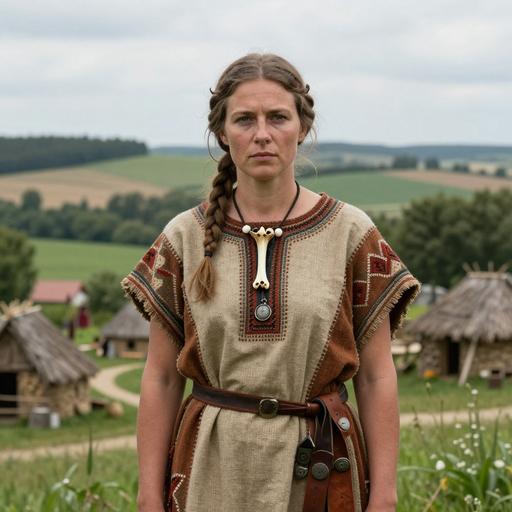
Because U5 lineages are strongly associated with European Mesolithic hunter-gatherers, U5B2C3 is best interpreted as part of that ancient substrate. Its persistence into the Neolithic and later periods in scattered cases indicates maternal continuity through transitions such as the spread of farming and later Bronze Age movements. It is not a hallmark lineage of Neolithic farmer expansions (which carried higher frequencies of haplogroups like H, J, and T), but it can appear in mixed contexts where forager and farmer ancestries admixed.
Archaeologically, U5B2C3's presence fits with cultures and regions characterized by long-term hunter-gatherer continuity or substantial local admixture with incoming groups (for example, some Mesolithic and Funnelbeaker contexts in northern Europe), and it may appear sporadically in later cultural horizons (Bell Beaker, Bronze Age) as a remnant lineage.
Conclusion
U5B2C3 is a small, geographically focused maternal lineage that exemplifies the deep Mesolithic roots of Europe’s mitochondrial diversity. Its rarity in modern samples and limited branching makes it a useful marker of local continuity in northern and western Europe, and an informative target for ancient DNA studies seeking to trace postglacial population dynamics. Further mitogenome sequencing from both modern populations and archaeological contexts will clarify its internal structure and more precisely delineate its historical movements.
关键点
- Origins and Evolution
- Subclades (if applicable)
- Geographical Distribution
- Historical and Cultural Significance
- Conclusion