部门背景
mtDNA 谱系分支 U7A4A1 的历史背景
Origins and Evolution
U7A4A1 is a downstream branch of mtDNA haplogroup U7A4A, itself nested within haplogroup U7, a West-Eurasian maternal lineage that shows strong Holocene signals of population movement from the Near East into adjacent regions. Based on the phylogenetic position beneath U7A4A (whose coalescence has been estimated near ~9 kya) and the geographic clustering of modern and ancient samples, U7A4A1 likely arose in the Holocene between the Near East and South Asia roughly ~7–8 thousand years ago. Its emergence fits a pattern of female-lineage diversification associated with post-glacial and early Neolithic demographic processes in western Eurasia and the adjacent South Asian subcontinent.
Subclades (if applicable)
As a relatively downstream subclade, U7A4A1 represents a defined branch below U7A4A. Published phylogenies and population surveys show few deeply nested, widely reported daughter clades of U7A4A1; instead, diversity within the clade is often characterized by geographic substructure (regional private mutations in Iranian and South Asian samples). Continued high-resolution sequencing of complete mitogenomes may recover further internal subclades specific to particular regions or populations.
Geographical Distribution
The modern distribution of U7A4A1 is concentrated in the Near East and South Asia, with decreasing frequencies radiating into neighboring areas. It is most commonly observed in Iranian populations and in parts of the Indian subcontinent (India, Pakistan), and it appears at lower frequencies across the Caucasus, Central Asia, the Levant/Arabian Peninsula, and sporadically in southern and eastern Europe (Italy, Greece, the Balkans). A small number of ancient DNA identifications (two reported samples in the referenced database) attest to its presence in archaeological contexts, supporting continuity or recurrent gene flow in these regions during the Holocene.
Historical and Cultural Significance
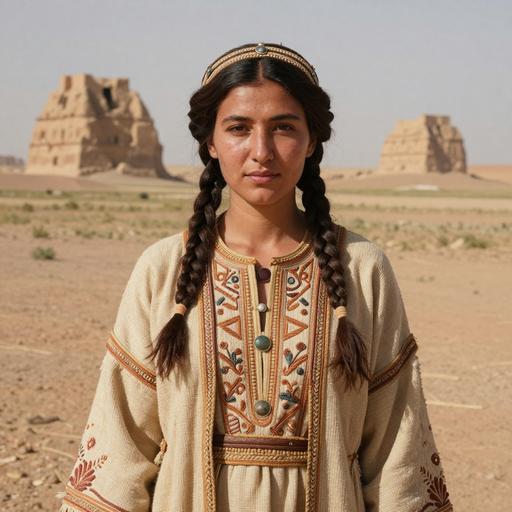
The geographic and temporal profile of U7A4A1 suggests participation in several Holocene demographic processes: the spread of Neolithic and post-Neolithic peoples from the Fertile Crescent and Iranian plateau, subsequent eastward movements that connected the Near East and South Asia, and later interregional contacts during Bronze Age trade and migration. Because mtDNA traces maternal lines, U7A4A1 can illuminate the movement of women and maternal ancestry associated with cultural formations in western Asia and South Asia rather than pinpointing specific archaeological cultures on its own. Its presence in Iran and South Asia is consistent with continuity from early Holocene populations of the Zagros/Irano-Anatolian region and with later incorporation into urbanizing Bronze Age societies such as those connected to the Indus cultural sphere.
Conclusion
U7A4A1 is a Holocene maternal lineage whose phylogenetic position and geographic pattern reflect a Near Eastern–South Asian maternal expansion beginning in the early to mid-Holocene. It is a useful marker for studies of maternal population structure linking Iran, the Caucasus, South Asia, and neighboring regions. As more complete mitogenomes and ancient samples are recovered, the internal structure and finer-scale dispersal history of U7A4A1 will become clearer, refining its timing and association with specific archaeological episodes.
关键点
- Origins and Evolution
- Subclades (if applicable)
- Geographical Distribution
- Historical and Cultural Significance
- Conclusion