部门背景
Y-DNA 谱系分支 B 的历史背景
Origins and Evolution
Y-DNA haplogroup B is an ancient African paternal lineage that branches early from the root of the human Y-chromosome phylogeny. It represents one of the primary non-A lineages that arose after the initial divergence of basal haplogroups in Africa. Age estimates for the B clade place its origin deep in the Pleistocene (on the order of hundreds of thousands of years ago), although exact timing varies by study and depends on the mutation-rate calibration used. Because B split near the base of the tree, the clade preserves deep structure that helps reconstruct early population subdivisions within Africa.
Subclades
Haplogroup B is divided into multiple deep sublineages with differing geographic affinities. These subclades show phylogeographic structure: some lineages are concentrated in Central African rainforest hunter-gatherer populations, while other subbranches occur at low frequencies in East African foragers, Nilotic groups, and southern African populations. Modern high-resolution sequencing has revealed several distinct B branches, but nomenclature and SNP names have been refined over time; broadly speaking, researchers recognize B subclades that are characteristic of (a) Central African forest-foragers, (b) scattered East African forager/pastoralist groups, and (c) low-frequency occurrences in other African regions resulting from ancient structure and later admixture.
Geographical Distribution
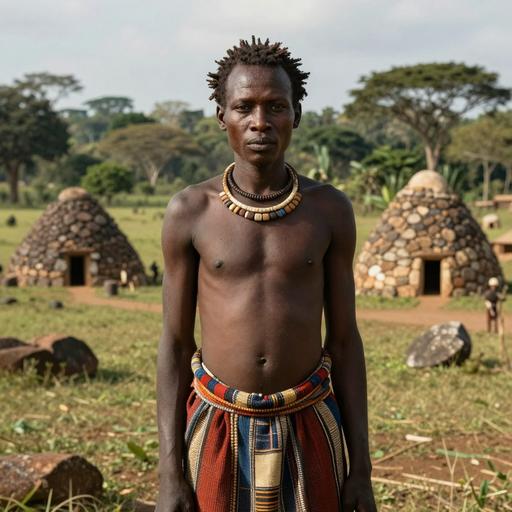
The highest concentrations of haplogroup B are reported in Central African rainforest hunter-gatherer groups (often referred to collectively as Pygmy populations), with moderate presence in parts of East and West Africa and low-frequency occurrences in southern and northern African populations. The distribution reflects a pattern of long-term persistence in relatively isolated forager groups and dilution through admixture with expanding agricultural and pastoralist populations (for example, Bantu-associated E1b1a lineages). Small but detectable frequencies of B also appear in diaspora populations outside Africa as a result of recent historical movements.
Historical and Cultural Significance
Haplogroup B is not generally associated with later continent-wide demographic expansions such as the Bantu expansion (which is dominated by E1b1a) or the major Eurasian-driven Bronze Age movements. Instead, B is most informative for reconstructing ancient African population structure and the demographic history of hunter-gatherer groups. Its persistence in Central African forest communities, occasional presence among East African foragers and Nilotic groups, and sporadic traces in southern African foragers highlight pre-agricultural population differentiation and local continuity through the Late Pleistocene and Holocene. Genetic studies that include high-coverage Y sequences from B-carrying individuals have used these lineages to infer branching order near the root of the Y-tree and to calibrate timelines for early male-line divergences within Africa.
Conclusion
Y-DNA haplogroup B is a deep-rooted African paternal lineage whose substructure preserves signals of very early population splits and long-term persistence of forager populations in Central and parts of Eastern Africa. While it occurs at moderate-to-high frequency only in a limited set of populations (notably Central African rainforest foragers), its presence elsewhere at low frequency underscores complex admixture and migration dynamics within Africa over tens of thousands of years. As sequencing and sampling improve, B continues to be valuable for resolving the earliest branches of the human Y-chromosome tree and for understanding prehistoric demographic processes in Africa.
关键点
- Origins and Evolution
- Subclades
- Geographical Distribution
- Historical and Cultural Significance
- Conclusion