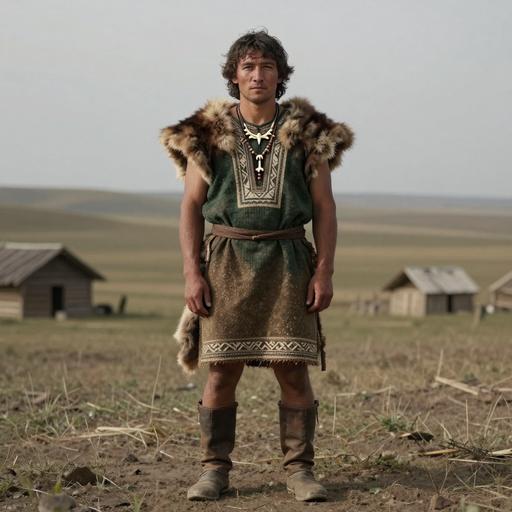
部门背景
Y-DNA 谱系分支 Q 的历史背景
Origins and Evolution
Y-DNA haplogroup Q is one of the major branches of the human paternal phylogeny, descending from P and closely related to haplogroup R. Most population genetic studies place the diversification of Q in northern Eurasia, with an estimated origin during the Upper Paleolithic to early post-Upper Paleolithic period, roughly 30,000 years ago. Its early history is tied to hunter-gatherer populations of northern Eurasia, followed by later expansions into Siberia and, ultimately, the Americas.
The deepest structure within Q reflects ancient movements across North Asia. Some lineages appear to have expanded in eastern Eurasia before the Last Glacial Maximum and/or during late glacial re-colonization, while others diversified much later in Siberia and adjacent regions. The branch is especially notable because it includes the paternal ancestors of many Indigenous peoples of the Americas.
Subclades
Haplogroup Q has several important downstream branches. Among the best-known are:
- Q1a: A major branch with strong representation in Siberia and the Americas.
- Q1b: A rarer branch found at low frequencies across parts of Eurasia.
- Q-M3: A highly important Native American founding lineage within Q1a, associated with the initial peopling of the Americas.
- Other Siberian and Central Asian subclades: These reflect complex population history in northern Asia and are useful in tracing regional ancestry.
Because Q is an intermediate clade, its significance lies not only in present-day distributions but also in its role as a connective node between older ancestral lineages and more regionally defined descendant branches.
Geographical Distribution
Haplogroup Q is found across a broad trans-Eurasian and trans-Beringian distribution, but it is most frequent in:
- Indigenous populations of the Americas, where certain Q lineages dominate paternal ancestry in many groups
- Siberian peoples, including several indigenous communities of northeastern Asia
- Central Asia, at lower to moderate frequencies
- Northern and Eastern Europe, usually at low frequencies, often reflecting historic migrations, admixture, or founder effects
- Parts of Southwest Asia and the Middle East, generally rare but present in some populations
The distribution strongly suggests an ancient northern Eurasian origin followed by repeated bottlenecks and expansions. The Beringian connection is especially important: one or more Q lineages crossed into the Americas with the ancestors of Native American populations.
Historical and Cultural Significance
Haplogroup Q is one of the most historically significant Y-DNA lineages because it is closely associated with the initial settlement of the Americas. Its descendant lineages, especially Q-M3, are widespread among Indigenous peoples from Alaska to South America and provide a key genetic marker for reconstructing early migration routes.
In Eurasia, Q lineages are informative for the study of Siberian hunter-gatherers, steppe-border populations, and later population movements across Central Asia and northern Europe. While Q is not typically linked to a single archaeological culture in the way some steppe-associated haplogroups are, it is repeatedly associated with Late Paleolithic, Mesolithic, and early Holocene northern Eurasian contexts, and later with Beringian and Native American founding populations.
Conclusion
Y-DNA haplogroup Q is a deeply important paternal lineage with an origin in North Eurasia and a major legacy in Siberia and the Americas. As an intermediate clade, it serves as a crucial bridge in the Y-chromosome tree, connecting ancient northern Eurasian ancestry to the paternal histories of many Indigenous peoples of the New World.
关键点
- Origins and Evolution
- Subclades
- Geographical Distribution
- Historical and Cultural Significance
- Conclusion