Arslantepe at Dawn

下载的 PDF 是图像副本。如需可选中文本及更好的辅助技术支持,请使用打印功能。

Arslantepe at Dawn

揭开一个失落的文明

正在加载考古记录……

正在收集古代记录

跳转到主内容
Arslantepe at Dawn
文明焦点

Arslantepe at Dawn

A frontier city of Early Bronze Age Anatolia, revealed through bones and soil

2860 CE - 2298 BCE
Arslantepe, Malatya Province, Turkey
滚动开始
Chapter I

剧情

了解 Arslantepe at Dawn 文化

Arslantepe (Malatya Province) c. 2860–2298 BCE: archaeology reveals fortified architecture, craft specialization, and social hierarchy. Four ancient genomes show Y haplogroup J in two individuals and diverse mtDNA (H, K, U, T). Limited samples make genetic interpretations preliminary.

Time Period

2860–2298 BCE

Region

Arslantepe, Malatya Province, Turkey

Common Y-DNA

J (observed in 2 of 4 samples)

Common mtDNA

H, K, U, T (one each among 4 samples)

Chapter II

时间线

这种文化历史上的关键时刻

2500 BCE

Arslantepe as a regional hub

Evidence of monumental architecture and specialized workshops suggests Arslantepe functioned as a center of craft and administration in the Early Bronze Age.

Chapter III

Origins & Emergence

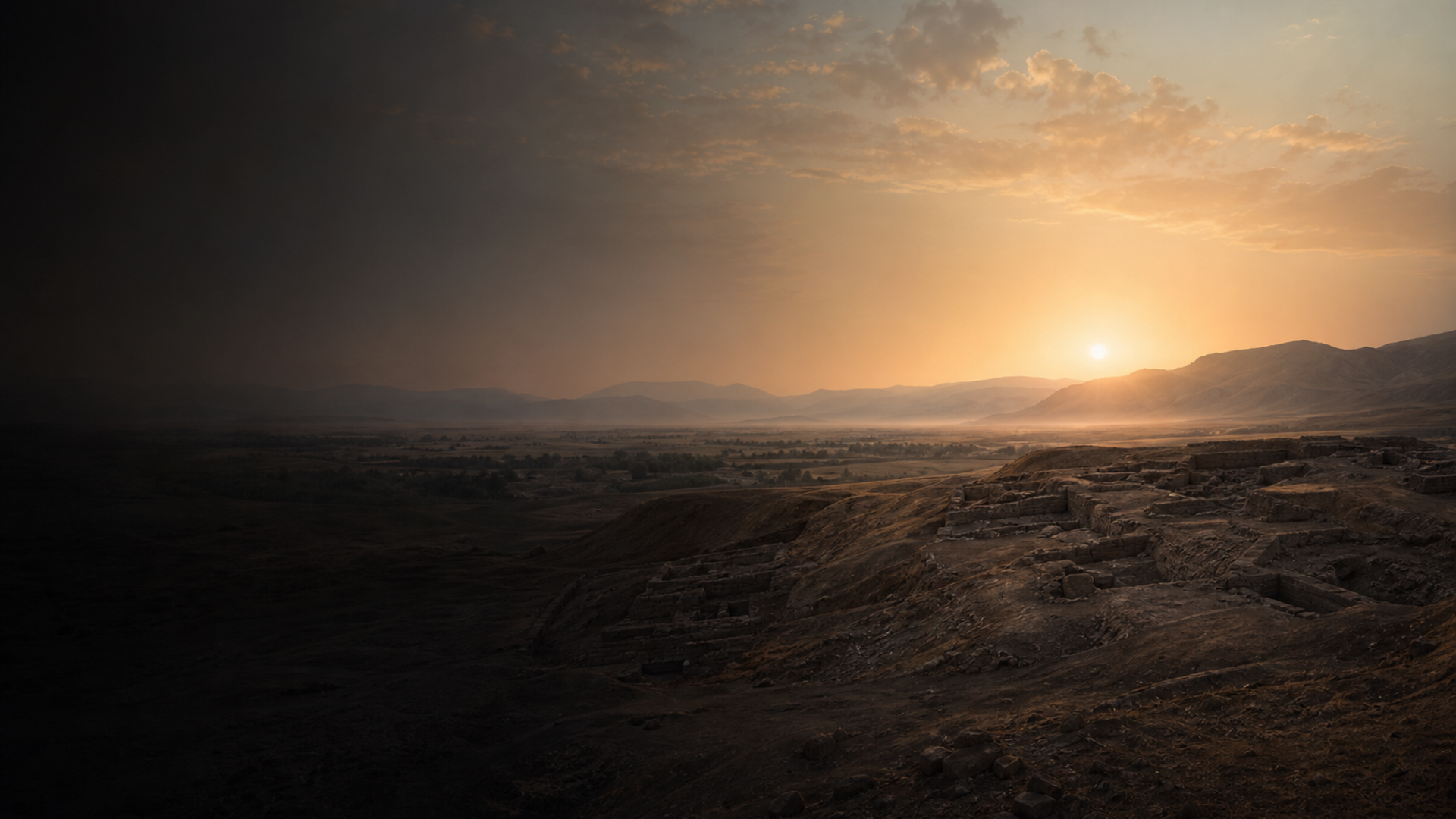
Arslantepe sits like a cliffside beacon over the Euphrates tributaries of eastern Anatolia. By the Early Bronze Age (c. 2860–2298 BCE) archaeological layers preserve a long sequence of settlement, marked by monumental architecture, fortification walls, and evidence for centralized administration. Excavations at Arslantepe reveal stone and mudbrick complexes, specialized workshops, and rich assemblages of metalwork and pottery that signal increasing social complexity and regional interaction.

The site’s material culture places it within a web of Anatolian and northern Mesopotamian connections: imported raw materials, stylistic influences in glyptic and metallurgy, and logistical signatures of long-distance exchange. Archaeological data indicates episodes of rebuilding and elite-controlled craft production, suggesting emergent social hierarchies and control of resources.

Limited evidence suggests that Arslantepe functioned as a regional hub on routes linking central Anatolia, the Levant, and the highlands to the east. While architecture and artifacts paint a cinematic portrait of early state formation, the human remains sampled for ancient DNA add an important biological dimension to this story, revealing how people who lived and worked at Arslantepe were connected — biologically and culturally — to their wider world.

  • Long occupational sequence with monumental architecture
  • Craft specialization and evidence of centralized control
  • Positioned on Anatolia–Mesopotamia interaction routes
Chapter IV

Daily Life & Society

Arslantepe’s streets and courtyards would have thrummed with the work of metalworkers, potters, and scribes. Archaeological layers contain kilns, slag and crucible fragments, and finely made metal ornaments that imply skilled workshops and control over metallurgical knowledge. Domestic spaces show storage facilities and household tools, while larger administrative buildings suggest redistribution of goods and possibly tribute.

Dietary remains, where recovered, indicate a mixed agricultural base—cereals, pulses, and domestic animals—augmented by craft economies that produced prestige items and practical tools. Funerary practices at nearby cemeteries are variable, reflecting social differentiation: some burials include grave goods and metal objects, while others are simpler. The material record implies a society negotiating inequality, craft specialization, and long-distance trade.

Arslantepe’s built landscape—fortifications and public buildings—speaks to concerns about defense and the projection of authority. These archaeological signals combine with genetic data to help reconstruct who these people were: their ancestries, their family connections, and how migration or local continuity shaped daily life.

  • Evidence of specialized workshops (metallurgy, ceramics)
  • Variable burial practices indicating social differentiation
Chapter V

Genetic Profile

Four ancient genomes from Arslantepe dated within 2860–2298 BCE provide a small but illuminating window into the biology of Early Bronze Age inhabitants. Two of the four males carry Y-chromosome lineage J, a haplogroup widely observed in Anatolia and the Near East. Maternal lineages recorded across the quartet are diverse—mtDNA haplogroups H, K, U, and T are each observed once—indicating a mixture of maternal ancestries present locally.

These genetic signals are consistent with an Anatolian context that frequently carries Near Eastern genetic components; haplogroup J on the Y-chromosome aligns with regional patterns rather than pointing to a single migratory event. The varied mtDNA pool suggests that maternal lineages were heterogeneous, possibly reflecting local continuity combined with incoming individuals or marriage networks across regions.

Crucially, sample count is very low (n=4). Because of this, conclusions must remain preliminary: patterns such as the frequency of haplogroup J or the diversity of mtDNA could shift with more data. Archaeogenetic interpretation is strongest when integrated with material culture and isotopic studies (mobility, diet) to build a nuanced narrative of population continuity, contact, and change at Arslantepe.
  • Y-DNA: J found in 2 of 4 samples, aligning with Anatolian/Near Eastern profiles
  • mtDNA: H, K, U, T each present once; small sample size makes conclusions preliminary
Chapter VI

Legacy & Modern Connections

Arslantepe’s archaeological and genetic traces form a palimpsest that connects the deep past to present populations of Anatolia. The presence of Y-haplogroup J and a range of maternal lineages echoes broader patterns seen across modern Anatolian and Near Eastern groups, but the limited ancient sample set prevents direct ancestry claims.

Archaeological continuity in settlement, craft traditions, and regional exchange contributes to cultural threads that endure in the material landscape of eastern Turkey. DNA data offers a humanizing counterpoint to artifacts: it suggests networks of biological relatedness and mobility that moved people as well as objects. Future genomic sampling paired with isotopic and archaeological analyses will refine how Arslantepe’s inhabitants contributed to the genetic tapestry of later Anatolian populations.

  • Genetic patterns resonate with broader Anatolian ancestry but are preliminary
  • Archaeology and DNA together illuminate continuity and long-distance connections
AI 电源

AI 助手

就 Arslantepe at Dawn 文化提问

AI 助手 由DNAGENICS公司制作

解锁此特性
Ask questions about the Arslantepe at Dawn culture. Our AI assistant can explain genetic findings, historical context, archaeological evidence, and modern connections.
AI 样本分析

Arslantepe at Dawn 文化是人类历史中值得了解的一章……

遗传分析揭示了与早期种群的联系,同时显示了独特的适应和文化创新的证据。 古代DNA样本提供了对迁徙模式、社会结构以及古代种群之间的生物关系的深刻见解。

这是人工智能分析的预览。 解锁全AI 助手, 以探索关于:

  • 遗传组成和祖先
  • 移徙模式和起源
  • 日常生活和文化习俗
  • 现代遗传遗产

探索更古老的文化

揭开古代世界文明的故事

使用优惠码 可减免 35% • 11月12日 到期




