Eleuthera Taino Echoes

下载的 PDF 是图像副本。如需可选中文本及更好的辅助技术支持,请使用打印功能。

Eleuthera Taino Echoes

揭开一个失落的文明

正在加载考古记录……

正在收集古代记录

跳转到主内容
Eleuthera Taino Echoes
文明焦点

Eleuthera Taino Echoes

A Late-1st-millennium burial from Preacher's Cave ties Bahamian life to wider Arawakan movements

892 CE - 1022 CE
Bahamas — Eleuthera (Preacher's Cave)
滚动开始
Chapter I

剧情

了解 Eleuthera Taino Echoes 文化

Ancient mtDNA from Preacher's Cave (Eleuthera, Bahamas), dated 892–1022 CE, identifies mtDNA haplogroup B2 in a Bahamas Taino individual. Archaeology and limited genetics suggest Arawakan connections; conclusions are highly preliminary given a single sampled individual.

Time Period

892–1022 CE (sample)

Region

Bahamas — Eleuthera (Preacher's Cave)

Common Y-DNA

No Y-DNA recovered (sample n=1)

Common mtDNA

B2 (sample n=1)

Chapter II

时间线

这种文化历史上的关键时刻

500 BCE

Saladoid dispersal begins

Ceramic-producing Arawakan-speaking populations expand northward into the Lesser Antilles, setting the stage for later Ceramic-age societies.

900 CE

Preacher's Cave burial (Eleuthera)

Human remains and artifacts at Preacher's Cave date to the interval 892–1022 CE; the mtDNA result comes from this context.

1492 CE

European contact and disruption

First sustained European incursions into the Caribbean initiate demographic, cultural, and ecological transformations across the islands.

Chapter III

Origins & Emergence

The individual from Preacher's Cave on Eleuthera dates to the Late Ceramic period in the northern Caribbean (radiocarbon-calibrated range 892–1022 CE). Archaeological data indicate that the people archaeologists label as Taino in the Greater Antilles and adjacent island groups are the product of long-distance movements of Arawakan-speaking, ceramic-producing populations that dispersed northward from northern South America over the first millennium BCE and into the first millennium CE. Material culture — including distinct pottery styles, ground stone tools, and settlement forms — shows affinities across the northern Lesser Antilles, the Greater Antilles, and the Bahamian archipelago.

Preacher's Cave has yielded cultural deposits that situate Eleuthera within these networks of exchange and mobility. The single genetic sample from this site provides a direct biological link to that archaeological horizon, but that link must be framed carefully: one mtDNA result can confirm presence of a lineage (here, haplogroup B2) but cannot by itself reconstruct migration routes, population size, or the full diversity of Bahamian peoples. Limited evidence suggests continuity with broader Arawakan ancestries, yet archaeological and genetic work across more Bahamian sites is needed to turn suggestive patterns into robust models.

  • Sample dated 892–1022 CE from Preacher's Cave, Eleuthera
  • Archaeological affinities with Ceramic-age Arawakan expansions
  • Single genetic specimen offers a preliminary biological anchor
Chapter IV

Daily Life & Society

Archaeological assemblages across the Bahamas and nearby islands reconstruct a life adapted to islands: fishing, shellfish gathering, and small-scale horticulture were central. Ceramic vessels — often decorated and made with temper appropriate for island clays — reflect cooking, storage, and social signaling. In the broader Taino world, plaza-centered villages, communal ballcourts (batey), and carved zemí (ancestor or spirit figures) appear in the material record; evidence for such features in the Bahamas is patchy but present in some excavated sites.

Settlement on Eleuthera and neighboring cays likely consisted of small villages or camps that exploited coastal and nearshore resources. Archaeobotanical remains and tool assemblages suggest cultivation of root crops such as cassava alongside marine protein reliance. Craft specialists produced shell tools, bone implements, and decorated pottery; domestic and ceremonial spheres were often interwoven. Burial contexts, like the one associated with Preacher's Cave, provide rare direct insight into mortuary practice and bodily treatment, but interpretations remain cautious: cave deposits can represent a range of behaviors from routine interment to episodic use during times of stress.

Archaeology paints a picture of resilient island lifeways, adaptive strategies, and social networks reaching across the Caribbean, even as many details remain unresolved by the limited Bahamian sample record.

  • Mixed subsistence: fishing, shellfish, horticulture (cassava)
  • Material culture: decorated ceramics, shell and bone tools
Chapter V

Genetic Profile

The genetic evidence from Preacher's Cave is currently limited to a single mitochondrial genome assigned to haplogroup B2. Haplogroup B2 is one of the well-established Native American maternal lineages with deep roots tracing back to the initial peopling of the Americas via Beringia and subsequent southward dispersals. Its presence in a Late-1st-millennium CE Bahamian individual is consistent with broader patterns of Indigenous American maternal diversity observed across the Caribbean and mainland Americas.

Important constraints shape interpretation. With only one sampled individual from Eleuthera (sample count = 1), any population-level inference is preliminary. The absence of recovered Y-chromosome data for this individual means paternal lineages remain unknown. Archaeogenetic studies from other Caribbean islands often show a mixture of Arawakan-associated ancestries and local insular variation; therefore, the Preacher's Cave B2 result signals continuity with Indigenous American maternal lineages but cannot alone define migration timing, admixture events, or the presence of other maternal haplogroups in the Bahamian population.

Future sampling across multiple Bahamian sites, incorporation of nuclear genome data, and direct comparison with contemporaneous Greater Antillean and South American ancient genomes will be required to move from suggestive connections to detailed reconstructions of ancestry, kinship, and population dynamics.

  • mtDNA B2 identified in the Eleuthera individual (preliminary)
  • No Y-DNA recovered; nuclear data lacking — conclusions tentative
Chapter VI

Legacy & Modern Connections

The material and genetic traces from the Bahamas record a chapter in a long story of Caribbean mobility, exchange, and adaptation. Archaeological continuity of decorative motifs, settlement patterns, and subsistence strategies links Bahamian people to a wider Arawakan-speaking world. The single mtDNA B2 result reinforces that Indigenous maternal lineages were part of the Bahamian genetic landscape prior to European contact.
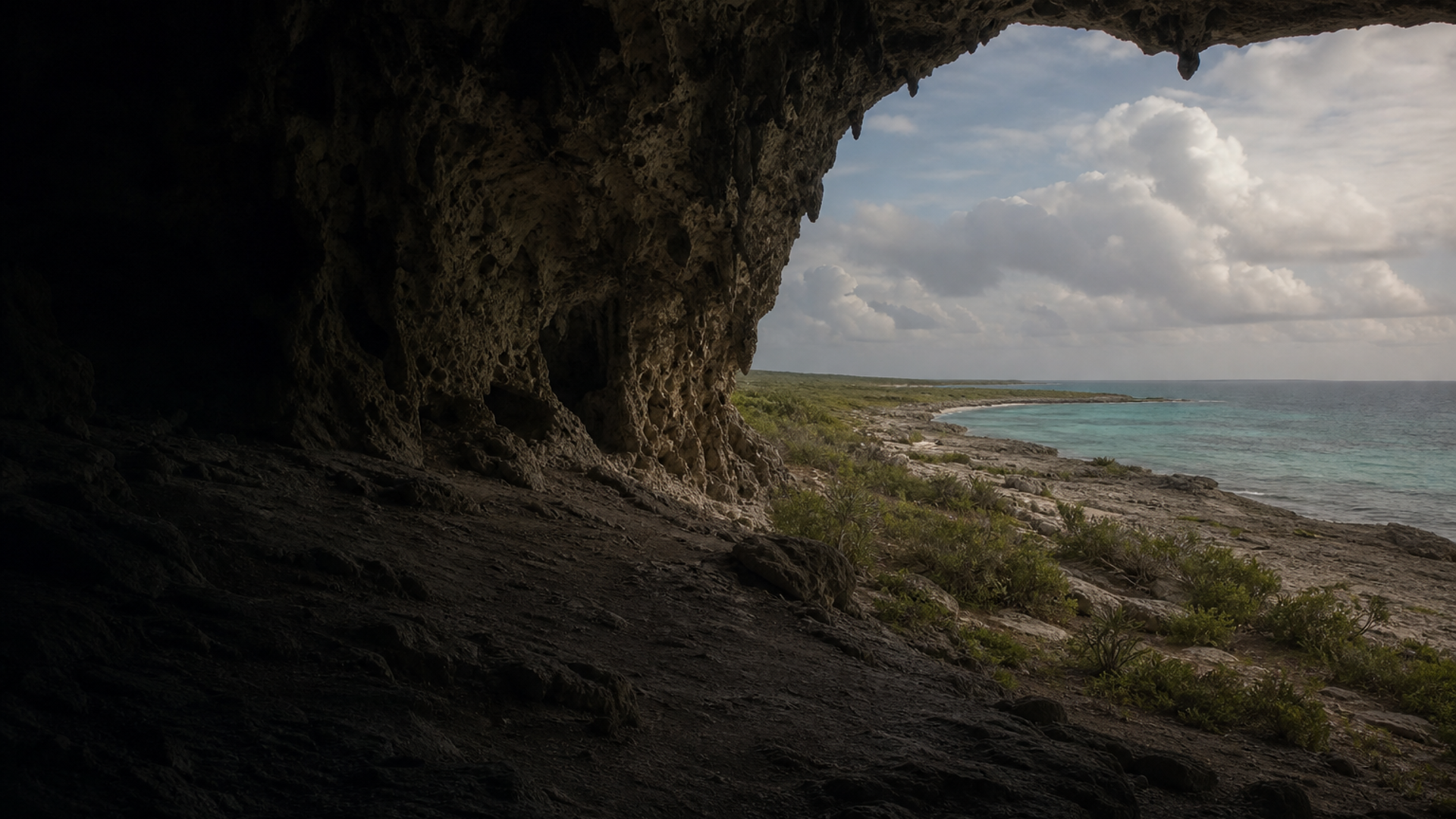

In the modern era, Caribbean populations carry complex ancestries shaped by Indigenous persistence, African diasporic contributions, and European colonization. Genetic studies of present-day Caribbean groups often detect Native American components, but the magnitude and distribution vary regionally. The Preacher's Cave specimen serves as a biological waypoint: it anchors an ancient Bahamian presence in time and genetics and highlights the need for expanded sampling to better understand continuity, loss, and cultural resilience in the archipelago.

All interpretations should emphasize uncertainty and the ethical responsibility to work with descendant communities in shaping future research agendas.

  • Pre-contact Indigenous maternal lineage (B2) present in the Bahamas
  • Modern Caribbean ancestries reflect Indigenous, African, and European mixtures
AI 电源

AI 助手

就 Eleuthera Taino Echoes 文化提问

AI 助手 由DNAGENICS公司制作

解锁此特性
Ask questions about the Eleuthera Taino Echoes culture. Our AI assistant can explain genetic findings, historical context, archaeological evidence, and modern connections.
AI 样本分析

Eleuthera Taino Echoes 文化是人类历史中值得了解的一章……

遗传分析揭示了与早期种群的联系,同时显示了独特的适应和文化创新的证据。 古代DNA样本提供了对迁徙模式、社会结构以及古代种群之间的生物关系的深刻见解。

这是人工智能分析的预览。 解锁全AI 助手, 以探索关于:

  • 遗传组成和祖先
  • 移徙模式和起源
  • 日常生活和文化习俗
  • 现代遗传遗产

探索更古老的文化

揭开古代世界文明的故事

使用优惠码 可减免 35% • 11月12日 到期




