Nea Styra — Early Bronze Age Echoes

下载的 PDF 是图像副本。如需可选中文本及更好的辅助技术支持,请使用打印功能。

Nea Styra — Early Bronze Age Echoes

揭开一个失落的文明

正在加载考古记录……

正在收集古代记录

跳转到主内容
Nea Styra — Early Bronze Age Echoes
文明焦点

Nea Styra — Early Bronze Age Echoes

A coastal Euboean community (2851–2292 BCE) where archaeology meets early DNA glimpses

2851 CE - 2292 BCE
Nea Styra, Euboea & Central Greece (Greece)
滚动开始
Chapter I

剧情

了解 Nea Styra — Early Bronze Age Echoes 文化

Nea Styra_EBA (2851–2292 BCE): five Early Bronze Age individuals from Nea Styra, Euboea and Central Greece reveal mixed Y-DNA (J, I2, G, L) and limited maternal data (mtDNA U). Limited samples mean conclusions are preliminary, but ties to Neolithic farmers and local European lineages emerge.

Time Period

2851–2292 BCE

Region

Nea Styra, Euboea & Central Greece (Greece)

Common Y-DNA

J (2), I2 (1), G (1), L (1)

Common mtDNA

U (1)

Chapter II

时间线

这种文化历史上的关键时刻

2500 BCE

Nea Styra Early Bronze occupation

Archaeological evidence indicates active coastal settlement and burial activity at Nea Styra, reflecting mixed farming, craft production, and maritime exchange during the Early Bronze Age.

Chapter III

Origins & Emergence

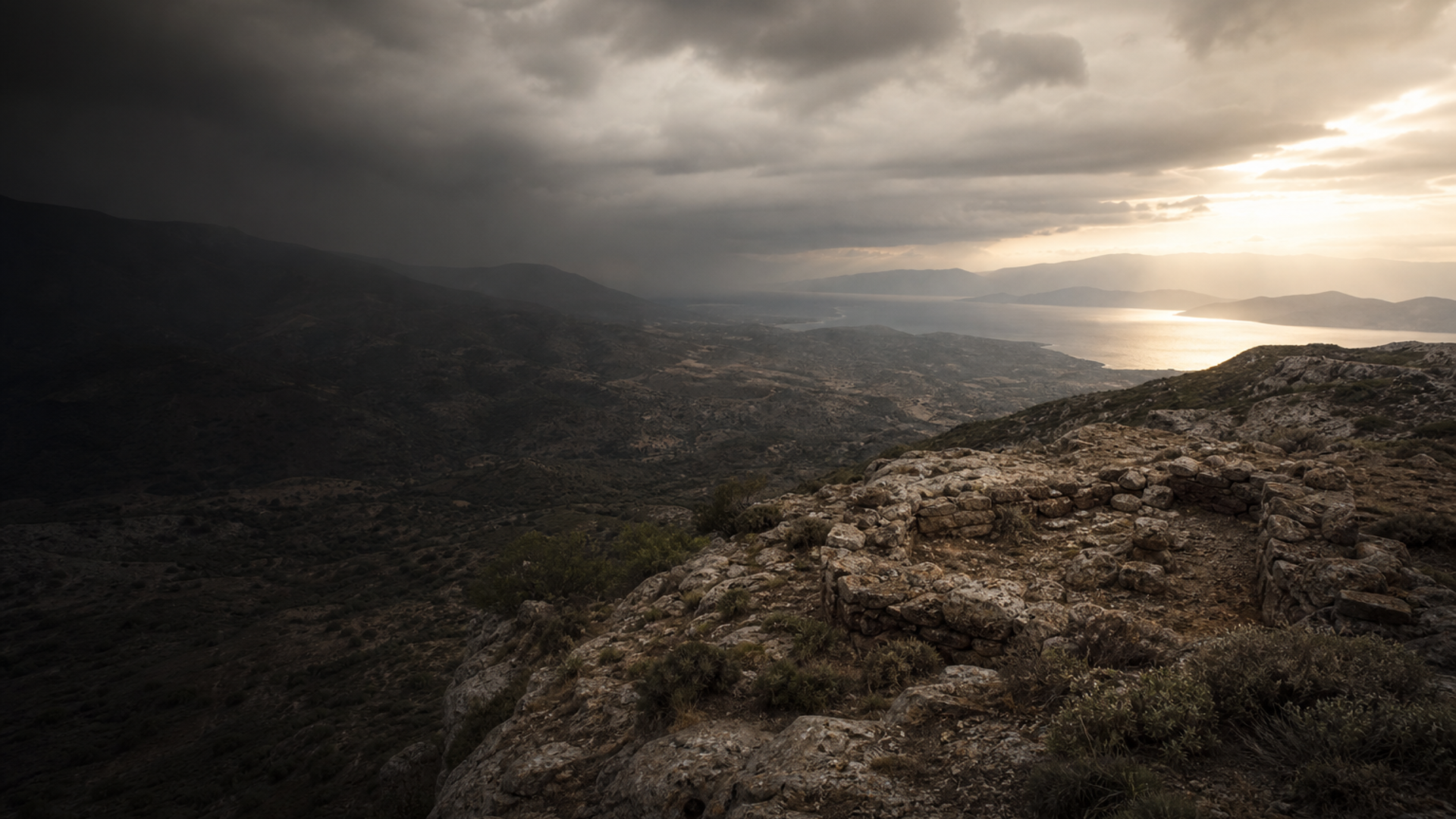
The rocky coast of Nea Styra on Euboea presides over a horizon of bronze — small harbors, scattered tombs, and pottery sherds that speak of a community adapting to new economies at the dawn of the Early Bronze Age (2851–2292 BCE). Archaeological data indicates continuity with Late Neolithic lifeways alongside innovations in metallurgy, craft specialization, and long-distance exchange. Excavations at Nea Styra reveal household ceramics and burial practices consistent with contemporaneous Aegean sites, suggesting integration into regional networks that connected the islands and mainland.

Cinematic imagery of salt-washed stone and hearth smoke gives way to measured inference: the limited burial assemblage and stratigraphic sequences imply a small, mobile population tied to both maritime routes and inland resources. Environmental evidence points to mixed agriculture and pastoralism, with seasonal exploitation of coastal fisheries.

Genetic signals from five individuals offer a new lens on emergence — one that must be read with caution. With only five samples, patterns are tentative, but they hint at a tapestry woven from local European lineages and ancestries linked to earlier Neolithic farmers. Limited evidence suggests Nea Styra was neither isolated nor a simple outpost; rather, it played a role in the shifting cultural landscapes of the Early Bronze Age Aegean.

  • Community active during 2851–2292 BCE at Nea Styra, Euboea
  • Material culture shows continuity with Late Neolithic and new Bronze Age practices
  • Site evidence indicates mixed agriculture, pastoralism, and maritime exchange
Chapter IV

Daily Life & Society

Daily life at Nea Styra can be imagined through the intimate traces left behind: cooking hearths, chipped tools, and the broken rims of storage jars. Archaeological data indicates households practiced mixed farming—barley, pulses, and domestic animals—supplemented by coastal fishing. Craft activities, including simple metalworking and coarse pottery production, point to local skill sets rather than large-scale workshop economies.

Settlement patterns suggest small, nucleated hamlets rather than dense urban centers. Burials are modest; grave goods are few, implying social difference but not extreme inequality. The sea shaped lifeways — craft exchange and seasonal mobility likely connected Nea Styra to neighboring Euboean and mainland communities.

Because preservation varies and the sample of human remains is small, reconstructions of kinship structures and social hierarchy remain provisional. Nevertheless, the archaeological picture is of a resilient coastal community: adaptive, networked, and engaged with the broader currents of the Early Bronze Aegean.

  • Households engaged in mixed farming, pastoralism, and coastal fishing
  • Modest burials and local craft production suggest small-scale, networked society
Chapter V

Genetic Profile

Five Early Bronze Age individuals from Nea Styra provide a slender but informative genetic snapshot. Y-chromosome lineages observed include J (2 individuals), I2 (1), G (1), and L (1). Maternal data are limited — one recorded mtDNA haplogroup U — and autosomal patterns are not specified here, so interpretations must remain cautious.

Haplogroup J and G are commonly associated with lineages expanding from Neolithic farmers in the Near East and into the Aegean; their presence at Nea Styra is consistent with archaeological evidence for enduring farmer-derived ancestry in the region. Haplogroup I2 is often linked to longstanding European hunter-gatherer-derived lineages and may reflect local continuity or admixture with indigenous populations. The single L lineage is unexpected in the Aegean context where L is usually rare; with only one sample, this could represent a low-frequency lineage, long-distance mobility, or a sampling artifact — more data are needed.

Because the total sample count is low (<10), conclusions about population structure, sex-biased migration, or the timing of incoming ancestries (for example, later Steppe-related inputs observed elsewhere in the Aegean) are preliminary. Archaeological context combined with these genetic hints suggests Nea Styra’s Early Bronze Age community carried a mosaic of ancestries, reflecting both local survival and connections that reached beyond the immediate coastline.

  • Y-DNA: J (2), I2 (1), G (1), L (1) — suggests farmer-linked and local European lineages
  • Small sample size (<10) makes interpretations preliminary; unexpected L haplogroup needs further study
Chapter VI

Legacy & Modern Connections

Nea Styra’s genetic and archaeological echoes contribute to a larger story of continuity and change in the Aegean. The blend of Y-lineages tied to Near Eastern farmer ancestry and European hunter-gatherer-derived lineages resonates with broader patterns seen across Bronze Age Greece. While modern Greek populations reflect many layered inputs over millennia, these Early Bronze Age individuals underscore deep regional roots alongside intermittent long-distance contacts.

Importantly, the tiny sample set cautions against sweeping claims of direct descent. Instead, Nea Styra offers a vignette: a maritime community whose people were part of the mosaic that, over centuries, contributed to the genetic and cultural fabric of the eastern Mediterranean. Future sampling and comparison with contemporaneous mainland and island sites will refine how these early threads connect to later populations.

  • Reflects mixture of local European lineages and farmer-derived ancestries seen in the Aegean
  • Small dataset implies careful interpretation; future samples may clarify links to modern populations
AI 电源

AI 助手

就 Nea Styra — Early Bronze Age Echoes 文化提问

AI 助手 由DNAGENICS公司制作

解锁此特性
Ask questions about the Nea Styra — Early Bronze Age Echoes culture. Our AI assistant can explain genetic findings, historical context, archaeological evidence, and modern connections.
AI 样本分析

Nea Styra — Early Bronze Age Echoes 文化是人类历史中值得了解的一章……

遗传分析揭示了与早期种群的联系,同时显示了独特的适应和文化创新的证据。 古代DNA样本提供了对迁徙模式、社会结构以及古代种群之间的生物关系的深刻见解。

这是人工智能分析的预览。 解锁全AI 助手, 以探索关于:

  • 遗传组成和祖先
  • 移徙模式和起源
  • 日常生活和文化习俗
  • 现代遗传遗产

探索更古老的文化

揭开古代世界文明的故事

使用优惠码 可减免 35% • 11月12日 到期