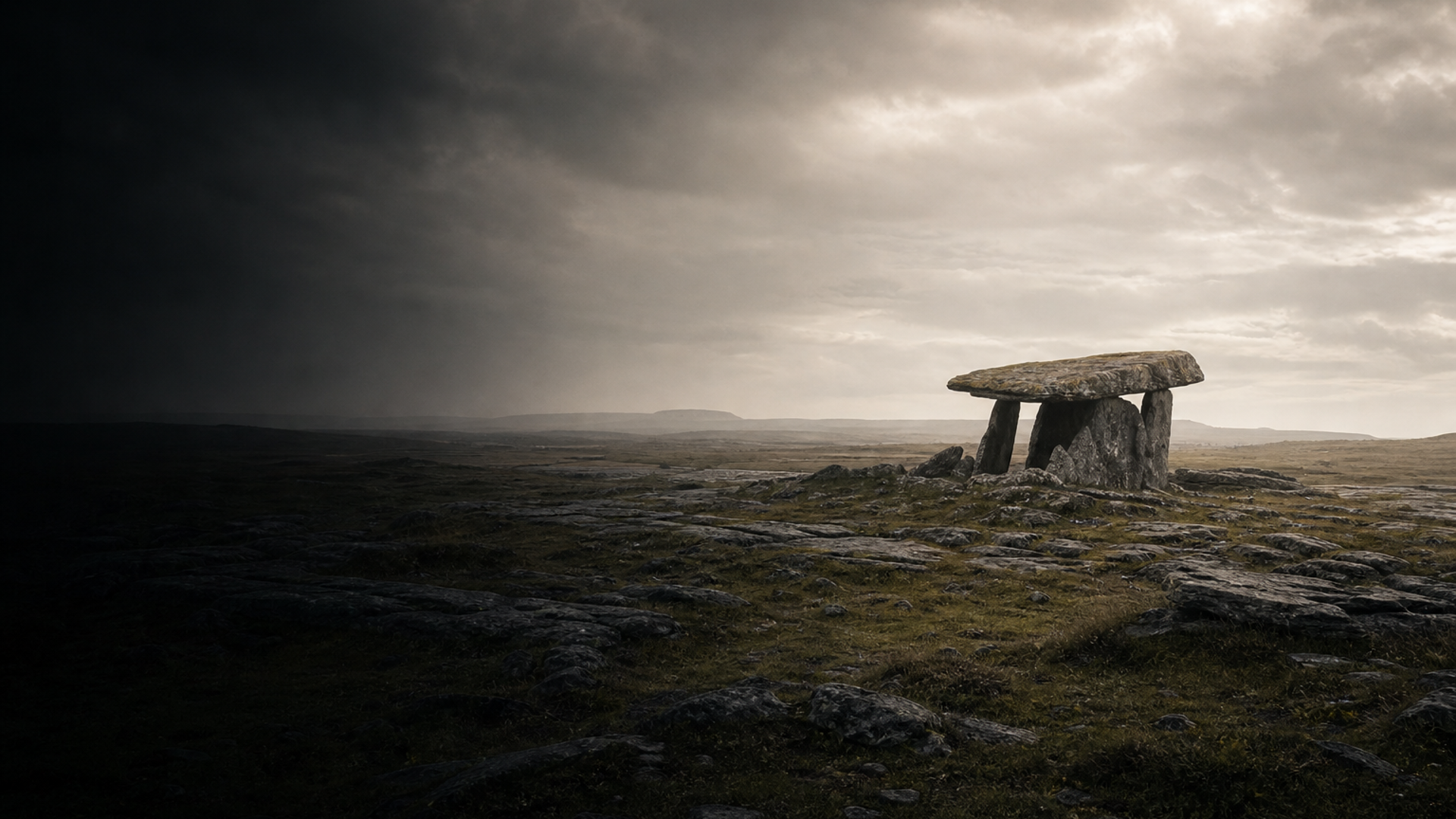
Poulnabrone Neolithic Voices

下载的 PDF 是图像副本。如需可选中文本及更好的辅助技术支持,请使用打印功能。

Poulnabrone Neolithic Voices

揭开一个失落的文明

正在加载考古记录……

正在收集古代记录

跳转到主内容
Poulnabrone Neolithic Voices
文明焦点

Poulnabrone Neolithic Voices

Early farmers and local lineages in County Clare, c. 3946–3651 BCE

3946 CE - 3651 BCE
Ireland (County Clare, Poulnabrone)
滚动开始
Chapter I

剧情

了解 Poulnabrone Neolithic Voices 文化

Archaeogenetic and archaeological evidence from Poulnabrone, County Clare (3946–3651 BCE) reveals a small Early Neolithic assemblage where Y-haplogroup I predominates and maternal lineages include H1*, K, and U. Limited samples suggest complex farmer–hunter‑gatherer interactions in western Ireland.

Time Period

3946–3651 BCE (Early Neolithic)

Region

Ireland (County Clare, Poulnabrone)

Common Y-DNA

I (3 of 4 samples)

Common mtDNA

H1*, K, U (each observed)

Chapter II

时间线

这种文化历史上的关键时刻

3946 BCE

Earliest sampled burial at Poulnabrone

Radiocarbon-dated human remains from Poulnabrone provide the earliest genomic window in this set (c. 3946 BCE), capturing Early Neolithic lifeways at the Burren’s portal tomb.

Chapter III

Origins & Emergence

The bones and stones of Poulnabrone speak of a pivotal chapter in Irish prehistory: the arrival and establishment of farming communities on the Atlantic edge of Europe. Archaeological data indicates the Early Neolithic in Ireland begins around 4000 BCE with the introduction of domesticated plants and animals, polished stone axes, and the construction of monumental tombs. The samples dated to 3946–3651 BCE come from human remains associated with the Poulnabrone portal tomb in County Clare, an iconic megalith situated in the Burren’s limestone landscape.

Genetic research places the Neolithic transformation in a wider continental story: first farmers carried ancestry ultimately traceable to Anatolian and Aegean sources, but they rarely arrived as a single homogeneous group. Limited evidence from these four individuals points to an unexpectedly high frequency of Y-chromosome haplogroup I — a lineage often linked to pre‑farming hunter‑gatherers or long‑standing European male lines — alongside maternal haplogroups (H1*, K, U) that appear among early farming and local forager populations. This admixture pattern suggests interaction, assimilation, or continuity at the frontier between incoming agriculturalists and resident groups. Given the very small sample size, such interpretations are preliminary, but they illuminate how the Neolithic in Ireland could be a mosaic of new practices and enduring local ancestry.

  • Arrival of farming in Ireland ≈ 4000 BCE; Poulnabrone samples dated 3946–3651 BCE
  • Poulnabrone portal tomb: focal point for burial and ritual in the Burren, County Clare
  • Genetic signals hint at farmer–forager interactions; conclusions are provisional
Chapter IV

Daily Life & Society

Stone walls and meadows whisper of lives organized around fields, herds, and the rhythms of a rugged coast. Archaeological remains from Early Neolithic Ireland indicate mixed farming economies: domesticated cereals and animals were cultivated alongside continued exploitation of marine and wild resources. Polished axes and grove-clearing tools appear in the material record, suggesting a landscape reshaped for cultivation and settlement.

Monuments such as portal tombs — Poulnabrone among the most dramatic — served as persistent places of remembrance. Excavations have shown that megalithic tombs were used repeatedly, often for small, curated assemblages of human remains rather than large single events. This practice implies social structures that valued ancestry and ritualized landscapes. DNA can complement bones and pottery here: genetic data reveal biological relationships, patterns of mobility, and sometimes sex-biased ancestry flows (for example, differences in maternal vs. paternal lineages). In this Poulnabrone set, with three Y-haplogroup I males and varied maternal lineages, archaeological and genetic evidence together hint at social dynamics in which male line descent or local male continuity might have played a role — though with only four samples, kinship and social organization remain open questions.

  • Mixed farming with continued use of marine and wild resources
  • Megalithic tombs used repeatedly; ritual and ancestry were central to social life
Chapter V

Genetic Profile

Four Early Neolithic individuals from Poulnabrone (dated 3946–3651 BCE) provide a small but intriguing genetic snapshot. Y‑chromosome data show haplogroup I in three individuals; mitochondrial haplogroups observed include H1*, K, and U. The predominance of Y‑haplogroup I contrasts with many continental Early Neolithic assemblages where Y‑haplogroup G2a and related lineages are common among first farmers. Such a pattern can reflect several scenarios: persistence of local hunter‑gatherer paternal lineages that were incorporated into emerging farming communities; arrival of farmer groups already admixed with hunter‑gatherer males; or simple sampling bias given the tiny number of males tested.

Maternal lineages (K and H1) are consistent with lineages frequently found among early farmers in Europe, while the presence of U — a haplogroup associated with Mesolithic hunter‑gatherers — underscores maternal continuity or admixture. Genome‑wide analyses are the most powerful tool to distinguish these models, by estimating proportions of Anatolian/early farmer ancestry versus indigenous hunter‑gatherer ancestry, and by testing for sex‑biased admixture. Because the sample count here is only four, all genetic inferences must be treated as preliminary; additional sampling across time and sites is essential to build a robust picture of Neolithic demographic processes in Ireland.

  • Y-DNA: I in 3 of 4 samples — unusual compared to continental Early Neolithic profiles
  • mtDNA: H1*, K, U — mix of lineages compatible with farmer and local hunter‑gatherer ancestry
Chapter VI

Legacy & Modern Connections

The stones of Poulnabrone remain an eloquent public symbol of Ireland’s deep past. Archaeologically, the portal tomb tradition shaped later ritual landscapes and contributed to a sense of ancestral continuity in the region. Genetically, some lineages identified in the Neolithic past persist at varying frequencies in modern populations, but the demographic story includes later transformative events — for example, Bronze Age migrations that reshaped Y‑chromosome distributions in much of Western Europe. Therefore, while elements of genetic continuity may link Neolithic inhabitants of County Clare to later Irish populations, the picture is complex and layered.

For descendants and researchers alike, the interpretive power resides in combining material culture, chronology, and DNA. Even small sample sets like these highlight the dynamic interplay of migration, adoption, and local survival that produced the living mosaic of Ireland’s ancestry. Future sampling across more sites and periods will sharpen our view of which lineages endured and how social practices mediated genetic exchange.

  • Poulnabrone remains a cultural touchstone linking landscape, ritual, and ancestry
  • Genetic continuity is possible but overprinted by later demographic changes; more data needed
AI 电源

AI 助手

就 Poulnabrone Neolithic Voices 文化提问

AI 助手 由DNAGENICS公司制作

解锁此特性
Ask questions about the Poulnabrone Neolithic Voices culture. Our AI assistant can explain genetic findings, historical context, archaeological evidence, and modern connections.
AI 样本分析

Poulnabrone Neolithic Voices 文化是人类历史中值得了解的一章……

遗传分析揭示了与早期种群的联系,同时显示了独特的适应和文化创新的证据。 古代DNA样本提供了对迁徙模式、社会结构以及古代种群之间的生物关系的深刻见解。

这是人工智能分析的预览。 解锁全AI 助手, 以探索关于:

  • 遗传组成和祖先
  • 移徙模式和起源
  • 日常生活和文化习俗
  • 现代遗传遗产

探索更古老的文化

揭开古代世界文明的故事

使用优惠码 可减免 35% • 11月12日 到期