Riverine Farmers of Grand Est

下载的 PDF 是图像副本。如需可选中文本及更好的辅助技术支持,请使用打印功能。

Riverine Farmers of Grand Est

揭开一个失落的文明

正在加载考古记录……

正在收集古代记录

跳转到主内容
Riverine Farmers of Grand Est
文明焦点

Riverine Farmers of Grand Est

Early Neolithic communities in eastern France, 5250–4900 BCE — archaeology meets ancient DNA

5250 CE - 4900 BCE
Grand-Est, France (Morschwiller-le-Bas; Schwindratzheim)
滚动开始
Chapter I

剧情

了解 Riverine Farmers of Grand Est 文化

Archaeological remains from Grand-Est (Morschwiller-le-Bas; Schwindratzheim) dated 5250–4900 BCE reveal Early Neolithic farmers. Three ancient DNA samples offer preliminary haplogroup snapshots (Y: C; mt: H, T2f, X2b), hinting at farmer–forager interactions in eastern France.

Time Period

5250–4900 BCE

Region

Grand-Est, France (Morschwiller-le-Bas; Schwindratzheim)

Common Y-DNA

C (observed in 1 of 3 samples)

Common mtDNA

H, T2f, X2b (each observed among 3 samples)

Chapter II

时间线

这种文化历史上的关键时刻

5250 BCE

Early Neolithic occupation in Grand-Est

Radiocarbon-dated contexts at Morschwiller-le-Bas and Schwindratzheim mark Early Neolithic farming activity in eastern France (c. 5250 BCE).

Chapter III

Origins & Emergence

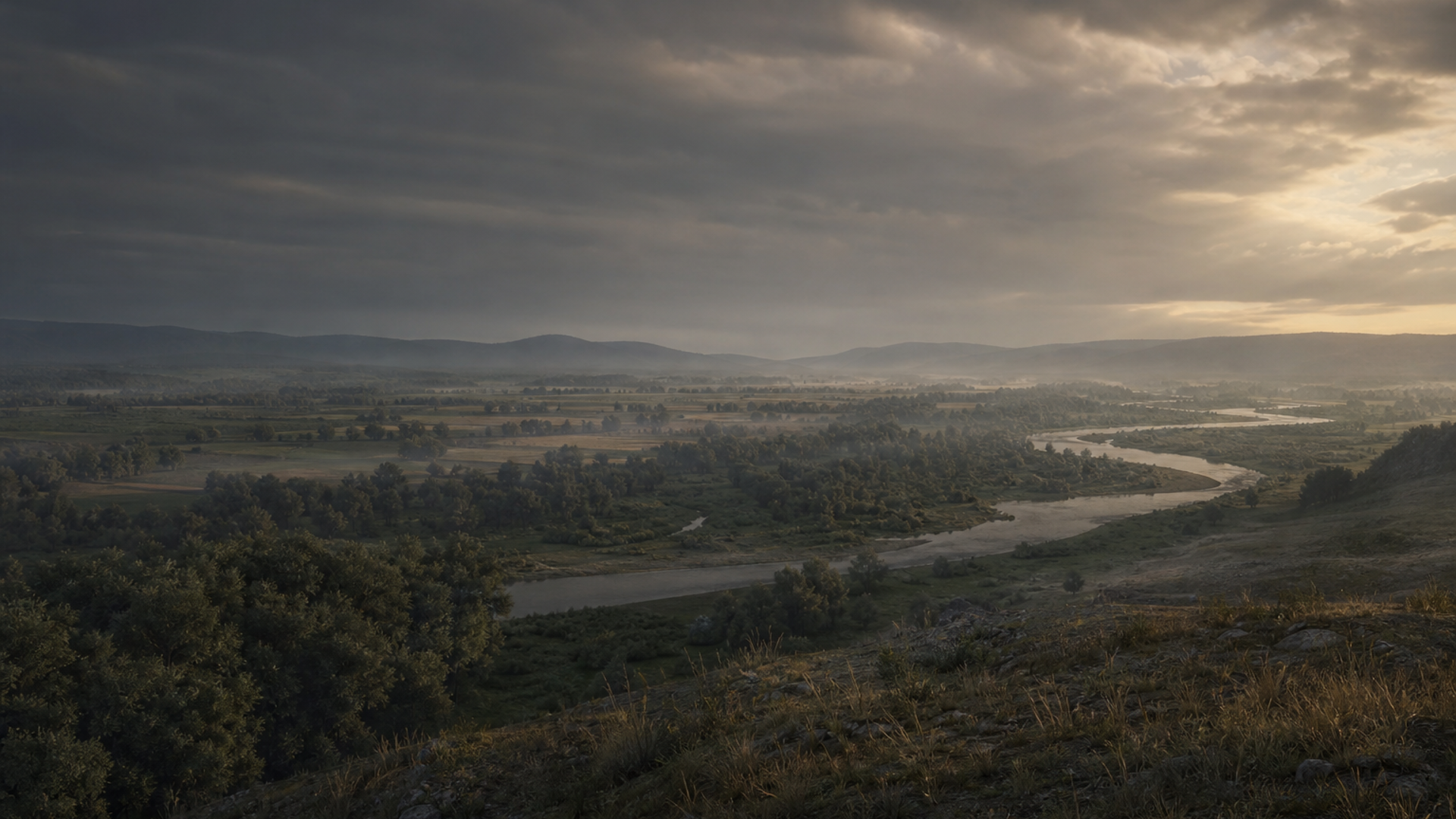
Across the low terraces and river meanders of Grand-Est, the first farmers transformed the landscape. Radiocarbon dates from contexts at Morschwiller-le-Bas and Schwindratzheim cluster between 5250 and 4900 BCE, placing these communities firmly in the Early Neolithic of eastern France. Archaeological data indicates domesticated cereals, ground stone tools, and fragmentary pottery—evidence of a settled, agrarian lifeway pushing into temperate river valleys.

Cinematic images of fields opening like stitched cloth across river plains are supported by materials: polished axes for clearing forests, pottery sherds for storage, and scattered hearths for processing grain. Regional patterns suggest this is part of the broader westward expansion of Neolithic farming traditions that originated in Anatolia and traveled along river corridors into Central and Western Europe. Genetic results from other sites in Europe point to an Anatolian-derived farmer ancestry as a major component of early Neolithic genomes; the Grand-Est samples are broadly consistent with this pattern, although the small sample set limits resolution.

Limited evidence suggests interactions with local Mesolithic forager groups—exchange, intermarriage, or assimilation remain plausible scenarios. The archaeological record here is evocative but fragmentary; each shard and flake helps reconstruct a story of migration, adaptation, and regional blending.

  • Dates: 5250–4900 BCE at Morschwiller-le-Bas and Schwindratzheim
  • Material culture: pottery fragments, polished stone tools, hearth features
  • Regional context: part of Early Neolithic expansion into western Europe
Chapter IV

Daily Life & Society

Daily life in Early Neolithic Grand-Est was intimate with the land. Archaeological deposits show domestic activity—cooking, craft production, and tool maintenance—clustered in small settlement loci. Stone grinders and cereal-processing residues point to cultivation of hulled wheats and barley, while bone assemblages indicate managed herds of sheep, goats, and possibly cattle were part of household economies.

Settlement architecture is inferred from posthole patterns and midden concentrations; timber structures with small internal divisions may have sheltered extended family units. Pottery served as both practical containers and social markers: variations in shape and decoration hint at networks of shared styles across the Rhine corridor. Flint-knapping debris and imported raw materials suggest mobility and exchange beyond immediate valleys.

Burial evidence in the region is sparse; where graves occur, they are often shallow and accompanied by modest offerings, which complicates interpretations of social hierarchy. Archaeological data indicates a mixed economy of farming and residual foraging, with seasonal movements to exploit riverine wetlands for fish and reeds.

These reconstructed lifeways evoke a quietly industrious people—fields tilled by hand, children playing near hearths, and a landscape reshaped by persistent human activity over generations.

  • Mixed economy: cereal cultivation, herding, and riverine foraging
  • Households: timber-built dwellings inferred from postholes and middens
Chapter V

Genetic Profile

Three ancient DNA samples from Grand-Est provide tantalizing, but preliminary, glimpses of population ancestry between 5250 and 4900 BCE. Haplogroup assignments from these individuals are limited in number: a single Y-chromosome lineage of haplogroup C, and three mitochondrial lineages—H, T2f, and X2b. Because genome‑wide data are sparse for these particular samples, conclusions must be cautious.

Haplogroup C on the Y chromosome is uncommon in later European Neolithic contexts; its presence here could reflect several scenarios: residual local male lineages from Mesolithic foragers, a rare incoming paternal lineage retained within a farming group, or a sampling artifact given the very small dataset. Mitochondrial haplogroups T2f and X2b are frequently observed in Early Neolithic and pre-Neolithic contexts across Europe and the Near East and are often associated with farming populations or early farmer–forager admixture. Haplogroup H is widespread in later European populations and appears occasionally in early farmer assemblages.

Genome-wide studies elsewhere indicate Early Neolithic individuals typically carry substantial Anatolian-derived farmer ancestry, often mixed to various degrees with local hunter-gatherer ancestry. The Grand-Est haplogroup mix is compatible with such a mixed picture, but with only three samples the signal is noisy. Limited evidence suggests interactions between incoming farmers and local groups, but larger sample sizes and genome-wide sequencing are required to resolve migration routes, sex-biased admixture, and continuity with later populations.

  • Small sample set (n=3)—interpretations are preliminary
  • Observed haplogroups: Y-C; mtDNA H, T2f, X2b — consistent with mixed farmer–forager ancestry scenarios
Chapter VI

Legacy & Modern Connections

The genetic and archaeological imprint of Early Neolithic communities in Grand-Est ripples into the present in subtle ways. Farming lifeways introduced during 5250–4900 BCE reorganized landscapes, founded settlements, and established cultural practices that persisted and transformed over millennia. Modern populations of northeastern France carry layers of ancestry accumulated from Neolithic farmers, Mesolithic hunter-gatherers, and later migrations.

While specific haplogroups seen in these three individuals do not map directly onto modern populations one-to-one, they contribute to the mosaic that underpins contemporary genetic diversity. Haplogroups such as T2 and X2 appear repeatedly in ancient European contexts and help trace maternal lineages that survive in low frequencies today. The lone Y-C signal is intriguing but may represent a local or transient thread rather than a dominant paternal legacy.

Overall, the legacy is complex: material culture and genes both testify to a tapestry woven from mobility, exchange, and continuity. Future ancient DNA sampling at Grand-Est sites will better define how these early threads integrate into France’s long genetic history.

  • Neolithic farming set demographic and cultural foundations in Grand-Est
  • Modern genetic diversity includes echoes of Early Neolithic maternal lineages; paternal signals here are tentative
AI 电源

AI 助手

就 Riverine Farmers of Grand Est 文化提问

AI 助手 由DNAGENICS公司制作

解锁此特性
Ask questions about the Riverine Farmers of Grand Est culture. Our AI assistant can explain genetic findings, historical context, archaeological evidence, and modern connections.
AI 样本分析

Riverine Farmers of Grand Est 文化是人类历史中值得了解的一章……

遗传分析揭示了与早期种群的联系,同时显示了独特的适应和文化创新的证据。 古代DNA样本提供了对迁徙模式、社会结构以及古代种群之间的生物关系的深刻见解。

这是人工智能分析的预览。 解锁全AI 助手, 以探索关于:

  • 遗传组成和祖先
  • 移徙模式和起源
  • 日常生活和文化习俗
  • 现代遗传遗产

探索更古老的文化

揭开古代世界文明的故事

使用优惠码 可减免 35% • 11月12日 到期