Sukhbaatar Late Medieval Steppe

下载的 PDF 是图像副本。如需可选中文本及更好的辅助技术支持,请使用打印功能。

Sukhbaatar Late Medieval Steppe

揭开一个失落的文明

正在加载考古记录……

正在收集古代记录

跳转到主内容
Sukhbaatar Late Medieval Steppe
文明焦点

Sukhbaatar Late Medieval Steppe

Burials from Sukhbaatar (1000–1500 CE) show steppe lives tied to northern and East Asian ancestries

1000 CE - 1500 CE
Mongolia (Sukhbaatar Province)
滚动开始
Chapter I

剧情

了解 Sukhbaatar Late Medieval Steppe 文化

Archaeological burials from Sukhbaatar Province (1000–1500 CE) reveal a Late Medieval Mongolian population with mixed northern Eurasian and East Asian genetic signals. Nine samples from multiple cairns and ovoos link material culture, landscape, and DNA to dynamic steppe lifeways. Conclusions are preliminary.

Time Period

1000–1500 CE

Region

Mongolia (Sukhbaatar Province)

Common Y-DNA

C (3), O (2), N (1)

Common mtDNA

M (3), N (1), Z (1), D (1), G (1)

Chapter II

时间线

这种文化历史上的关键时刻

1000 CE

Earliest burials in dataset

Archaeological burials in the Sukhbaatar sample cluster are dated to around 1000 CE, marking the start of the studied Late Medieval range.

1206 CE

Mongol unification (regional context)

Genghis Khan's rise reshaped steppe polities; regional movement and alliances intensified, providing a backdrop for genetic and cultural exchange in eastern Mongolia.

1500 CE

Upper range of sampled dates

The latest burials in the Sukhbaatar collection date toward 1500 CE, closing the Late Medieval interval represented by the nine samples.

Chapter III

Origins & Emergence

In the hollow of the eastern Mongolian steppe, funerary cairns and ovoos at sites such as Lamt Mountain and Gangyn Tsagaan Ovoo record human stories between 1000 and 1500 CE. Archaeological data indicates settlements and ritual landscapes persisted here across the Late Medieval period, shaped by mobility, animal pastoralism, and regional networks.

Material traces — stone mounds, isolated grave goods, and spatial clustering of burials at Sharga Uul and Shar Khad — suggest a community adapted to seasonal movement and local sacred topography. Limited evidence suggests interactions with neighboring populations: the presence of artifacts stylistically related to wider steppe traditions hints at exchange rather than isolation.

Genetic sampling (nine individuals from multiple Sukhbaatar localities) offers a preliminary window into origins. While the sample size is small, the combined archaeological and genetic signal points to a population rooted in northern Eurasian steppe traditions with contributions from East Asian lineages, reflecting a borderland of cultural and biological mixing rather than a single homogeneous origin.

  • Burials from Lamt Mountain, Gangyn Tsagaan Ovoo, Sharga Uul and Shar Khad
  • 1000–1500 CE: continuity of steppe funerary practices
  • Preliminary evidence for regional exchange and mixed origins
Chapter IV

Daily Life & Society

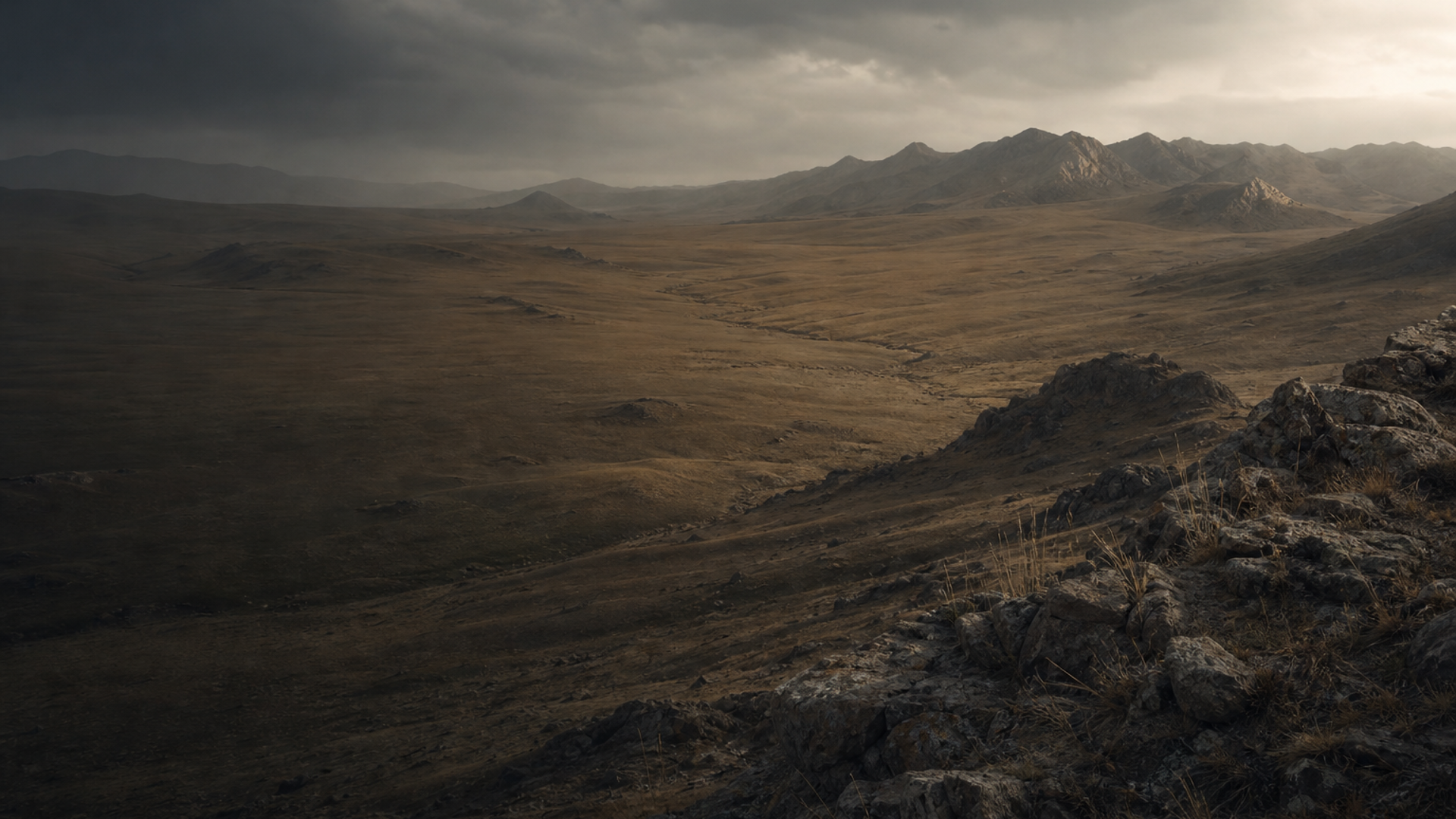
Archaeology evokes a stark, cinematic landscape of mobile herders, seasonal camps, and ritual landmarks. Stone cairns and small ovoos mark graves and sacred sites on windswept ridges; faunal remains and tool fragments recovered near burial clusters point to an economy centered on sheep, horse, and goat herding with specialized pastoral knowledge.

Household items are sparse in mortuary contexts from these sites, consistent with highly mobile lifeways where perishable dwellings left little trace. Burial orientations, grave depth, and occasional personal items imply social differentiation at a local scale — possibly age, sex, or status markers — though the small sample from Sukhbaatar limits broad inferences.

Archaeological data indicates ritual emphasis on landscape features: high places such as Khanan bor and Zamyn Khashat functioned as focal points for memory and exchange. These material practices frame a society where kinship ties and seasonal movement structured everyday life, and where contact with neighboring groups occurred through trade, marital ties, and shared pastoral routes.

  • Pastoral economy focused on horses, sheep, and goats
  • Ritualized use of high places and cairn burials
Chapter V

Genetic Profile

The genetic dataset from Sukhbaatar comprises nine samples collected from multiple burial localities — a valuable but small dataset that requires cautious interpretation. Y-chromosome haplogroups show predominance of C lineages (3 individuals), followed by O (2) and N (1). Haplogroup C and N are often found across northern Eurasia and the steppe and can reflect long-term continuity of paternal lineages in this region; O-lineages indicate connections to broader East Asian gene pools and may reflect admixture or incoming paternal ancestry.

Mitochondrial diversity is high relative to sample size: haplogroups M (3), N (1), Z (1), D (1), and G (1) are represented. These mtDNA types are characteristic of East Asian and Siberian maternal lineages, suggesting maternal ancestry tied to northern and eastern East Asia. The combination — northern-associated paternal markers alongside East Asian maternal diversity — paints a picture of mixed ancestries consistent with archaeological signs of regional interaction.

Because the sample count is fewer than ten, conclusions are preliminary: statistical power is limited and may not capture the full population structure. Still, the concordance between archaeological contexts and genetic signals supports a Late Medieval Sukhbaatar population shaped by both deep northern Eurasian roots and ongoing contact with East Asian groups.

  • Y-DNA dominated by C, with O and N present
  • mtDNA diversity (M, N, Z, D, G) indicates East Asian/Siberian maternal input
Chapter VI

Legacy & Modern Connections

The echoes of Sukhbaatar's Late Medieval inhabitants resonate in the modern genetic landscape of eastern Mongolia and adjacent regions. Archaeological continuity in funerary practice and the genetic mixture observed suggest that local populations contributed to the complex ancestry of later Mongolian groups.

Modern comparisons must be cautious: population movements since 1500 CE, including the expansion of empires and later demographic shifts, have reshaped genetic landscapes. Nevertheless, the Sukhbaatar dataset provides a tangible link between past pastoral communities and present-day diversity, illustrating how the steppe has long been a corridor for genes and cultures. Future, larger-scale ancient DNA sampling across the region will be essential to clarify how representative these nine samples are and to trace specific lines of descent.

  • Contributes to understanding ancestry of eastern Mongolian populations
  • Larger ancient DNA datasets needed to confirm representativeness
AI 电源

AI 助手

就 Sukhbaatar Late Medieval Steppe 文化提问

AI 助手 由DNAGENICS公司制作

解锁此特性
Ask questions about the Sukhbaatar Late Medieval Steppe culture. Our AI assistant can explain genetic findings, historical context, archaeological evidence, and modern connections.
AI 样本分析

Sukhbaatar Late Medieval Steppe 文化是人类历史中值得了解的一章……

遗传分析揭示了与早期种群的联系,同时显示了独特的适应和文化创新的证据。 古代DNA样本提供了对迁徙模式、社会结构以及古代种群之间的生物关系的深刻见解。

这是人工智能分析的预览。 解锁全AI 助手, 以探索关于:

  • 遗传组成和祖先
  • 移徙模式和起源
  • 日常生活和文化习俗
  • 现代遗传遗产

探索更古老的文化

揭开古代世界文明的故事

使用优惠码 可减免 35% • 11月12日 到期




